 Explore Maharashtra
The Stepwells of Mandu: Water Architecture in a Fortress City
Mandu rises from the Malwa plateau in central India as a city of walls, gateways, palaces and ruined courts. Its dramatic setting often draws attention to the romantic outlines of Jahaz Mahal and Hindola Mahal, yet the settlement’s water architecture is equally revealing. Stepwells, reservoirs, tanks and channels made life possible on a windswept plateau where seasonal rainfall had to be collected, stored and carefully managed. Learn more about How The Quakers Shaped Burial Practices In County Waterford.
The historic city, also known as Mandav, developed under the Paramaras and later became an important seat of the Delhi Sultanate’s Malwa rulers. Its monuments reflect changing political powers, but the need for reliable water remained constant. A baoli or baori was more than a deep stairway to a well: it was an engineered response to fluctuating groundwater, intense heat and the practical demands of a fortified urban centre.
Mandu’s water structures are often encountered as part of a wider landscape rather than as isolated monuments. A stepped well may stand near a palace complex, while a tank occupies a hollow between ridges or a reservoir gathers monsoon runoff below the fortifications. Their relationship with roads, gardens, mosques, residences and defensive walls helps explain how the city functioned.
For visitors from Australia, Mandu offers a useful comparison with places shaped by water scarcity. The dry-season concerns familiar in Adelaide, Perth and inland New South Wales make its storage systems immediately legible, even though the climate, materials and historical setting are different. Reading the site through water also creates a richer alternative to viewing it only as a collection of picturesque ruins.
A plateau city shaped by seasonal water
Mandu occupies a high, irregular plateau with steep escarpments and ravines around its edges. The elevated position offered strategic protection, but it also created a demanding environment for settlement. Rain arrives intensely during the monsoon, then gives way to a long dry period. The city therefore depended on capturing rainfall, slowing runoff and preserving water for domestic use, gardens, animals and courtly life.
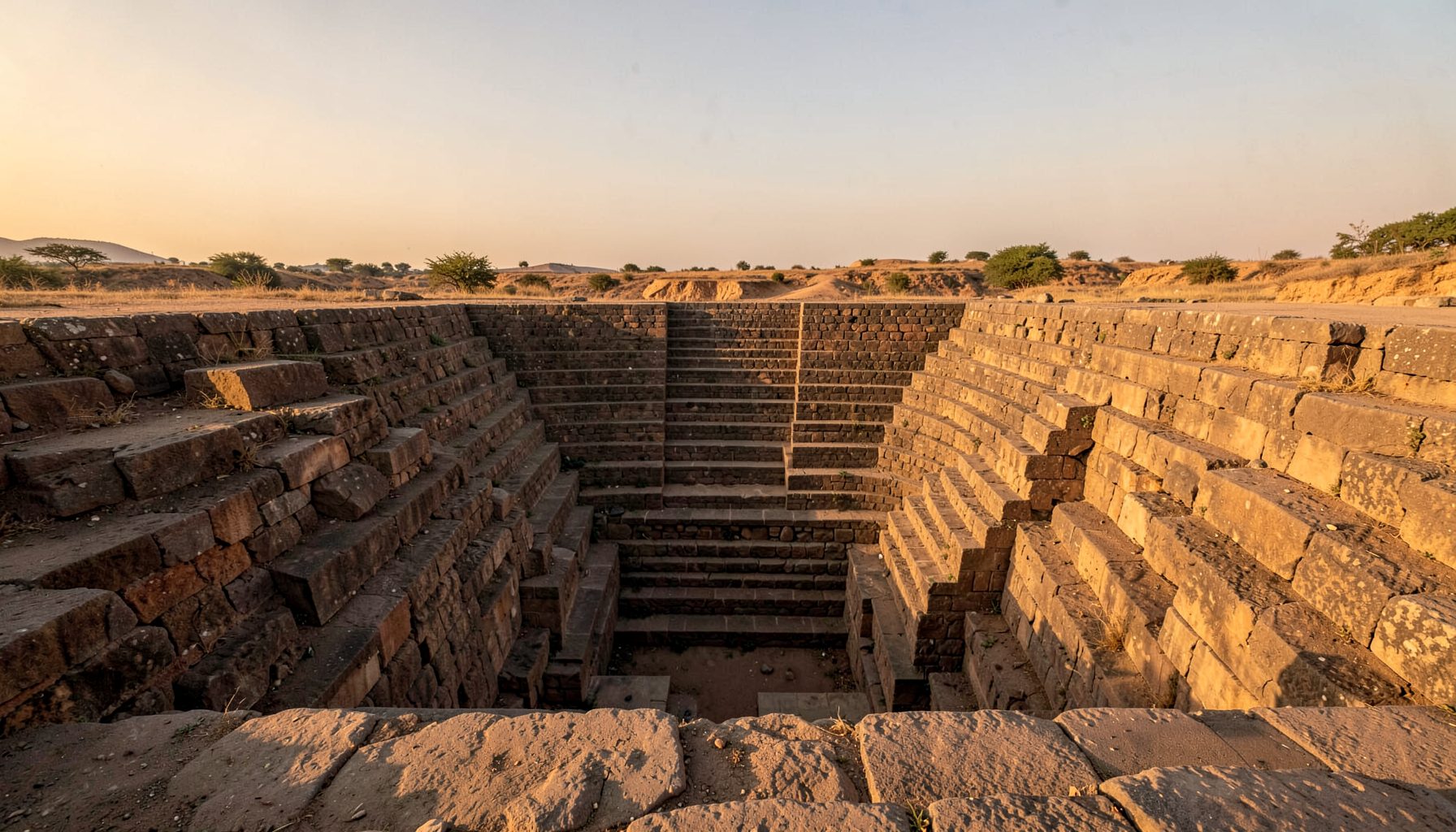
Its reservoirs and tanks formed part of a connected hydraulic landscape. Some collected surface water, while wells reached underground supplies and provided access as the water level changed. The steps in a baoli allowed people to descend progressively through the dry season, maintaining access when the water surface fell. This flexibility was essential in a region where storage capacity mattered as much as rainfall itself.
The fort’s walls, embankments and built terraces also influenced drainage. Water management was integrated into the terrain rather than imposed upon a flat urban grid. A channel, cistern or tank could serve several purposes at once: supplying residents, cooling a garden, supporting ritual activity and reinforcing the visual power of a palace complex.
Champa Baoli and the experience of descent
Champa Baoli is among Mandu’s best-known stepwells. It is associated with the Jahaz Mahal area and is generally described as a multi-level structure with a deep, stepped approach. Its name is linked in local tradition with the champa flower, whose fragrance and cultural associations add a sensory dimension to the site, although stories about the well’s atmosphere should be treated as part of its living heritage rather than as simple engineering evidence.
The design demonstrates how a water source could become an architectural interior. Descending steps, shaded landings and masonry walls moderated the journey from the hot surface to the cooler depths. Such spaces offered relief from heat and created places for conversation, waiting and daily labour. The well was functional, yet its scale and finish also expressed the status of the surrounding royal precinct.
A close study of stepwell design shows how stairs, platforms, water access and ritual movement can overlap in Indian water architecture. Mandu’s examples should not be forced into a single typology, but they can be read alongside vavs, kunds and temple tanks elsewhere to understand a broader vocabulary of descending, gathering and approaching water.
Ujala Baoli, Andheri Baoli and hidden infrastructure
Ujala Baoli and Andheri Baoli are often discussed together because their names suggest contrasting experiences of light. Ujala, associated with brightness, is more open to daylight, while Andheri, meaning dark, conveys the enclosed and shadowed character of a subterranean water structure. These names remind us that historic architecture was understood through bodily experience as much as through formal description.
The distinction between illuminated and dark spaces was practical. Deep masonry shafts naturally reduced heat and glare, while covered or partially enclosed passages helped protect water from evaporation and contamination. Steps, retaining walls and landings also made inspection and drawing water safer than relying on a sheer-sided pit.
Mandu’s baolis were embedded in a larger network of tanks and reservoirs, including the broad water bodies that supported the city’s palaces and gardens. Their importance can be missed when photographs isolate a single staircase. Field documentation should record approach paths, drainage lines, nearby buildings, vegetation, water levels and signs of repair, because these details reveal how the structure operated within its setting.
Water, power and everyday life
In a fortified capital, water security had political meaning. A city able to store supplies during a siege or prolonged dry period was more resilient than one dependent on exposed sources beyond its walls. Reservoirs and wells therefore supported both everyday settlement and the authority of rulers who commissioned large public works.
Water architecture also shaped social routines. People arrived with vessels, animals needed watering, gardens required irrigation and travellers depended on accessible sources along routes. The steps of a baoli created a sequence of thresholds between public movement and the protected depth of the well. Different users may have occupied different landings at different times, although the surviving masonry rarely preserves those social distinctions clearly.
The comparison with the stepwells of Saurashtra is valuable because it places Mandu within western and central India’s wider tradition of adapting water structures to local geology, rainfall and community needs. Each region developed its own forms, materials and customs; the shared principle was that water infrastructure could also become civic architecture.
Reading Mandu through heritage photography
Photography can document more than ornament. A useful record of a Mandu baoli includes the scale of the stairway, the texture of laterite or sandstone, vegetation rooted in joints, modern rubbish, water staining and repairs made with incompatible cement. Drone images can show how a well relates to walls, roads, reservoirs and the plateau edge, while ground-level views preserve the human experience of shade and enclosure.
For an Australian audience, this approach connects with familiar heritage practices in Melbourne laneways, Sydney sandstone precincts and regional town conservation projects. It also speaks to the local market for cultural tourism, where visitors increasingly look for interpretation, walking routes and credible stories rather than quick photographs alone. Clear signage and carefully researched maps would help Mandu’s water sites become part of a richer heritage itinerary.
Documentation must also distinguish between observation, archival evidence and local memory. A story attached to a baoli may not be verifiable in written sources, yet it can still explain how residents understand the place. Recording those accounts respectfully is especially important when restoration, tourism or new infrastructure changes access to historic water sites.
Conservation lessons for a living heritage site
Mandu’s stepwells face familiar pressures: vegetation growth, erosion, unstable edges, altered drainage, litter and the gradual loss of practical knowledge. A dry well is not necessarily an abandoned one; its structure may still influence groundwater movement, local ecology and the visual identity of the fort. Conservation should begin with measured surveys and condition assessments before cosmetic repairs are attempted.
Adaptive reuse can offer ideas, provided it does not erase the original character of the structure. The example of adaptive reuse in Rajasthan demonstrates how a historic water site can acquire a new civic role while remaining legible as heritage. Mandu requires solutions suited to its own masonry, hydrology and visitor patterns rather than a standard treatment imported from another region.
Community participation is equally important. Guides, residents, researchers, photographers and local authorities hold different kinds of knowledge. Australia’s heritage sector has increasingly recognised the value of consultation, place-based interpretation and Indigenous cultural protocols; comparable care in Mandu can help ensure that documentation serves local communities as well as visitors.
Practical priorities for documenting and protecting Mandu’s water architecture
- Survey each baoli, kund and reservoir with measured drawings, photographs, drone imagery and written condition notes.
- Record seasonal water levels, drainage paths and evidence of blocked or redirected channels.
- Consult local residents, guides and caretakers about names, stories, access customs and recent changes.
- Use low-impact visitor routes that protect steps, masonry edges, vegetation and fragile deposits.
- Create interpretation linking Mandu’s water system with its palaces, gardens, roads and defensive landscape.
- Compare conservation methods across Indian regions without treating every stepwell as the same architectural type.
- Share verified documentation through schools, exhibitions, heritage walks and responsible digital archives.
The enduring value of Mandu’s stepwells lies in their combined intelligence: they store water, manage climate, organise movement and express political ambition. Seen together with tanks, reservoirs and natural ravines, they reveal a fortress city designed around uncertainty. Their preservation is therefore about more than saving attractive ruins. It is about retaining evidence of how people adapted architecture to rainfall, heat, power and community life.
Get in Touch
Have information about a stepwell that is not yet on our map? We would be glad to document it and give you full credit. Whether it is a Barav, Kund, Vihir, or any other form of stepwell, every contribution helps preserve India's water heritage.
Call or message us with details about the location, and we will follow up.
#9372496819
Send a Message
What People Say
"The Maharashtra Stepwells campaign has brought attention to structures that were nearly forgotten. The architectural documentation and drone photography are invaluable resources for researchers and students alike."
"Collaborating with the Indian Stepwells team gave our architecture students hands-on exposure to traditional water-harvesting structures. The presentations were insightful and inspiring."
"I shared details of a stepwell near my village that was not on any map. The team visited, documented it beautifully, and credited me. It felt wonderful to contribute."