 Explore Maharashtra
Raniji ki Baori Revival: A Restoration Triumph in Bundi
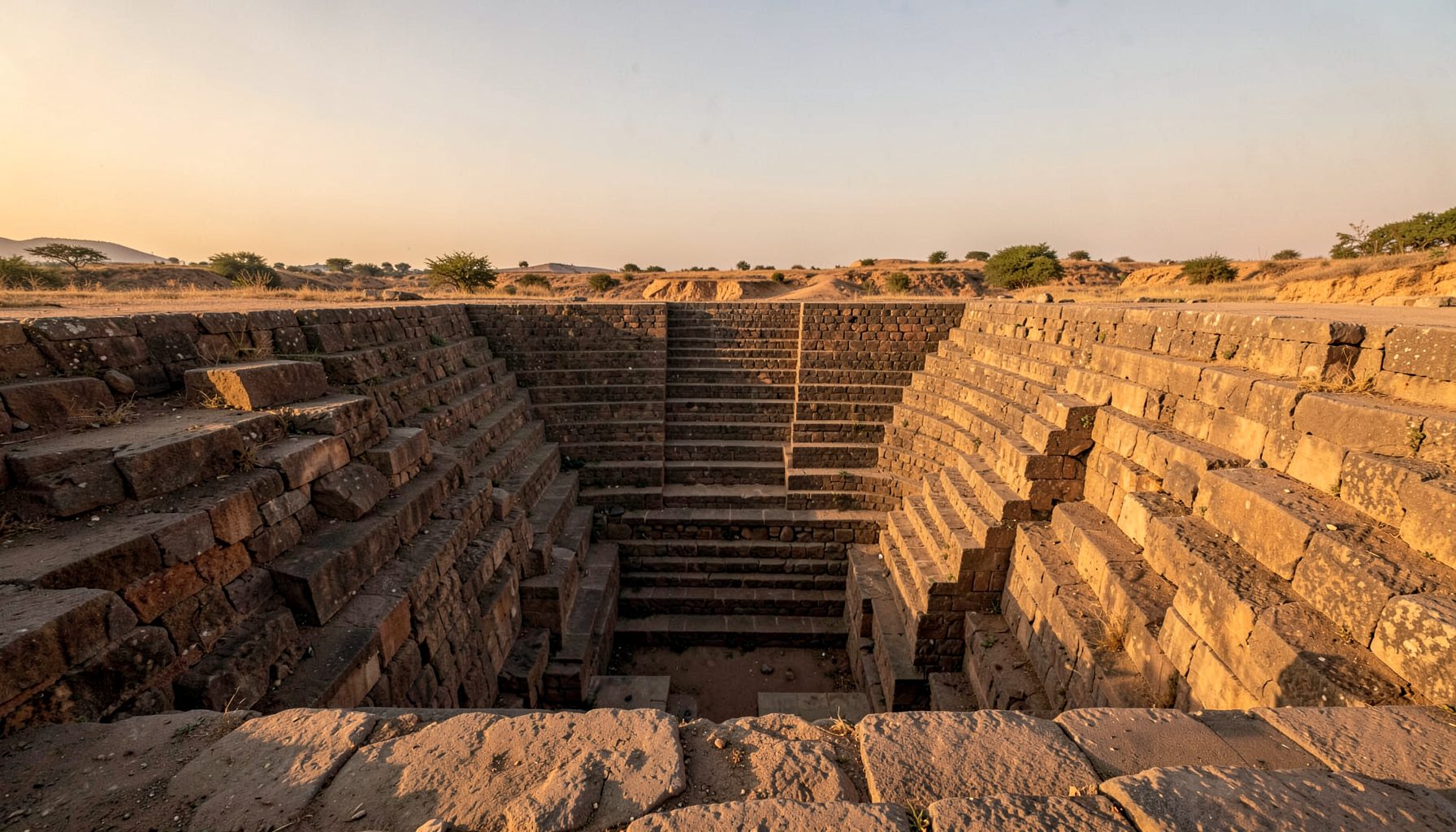
Tucked into the sandstone ridge above the town of Bundi in Rajasthan, Raniji ki Baori rises through nine storeys of carved stone, its pillars descending more than forty metres into the earth. Built in 1699 by Rani Nathavatji, queen of Rao Raja Anirudh Singh of Bundi, the stepwell was conceived as both a practical reservoir and a devotional space, a place where water met worship and everyday life. It served caravans crossing the Aravalli foothills and pilgrims moving toward the Taragarh fort above, supplying the town through long dry stretches when rivers ran low.
The baori's nine tiers contain over two hundred cantilevered pillars supporting stepped corridors that funnel cool air into the water level. Sculpted panels depicting Gaja-Lakshmi, scenes from the Ramayana, and dancing apsaras line the interior walls, while small chambers once housed lamps during festivals such as Gangaur and Teej. Few stepwells in India integrate a temple sanctuary with a functional well so completely, and fewer still survive in active use after three centuries.
For visitors tracing heritage routes between Sydney and Jodhpur, or planning an itinerary that combines Melbourne's laneway galleries with Rajasthani craft markets, the restored baori offers a tangible link to pre-modern water wisdom. Australia's own dry inland regions share surprising common cause with Rajasthan, since both have learned, sometimes painfully, that water security is also heritage security. The Great Artesian Basin beneath Queensland, New South Wales and South Australia carries ancient water much like the deep wells beneath Bundi, and both systems face extraction pressures that heritage legislation alone cannot solve.
Across India, hundreds of stepwells have vanished from public memory, swallowed by urban sprawl, silted by monsoon runoff, or quarried for dressed stone. Recent fieldwork on the stepwells of Pune has revealed structures that never made it into colonial gazetteers, and field reports from Delhi document baolis tucked behind petrol pumps and market yards. The revival at Bundi stands out precisely because it shows what careful, patient conservation can accomplish when local government, artisans and heritage scholars agree on a shared method.
A Royal Builder's Vision
Rani Nathavatji commissioned the baori during a period of relative peace in Bundi, when trade in indigo, opium and cotton brought sufficient revenue to fund monumental construction. The queen was unusual in wielding direct patronage over such a project, as most Rajasthani stepwells of comparable scale bear the names of male nobles or wealthy merchants. Her dedication carved above the entrance identifies her as the builder, a rare instance of female authorship in the regional water architecture canon.
The design draws equally from earlier Chanda baoris in the Shekhawati region and the older Bundi stepwells clustered around the Sagar Talao. Craftsmen deployed the local Bundi sandstone, prized for its fine grain and ability to hold sharp relief, rather than the coarser Kota stone used in nearby Hadoti monuments. This choice explains why the figural panels at Raniji ki Baori retain such remarkable crispness three centuries after carving. Travellers interested in the broader architectural lineage can trace similar construction logic in this Deccan Plateau guide, where comparable multi-storey wells solve the same problems of light, air and access.
Decades of Decay Before Recovery
By the late twentieth century, the baori had slipped into severe neglect. The lower three tiers were choked with silt and construction debris, and the water channel connecting to the seasonal Ghantaji Nallah had been diverted during a mid-century road widening. Local lore held that the well still held water deep below, but no resident in living memory had seen its mirror surface. Rainwater poured unchecked down the open shaft, accelerating erosion of the carved pillars.
Several factors complicated earlier rescue attempts. The site lies inside the regulated perimeter of Taragarh fort, requiring coordination between the Archaeological Survey of India, the state archaeology directorate and the Bundi district administration. Funding proposals stalled in competing departmental files for almost two decades. At the same time, the surrounding neighbourhood grew denser, with houses encroaching on the outer plinth and aggressive bore pumping in the area putting additional pressure on groundwater levels.
Similar patterns of institutional inertia have stranded heritage projects elsewhere in the world. The ongoing effort to preserve the Achill Island graveyard in County Mayo shows how even sites of profound communal memory can linger in bureaucratic limbo for generations. Conservation ultimately depends on local champions as much as national policy, a lesson Bundi's stakeholders absorbed slowly.
Engineering the Restoration
Restoration work began in earnest in 2015, led by a partnership between the Rajasthan Department of Archaeology and Museums and a local trust founded by retired engineers and former students of the Bundi school system. Specialists from Jaipur supervised structural stabilisation of the cantilevered arches, applying lime-based mortars mixed with traditional admixtures rather than modern cement. Where original members were lost, replacement stones were quarried from the same geological seam used by the original builders, then marked discreetly on the underside to distinguish them from authentic fabric.
The water system required the most imaginative thinking. Engineers cleared the blocked drainage channel, rebuilt the silt trap, and reinstated a stepped ghat leading down to the restored water level. A simple float-controlled inlet now diverts monsoon flow from the Ghantaji Nallah during peak rainfall, while a manual chain-and-pulley system, copied from agricultural wells in the district, allows draw during dry months without mechanised pumps that risk damage to the carved floor.
Lighting was deliberately kept minimal, following the conservation philosophy espoused by the German memorial initiative Erinnern ermöglichen, which argues that appropriate atmosphere is itself a heritage value. Soft LED lamps tucked behind the pillars mimic the flickering of the oil lamps mentioned in historic descriptions, allowing visitors to appreciate the carvings without exposing them to heat or ultraviolet damage.
Stone Carvings and Cultural Memory
The carved programme at Raniji ki Baori was catalogued in detail during the restoration, with every figural panel photographed under raking illumination and sketched at one-to-twenty scale. Specialists identified sixty-eight distinct sculptural compositions, including a rare depiction of the river goddess Ganga astride a makara, framed by miniature temple towers. Several panels had lost their noses and projecting fingers through centuries of accidental knocks, and conservators used computer-modelled replacements to guide new carving from original blocks.
This attention to carved detail echoes a wider shift in Indian conservation, where decorative programmes are now treated as primary historical evidence rather than incidental ornament. Researchers working on the Delhi baoli fieldwork have documented similar iconographic programmes, noting recurring motifs of lotus medallions, celestial musicians and royal patrons across northern India. Comparative work across these datasets is finally allowing scholars to map workshop networks that once moved between Bundi, Jaipur, Jodhpur and Ahmedabad.
Key architectural elements preserved during the project include:
- The nine-tiered shaft with its cantilevered pillars and stepped corridors
- The sculptural panels depicting Gaja-Lakshmi, Ramayana scenes and river deities
- The restored drainage channel linking the baori to the Ghantaji Nallah
- The temple sanctuary of Harshat Mata within the upper landing
- The carved entrance arch bearing the founding inscription of Rani Nathavatji
Local Communities and Living Heritage
Restoration would have meant little without residents willing to use the baori again. Trust members organised school visits, heritage walks and evening cultural events, gradually rebuilding familiarity with a structure that many younger residents had never entered. Today, the site hosts regular performances of Bundi-style miniature painting demonstrations, puppet shows and classical music recitals during the cooler months, drawing both domestic visitors and international travellers.
The baori now also functions as a working water source for ceremonial use, with a small quantity of clean groundwater drawn annually for ritual ablutions associated with the Harshat Mata temple adjacent to the entrance. This living function gives conservators early warning of any contamination or structural concern, and it anchors the monument in the rhythms of local religious life rather than relegating it to a static museum. Local schoolchildren now learn the names of pillars and panels that their grandparents had almost forgotten.
What Australia Can Learn from Bundi
Australia's own heritage water systems, from the nineteenth-century water-towered reservoirs of Adelaide to the brick-lined tanks of inland pastoral stations, share the same vulnerability demonstrated at Bundi before restoration. The Murray-Darling Basin's century of irrigation expansion offers a sobering parallel: how quickly a finely tuned hydraulic system can be pushed beyond its natural replenishment when governance lags behind extraction. Heritage listings, from the Australian National Heritage List to state registers in New South Wales and Victoria, can slow damaging change, but they rarely restore what has already been lost.
Bundi's example suggests that the most effective projects combine statutory protection with sustained community use, traditional materials and a long funding horizon measured in decades rather than electoral cycles. Brisbane's heritage officers and Sydney's conservation architects studying this work can draw practical lessons about lime mortar recipes, monsoon-fed silt traps and the patient reawakening of neighbourhood memory around a restored water monument. Perth practitioners working on nineteenth-century convict-built weirs could similarly pair technical repair with renewed community programming.
Practical conservation strategies applicable to Australian heritage sites include:
- Adopting lime-based mortars instead of modern cement in stone restoration work
- Combining statutory protection with active community programming and use
- Using traditional water-flow designs wherever modern pumping risks damage
- Cataloguing carved and decorative features as primary historical evidence
- Engaging retired tradespeople whose skills mirror original craft traditions
- Funding projects on multi-decade horizons tied to community renewal
Get in Touch
Have information about a stepwell that is not yet on our map? We would be glad to document it and give you full credit. Whether it is a Barav, Kund, Vihir, or any other form of stepwell, every contribution helps preserve India's water heritage.
Call or message us with details about the location, and we will follow up.
#9372496819
Send a Message
What People Say
"The Maharashtra Stepwells campaign has brought attention to structures that were nearly forgotten. The architectural documentation and drone photography are invaluable resources for researchers and students alike."
"Collaborating with the Indian Stepwells team gave our architecture students hands-on exposure to traditional water-harvesting structures. The presentations were insightful and inspiring."
"I shared details of a stepwell near my village that was not on any map. The team visited, documented it beautifully, and credited me. It felt wonderful to contribute."