 Explore Maharashtra
the abandoned baolis of Delhi: a field report
Delhi in late October still cooks. By two in the arvo, the bitumen outside the Mehrauli bus stand softens underfoot, and the only shade comes from peeling tin awnings over chai stalls. I had come chasing a list of twelve baolis drawn from old gazetteers and nineteenth-century water board maps. Three sat within walking distance in south Delhi, none of them signposted. This field report follows what I found over ten days of walking the city's older neighbourhoods, talking to residents and photographing structures most locals pass without realising what they are standing on.
The trip builds on earlier fieldwork shared through Indian Stepwells, the heritage documentation project run from Maharashtra that maps lesser-known water structures across western India. Readers familiar with the hidden stepwells of Pune will recognise a familiar pattern: a working monument, then a forgotten one, then a vanished one. Delhi offers the same gradient compressed into a denser urban fabric, where a sixteenth-century well can sit fifty metres from a flyover and a vape shop.
These structures were once central to life on the subcontinent. The broader story of how subcontinental water harvesting worked is laid out in a useful piece on how stepwells shaped medieval Indian water management. What follows is one small chapter of that story, told from inside three abandoned baolis.
Agrasen ki Baoli and the sensory shock of descent
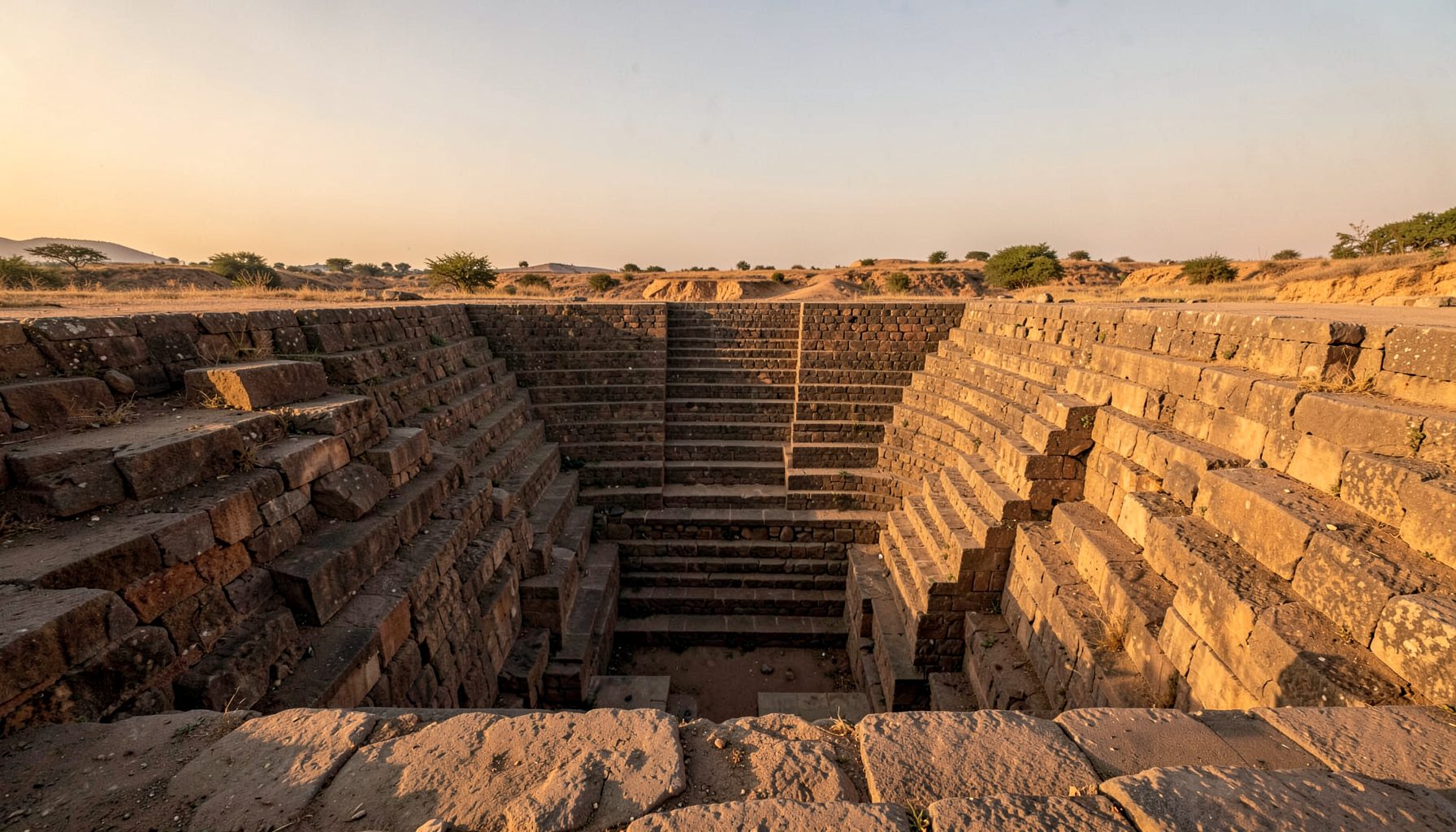
Agrasen ki Baoli is the only Delhi stepwell with a permanent security guard, and the only one that appears in most guidebooks. Even so, walking down its steps feels like entering a different building. Light thins, the temperature drops, and the city's noise closes overhead. The baoli has three storeys, each marked by a deeper landing and a sharper fall in temperature. Pigeons roost in niches that once held oil lamps, and the lowest platform, which would have been submerged for much of the year, now sits dry on cracked silt.
The structure is textbook Tughlaq-era engineering, with pointed arches, heavy buttresses and stepped galleries that broke the fall of pilgrims, workers and animals. Reading it against standard documentation practice shows how baolis were designed for layered use: washing at the top, drinking water partway down, ritual immersion at the lowest level. Today the water is well below the floor. Like catchments in inland New South Wales during a dry stretch on the Murray, the aquifer has simply drawn down.
The lower platform is where acoustics shift. Voices carry sideways instead of up. A small group of architecture students sketching the eastern wall complained that the stone held heat long after sunset. One pointed out a faint ring of soot near the highest landing, probably from a funeral pyre at the time of a small plague outbreak in the early nineteenth century. None of this is signed. The visitor is left to assemble the site from fragments.
Rajon ki Baoli, tucked behind a row of houses
Rajon ki Baoli sits in a quiet residential pocket in Mehrauli, twenty minutes on foot from Qutub Minar but invisible from the main road. To reach it you walk past a wedding band practising in a courtyard, then through a narrow lane where a man repairs a motorcycle under a tarp. The baoli announces itself through a sudden opening in a wall: a plunge into stone, with fig trees leaning over the rim and a colony of bats roosting in the upper arcade.
This baoli is older than Agrasen ki Baoli and in worse condition. A retaining wall along its southern face has failed and now leans inward at a worrying angle. The lowest steps are buried under silt and household debris, broken terracotta pots, plastic sheets and a rusted iron cot frame. A local schoolteacher, Mr Bhatt, said the debris had been accumulating for two generations. He still remembers his grandfather drawing water from the third landing during the summers of the 1950s.
Locals often repeat a story that during Partition several families hid in the well for days, surviving on stored grain and a small spring that still trickled into the lowest chamber. Whether literally true or not, oral tradition treats the baoli as refuge rather than monument. In Australia, when heritage advocates talk about places like the nineteenth-century Cumberland Plain woodlands or the stone foundations around Port Arthur, they speak of similar layered meanings: practical, sacred and political at once.
The hidden engineering of Delhi's medieval water systems
What struck me across all three baolis was how much engineering intelligence sits just below the walking surface. The architects understood groundwater behaviour in a way modern consultants rarely replicate. Wells were not dug to a fixed depth but followed the water table downward. Stepped landings acted as sediment traps. Niches in the walls once held metal rings for lowering buckets and for tying animals that hauled the water up.
Many features are still legible if you know where to look. At the third baoli I visited, an unnamed one near Wazirabad that does not appear on most maps, the eastern wall carries a series of carved niches that align with seasonal water marks. The marks are not dated, but they show the structure was used across many centuries of fluctuating groundwater. Like the old mill races around Ballarat or the Aboriginal fish traps at Budj Bim in western Victoria, these are working pieces of landscape rather than decorative ruins.
The most overlooked feature is the underground feeder channel that links many Delhi baolis to the Yamuna floodplain. Some are still traceable in old property boundaries, where a parcel of land is curved rather than rectilinear because it follows the line of a now-buried aqueduct. A senior archaeologist at the site suggested that at least four baolis in the capital were originally connected by these feeders, functioning less like isolated wells and more like a small network, comparable in scale and logic to the nineteenth-century water races that once channelled snowmelt through towns in the central Victorian goldfields.
Water tables, climate and a century of neglect
The condition of Delhi's baolis is inseparable from the city's water politics. The Yamuna is now treated as a drain rather than a source. Treated sewage outflows, unregulated bore drilling and the paving over of catchment areas have all pushed the water table lower each decade. Most baolis that were functional in the early twentieth century had dried out by the 1980s. Once dry, they became convenient places to dump rubble and waste. Once used as dumps, they were forgotten.
The trajectory has parallels in Australia, where sustained over-extraction along the Barwon–Darling system in recent decades has left river towns dealing with dry riverbeds, fish kills and a slow public reckoning about who is responsible for repair. In Delhi the equivalent reckoning has barely begun. A handful of baolis have been conserved, often by the Archaeological Survey of India, but the bulk of the city's medieval water heritage sits in a regulatory grey zone. It is too old for modern water authorities to claim and too ruinous for tourism departments to promote.
The result is a particular kind of neglect. Walls are intact enough to read, water systems are silted beyond use, and the communities who once relied on them have moved to piped supply. There is no constituency for repair, because there is no immediate user. Heritage listings in Australia, whether at state or federal level, have struggled with similar questions: how do you fund maintenance of a structure whose original economic purpose has been made obsolete by a modern utility network?
Community memory and the slow fading of oral history
Perhaps the most fragile element of these sites is the human memory attached to them. In Wazirabad, an elderly woman who runs a small provisions shop across the lane from the unnamed baoli told me she had not entered the structure since childhood, when her mother sent her to fetch water during a long municipal outage. Her granddaughter had no idea there was a stepwell at the end of the lane. The woman laughed, then went quiet. The same pattern repeated itself in three other neighbourhoods.
This is the part of fieldwork that cannot be photographed. Each year the pool of people who remember these wells as working structures shrinks. Once that generation passes, the oral history of Delhi's water architecture will have to be reconstructed from records, mostly colonial ones. The Indian Stepwells documentation project treats this kind of recording as core fieldwork, alongside photography and architectural sketching. Australian projects dealing with post-contact water infrastructure in places like Beechworth or the older orchards of the Goulburn Valley have run into a similar gap. Recording what older residents remember, while they are still around to remember it, has become an urgent task in both countries.
There is also a quieter form of cultural loss. Several of the baolis I visited carried faint traces of Hindu and later Mughal-era religious use, including niches that once held lamps and steps worn smooth by ritual foot traffic. Without active worship, these features read as archaeological detail rather than living practice. A heritage listing does not bring back the rituals, but it can at least keep the structure from being filled in by the next developer who buys the lot.
Field notes for anyone planning similar documentation work
A few practical pointers drawn from this trip, which may help anyone planning similar baoli fieldwork in Delhi or elsewhere.
- Visit in the cooler months. October to February is workable, but even then carry plenty of water and a hat.
- Carry old survey maps. The Survey of India sheets from the 1960s and 1970s name several baolis that have since lost their visible traces.
- Always seek permission from the nearest resident before entering a baoli that sits within a private compound. Many are technically on private land.
- Bring a notebook for oral histories. Audio, if locals consent, is even better. Memory is the most fragile layer of any heritage site.
- Photograph in the late morning if you want shadow detail on the steps, or just before sunset for the warm light that picks up carvings on the western walls.
- Coordinate with state archaeology departments before publishing structural assessments. Many baolis fall under overlapping jurisdictions, and an informal report can complicate future conservation grants.
Get in Touch
Have information about a stepwell that is not yet on our map? We would be glad to document it and give you full credit. Whether it is a Barav, Kund, Vihir, or any other form of stepwell, every contribution helps preserve India's water heritage.
Call or message us with details about the location, and we will follow up.
#9372496819
Send a Message
What People Say
"The Maharashtra Stepwells campaign has brought attention to structures that were nearly forgotten. The architectural documentation and drone photography are invaluable resources for researchers and students alike."
"Collaborating with the Indian Stepwells team gave our architecture students hands-on exposure to traditional water-harvesting structures. The presentations were insightful and inspiring."
"I shared details of a stepwell near my village that was not on any map. The team visited, documented it beautifully, and credited me. It felt wonderful to contribute."