 Explore Maharashtra
Stepwells and the architecture of water in medieval India
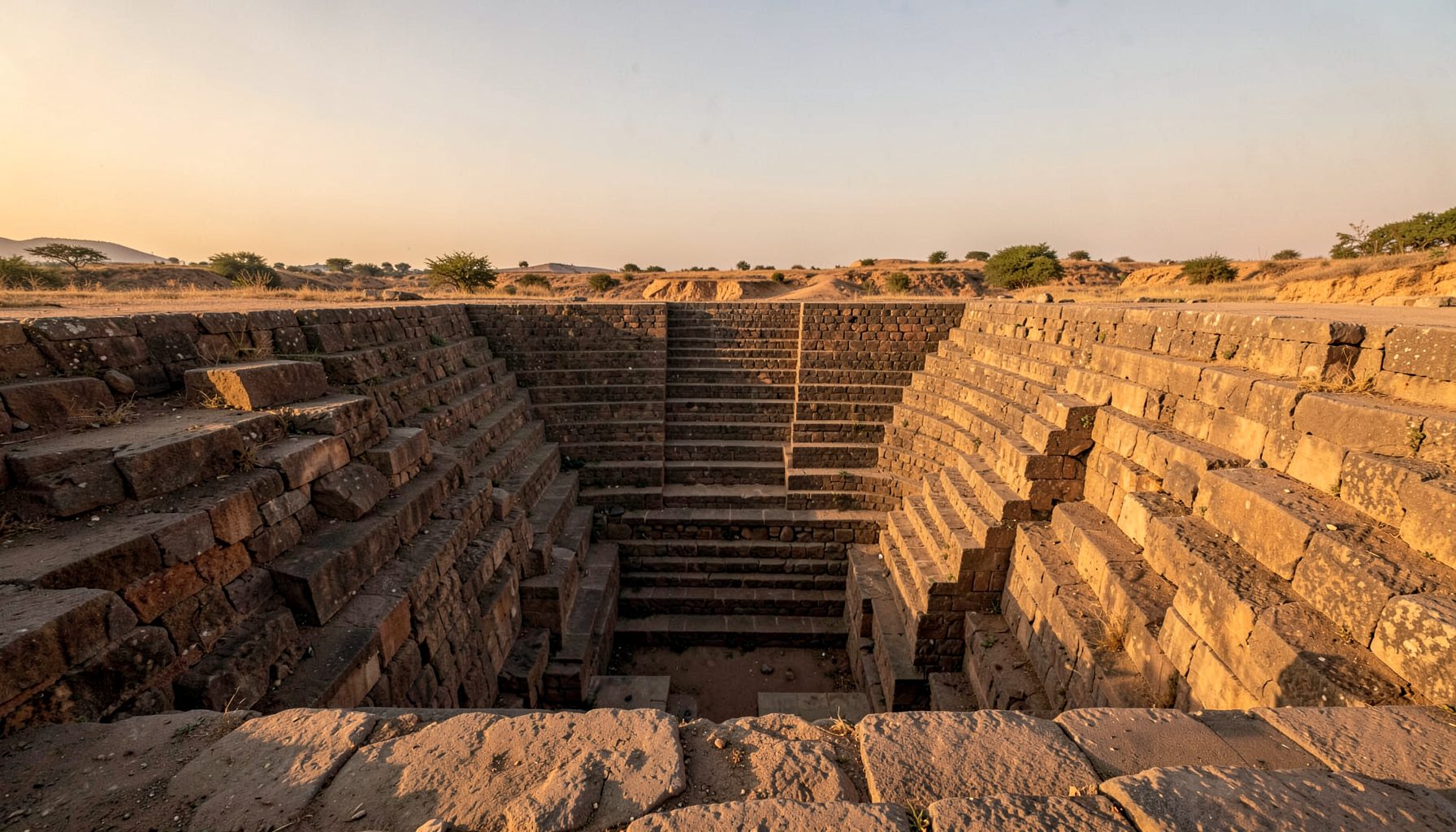
Across the dusty plains of Rajasthan, the basalt plateaus of the Deccan, and the soft sandstone belts of Gujarat, communities of medieval India built a remarkable answer to a brutal question: how do you capture monsoon fury and stretch it across nine dry months? Between roughly the 6th and 16th centuries, an architectural form evolved that did precisely that. Stepwells, known regionally as vavs, baolis, bawdis, kunds, and baravs, descended into the earth in elaborate tiers of carved stone, turning the act of drawing water into a daily ritual performed beneath colonnaded pavilions and latticed screens. They became arteries of survival in landscapes where surface water vanished within weeks of the rains ending.
These subterranean structures were engineered to harvest, store, and slowly recharge groundwater across vast catchment zones. Their geometric precision, hydraulic logic, and capacity to function as year-round gathering places made them the backbone of medieval Indian water management. Understanding how they worked, why they spread, and what they offered to ordinary villagers and royal patrons alike reveals a system that still resonates in conversations about climate resilience today, including in places like Sydney and Melbourne where councils now wrestle with ageing catchments and dwindling storages. The Indian Stepwells project documents many of these structures in detail, and a broad overview begins on its homepage.
Origins in arid and semi-arid landscapes
The earliest recognisable stepwells appear in inscriptions dating from the 6th and 7th centuries, when royal and monastic patronage began funding elaborate water infrastructure across western and central India. The motivation was straightforward: rainfall in regions like Saurashtra, Mewar, and the Marathwada plains was seasonal, often violent, and unpredictable. A single failed monsoon could empty village cisterns within weeks. Stepwells offered a way to catch flash-flood water in deep, stepped reservoirs that filtered sediment through successive terraces before replenishing the aquifer below.
What distinguished stepwells from ordinary ringed wells was their accessibility. Where a traditional well demanded rope-and-pulley hauling from a single point above, stepwells allowed users to descend along flights of stone steps, reaching the water at different depths depending on seasonal drawdown. During years of severe drought, when surface water vanished and groundwater plummeted, this flexibility proved essential. It is a principle not unlike the tiered water restrictions in Adelaide and Perth, where graduated allocation rules respond to dam levels dropping below defined trigger lines.
Jain monastic records and Sanskrit poetry describe stepwells being commissioned to mark royal weddings, military victories, or temple completions. Some were endowed with agricultural land so that the income from harvest would perpetually maintain the structure, a community-funded model of water security that feels strikingly modern alongside Australia's Murray-Darling Basin Plan, which similarly attempts to balance competing demands between irrigators, communities, and ecosystems.
Engineering genius: from shafts to multi-storied pavilions
Medieval stepwells reflect centuries of accumulated hydraulic knowledge. Builders understood that water temperature, evaporation rates, and microbial activity could be controlled through depth and shade. Pavilions with pierced stone screens wrapped around the upper levels admitted breezes while blocking harsh sun, keeping the water several degrees cooler than open surfaces. The deeper levels, often narrow shafts lined with chiseled basalt or sandstone, acted as inverted funnels tapping multiple aquifers.
A mature stepwell dropped between three and twelve stories, with each storey projecting inward on carved brackets to counter lateral earth pressure. Some, like the famous Adalaj vav near Ahmedabad, extend over seventy metres in length, while others in the Burhanpur region reach depths of more than thirty metres. Each transition from stair to landing was engineered to slow floodwater, allowing silt to settle in shallow forecourts before cleaner water passed deeper.
Key structural elements that defined a stepwell:
- Tiered staircases on multiple axes, allowing controlled descent in a spiral
- Octagonal or square pavilions at landings that doubled as rest and gathering rooms
- Carved brackets supporting cantilevered upper floors, distributing weight away from the well shaft
- Percolation wells at the deepest level, drawing from stable aquifers below seasonal fluctuation
- Surrounding courtyards and feeder channels that captured rooftop and courtyard runoff
This integration of beauty and engineering meant a single structure could serve as a water source, a cool retreat during hot winds, a religious site, and a community meeting point for centuries.
Social hubs where water met community
Stepwells were among the few public spaces in medieval Indian towns where women could legitimately gather outside domestic settings. Fetching water was rarely a solitary errand; groups descended together, taking advantage of shaded landings to chat, wash grain, mend clothes, and exchange news. In Gujarat and Rajasthan especially, stepwells hosted weekly markets along their parapets during cooler hours, with traders setting up stalls on upper terraces while water carriers worked below.
The social function had tangible benefits. Visitors from distant villages arrived at harvest festivals, and stepwell courtyards became informal rest houses where travellers could sleep safely, water their animals, and refill containers. Inscriptions carved into walls record donations from merchants, regimental commanders, and widow benefactors, indicating that funding came from every strata of society. The result was a network of community-maintained infrastructure that no single household or ruler could have financed alone.
This layered role is something modern Australian councils have struggled to replicate. Community centres in Brisbane and Hobart offer climate-controlled spaces but rarely integrate water harvesting with their architecture, leaving the original genius of the stepwell largely unmatched. A well-run stepwell met domestic, civic, religious, and economic needs in a single footprint, while contemporary infrastructure typically segregates these functions across multiple buildings and departments.
Faith, symbolism, and ritual functions
Water has always carried sacred weight across the Indian subcontinent, and stepwells embodied this reverence in stone. Many were oriented so that descending steps aligned with sunrise on particular festival mornings, casting geometric shadows across the water. Carvings of makaras, nagakanyas, and Vishnu in his Varaha avatar adorned the deepest levels, reinforcing the belief that water was a living, sacred substance to be approached with care.
Rituals often began at the top entrance with purification rites and offerings to the local naga or water goddess, before devotees descended to bathe at specific sanctified points. Pilgrimage routes across western India were threaded with stepwells, each one positioned a day's walk apart so travellers could purify themselves before reaching the next temple. This spiritual choreography reinforced the practical one: every visitor understood the value of clean, dependable water, and behaved accordingly.
The very word vav derives from Sanskrit roots meaning "to flow" or "to be born", a reminder that water was seen as something continually regenerating from the earth itself. This perspective resonates with Aboriginal Australian understandings of waterholes and soaks as living entities deserving of stewardship, suggesting that communities separated by half a world nevertheless arrived at comparable philosophies about how water should be treated and shared.
Decline, revival, and lessons for modern water stewardship
The arrival of Mughal and later colonial water infrastructure gradually displaced stepwells from active use. Wide-mouthed wells fitted with mechanical pumps, municipal piped systems, and boreholes drilled into deeper aquifers drew communities away from traditional sources. Many stepwells silted up, collapsed, or were deliberately filled to prevent accidents. By independence, several thousand across western India lay forgotten or buried under modern construction.
The last four decades have brought renewed interest. Heritage photographers, conservation architects, and climate researchers have argued that stepwells offer tested answers to questions contemporary societies are only beginning to ask: how do you capture monsoon deluge in a way that recharges rather than erodes? How do you provide social infrastructure that doubles as water infrastructure? Australian readers familiar with the Water Act 2007 and ongoing reforms within the Murray-Darling Basin will recognise the same dilemma playing out across state borders.
Practical lessons drawn from medieval stepwell design include:
- Tiered catchment systems that slow and filter runoff before storage
- Shaded reservoirs that reduce evaporation losses in arid climates
- Community-funded maintenance endowments attached to productive land
- Multipurpose architecture that increases daily use and thus daily care
- Integration with religious and cultural life, embedding water stewardship in identity
The Indian Stepwells project captures much of this living heritage through field documentation, drone surveys, and conversations with village elders. Those wishing to support the work or contribute local knowledge about overlooked structures can learn more on the About page.
Get in Touch
Have information about a stepwell that is not yet on our map? We would be glad to document it and give you full credit. Whether it is a Barav, Kund, Vihir, or any other form of stepwell, every contribution helps preserve India's water heritage.
Call or message us with details about the location, and we will follow up.
#9372496819
Send a Message
What People Say
"The Maharashtra Stepwells campaign has brought attention to structures that were nearly forgotten. The architectural documentation and drone photography are invaluable resources for researchers and students alike."
"Collaborating with the Indian Stepwells team gave our architecture students hands-on exposure to traditional water-harvesting structures. The presentations were insightful and inspiring."
"I shared details of a stepwell near my village that was not on any map. The team visited, documented it beautifully, and credited me. It felt wonderful to contribute."