 Explore Maharashtra
A guide to the stepwells of the Deccan Plateau
The basalt spine of central India holds water in ways that often surprise travellers. Across the Deccan Plateau, communities carved descending staircases into bedrock to capture seasonal rain, monsoon runoff, and the waters of seasonal rivers. These structures, known regionally as kalyanis, baolis, and baravs, served as reservoirs, cool retreats, and sacred meeting points for nearly a millennium. Their scale and variety remain less documented than the more famous wells of Gujarat, yet they reveal a sophisticated understanding of hydrology that is drawing renewed attention from researchers far beyond India.
A growing number of Australians are encountering these places through travel writing, university field schools, and the country's large Indian diaspora concentrated in Sydney, Melbourne, and Brisbane. For visitors accustomed to the preserved sandstone terraces of Sydney's harbour foreshores or the dry-stone walls of the Adelaide Hills, the Deccan offers a parallel tradition of water architecture that has weathered a very different climate. Understanding these wells matters here too, as Australian planners grapple with their own dry-zone heritage and the lessons offered by cultures that sustained cities through long droughts.
This guide walks through the geography, engineering, and cultural life of stepwells across the Deccan, drawing on field documentation and the broader heritage record. It also points readers toward further reading on stepwell influence on temple tanks, where many of the same engineering ideas reappear in temple precincts.
The landscape that shaped the wells
The Deccan Plateau stretches from the Western Ghats eastward across Maharashtra and Karnataka into Telangana, capped largely by Deccan Trap basalt. This volcanic rock fractures predictably, holds aquifers, and weathers into the dark black cotton soil that defines much of the region's farmland. Rainfall arrives in violent bursts between June and September, then disappears for eight months. Communities wishing to survive the dry season had to capture, store, and share water with care.
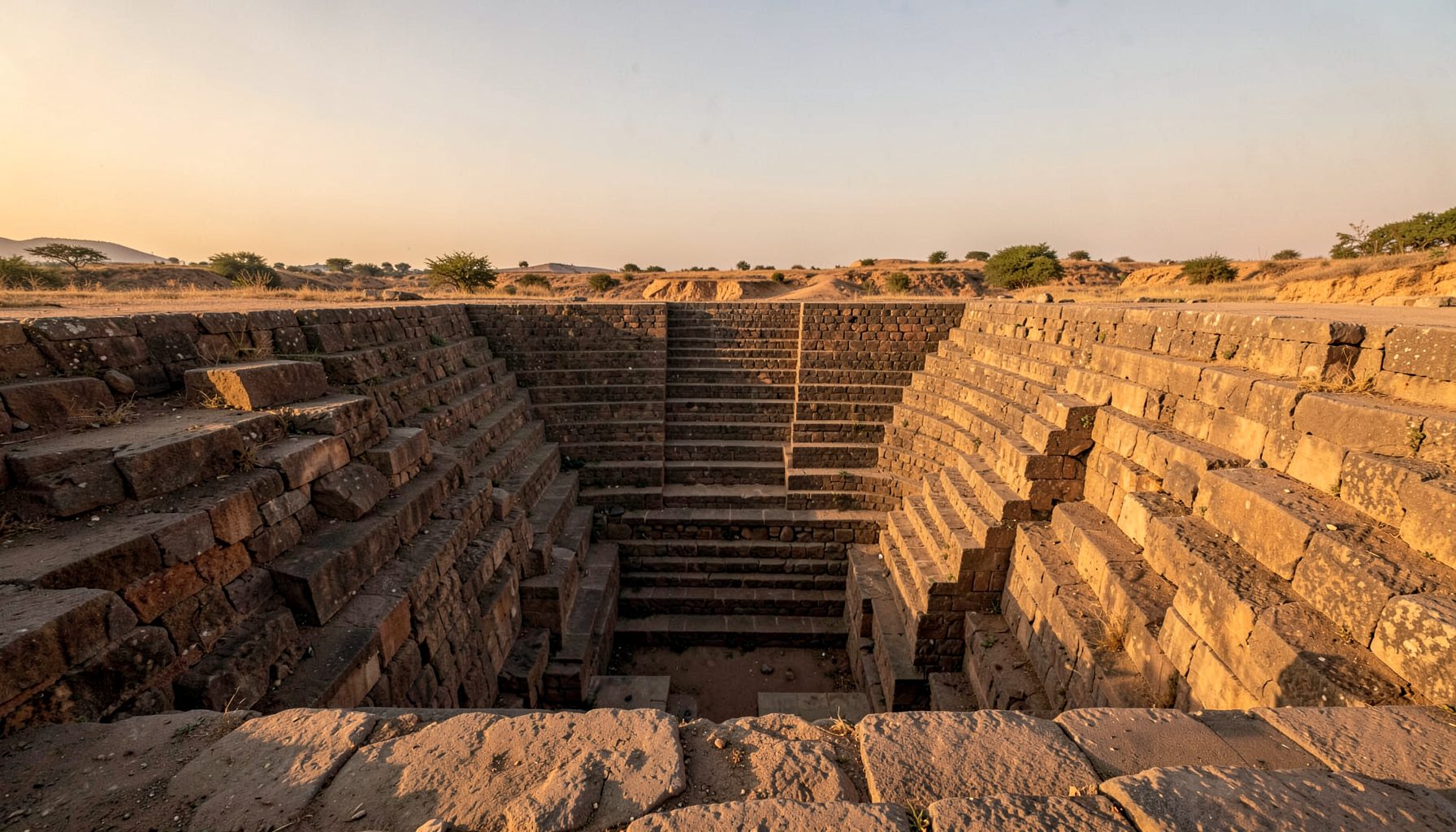
Villages invested heavily in catchment ponds, percolation tanks, and stepped reservoirs cut directly into the basalt. Unlike the sandy soils of Rajasthan or Gujarat, the Deccan held water well once stored, and they rarely required the long, deep descending passages of western India's famous vavs. Local builders created broad, often rectangular basins with descending flights on all four sides, sometimes ten or twelve metres deep. The result is a different aesthetic: more open, more civic, and oriented around gathering rather than solitary descent.
In contemporary Australia, parallels appear whenever a stretch of the Murray-Darling basin enters restricted flow. Melbourne's millennium drought prompted the state government to mandate household tanks and greywater systems, while rural councils in New South Wales revived old earth-tank designs for stock water. The Deccan experience, where every village calibrated its reservoir to a precise catchment area, offers a long historical precedent for those debates.
Forms unique to the plateau
Three broad types dominate the Deccan. The kalyani, or temple tank, sits at the heart of a religious precinct and draws its form from the Vedic bathing tank described in ancient texts. These basins often feature carved mandapas at their corners, with steps descending from each cardinal direction so pilgrims can enter the water from any side. The baoli, more secular in origin, served towns and caravans, with one side typically dominated by a long flight and a covered well-shaft.
The third form, the barav, is rarer and more dramatic. Found in the northern Deccan and the Malwa fringe, these multi-storeyed structures descend through several terraced landings, each carved with pavilions and pierced stone screens that filter light and air. A visit to the barav at Mandu or the twin stepped tanks near Bijapur shows how builders stacked reservoirs, letting the upper tank overflow into the lower one during the heaviest rains.
Because basalt holds water so well, builders could afford open, light-filled wells rather than the narrow shafts of the western desert. Carvers exploited this by adding sculptural programs impossible underground: cornices of elephants, friezes of dancers, brackets showing gods and river goddesses. Many motifs survive on kalyanis in Hampi, Bidar, and Latur.
Royal patronage and master builders
The Deccan's stepwell tradition flourished under successive dynasties. The early Chalukyas of Badami built tanks that emphasised geometric clarity, while the Rashtrakutas experimented with sub-surface cisterns beneath temple courtyards. The later Chalukyas and Kalachuris added the multi-tiered barav concept, and the Bahmani and Adil Shahi sultanates of Bidar and Bijapur integrated Indo-Islamic elements into the older stepped forms.
These royal projects depended on a guild system of sthapathis, or master builders, who travelled between sites carrying pattern books, technical knowledge, and family lineages of craft. The same family names appear in inscriptions across widely separated wells, hinting at a profession that was both mobile and hereditary. By the sixteenth century, regional courts commissioned tanks that blended Deccan, Persian, and Maratha sensibilities, particularly under the Adil Shahis.
Understanding this patronage history enriches an Australian viewer's reading of heritage. When Sydneysiders walk through the conserved Victorian terraces of The Rocks or browse the sandstone carvings of the University of Sydney's Quadrangle, they are reading a similar story of patron ambition translated through the vocabulary of available stone. The Deccan story is older, but the impulses are recognisable.
Hydraulic engineering and seasonal rhythms
The technical achievements of Deccan stepwells are often overlooked. Builders calculated catchment-to-storage ratios based on decades of observation, lining tank floors with a mix of clay, lime, and crushed rock to reduce seepage. Inlet channels, sometimes running for kilometres, directed monsoon runoff into reservoirs while bypass weirs diverted excess during storms to prevent scouring. Stepped revetments slowed incoming water, letting silt settle before clearer flow entered the basin.
Many tanks also incorporated observation wells, separate narrow shafts near the main structure that allowed priests or village elders to monitor groundwater levels without disturbing the main reservoir. Some sites included channels linking the tank to adjacent fields, providing controlled irrigation during the dry season. The math underlying these systems is remarkably precise, and ongoing research at institutions including the Australian National University has begun to compare Indian subcontinental water systems with comparable traditions in arid Australia.
A useful overview of how these engineering principles migrated into temple architecture appears in the linked study on stepwell influence on temple tanks. The crossover helps explain why temple-tank design across India reads as a family of related forms rather than scattered local experiments.
Sacred geometry and everyday life
Stepwells were never purely utilitarian. Bathing in their waters was believed to wash away sin, and many tanks stood at pilgrimage junctions where rivers of devotees flowed through the year. The descending steps symbolised a journey from the earthly to the divine, and the water itself was sometimes identified with a specific deity or cosmic sea. Festivals such as the kalyani utsava drew thousands to decorated basins, with floating lamps, music, and ritual processions.
In ordinary life, women collected water here, children learned to swim, and traders paused with their caravans to rest in the cool shade of the pavilions. Stepwells were the village living room, the village temple, and the village emergency supply all in one. That triple function explains why so many were built, why they were maintained across centuries, and why their decline following piped-water schemes left such a noticeable gap in community memory.
For Australian visitors accustomed to meeting places around Sydney Harbour or the public baths at the foot of the Melbourne skyline, the social role of a Deccan tank should feel strangely familiar. Public water has always shaped public life, and the gap between a colonial-era swimming pool and a Chalukyan kalyani is smaller than one might think.
Modern threats and the road ahead
Today, many Deccan stepwells face encroachment, siltation, and groundwater over-extraction. Urban expansion around Hyderabad, Bengaluru, and Pune has swallowed several historic tanks, while agricultural borewells have lowered water tables below the reach of older, shallower structures. Pollution from urban runoff, plastic waste, and damaged inlet channels further reduces their viability as community resources. Conservation work, often led by local heritage trusts and state archaeology departments, struggles with limited funding and competing land-use pressures.
The challenges here mirror those at better-known sites such as Rani ki Vav. The linked report on Rani ki Vav conservation work outlines the difficulties that have emerged at one of India's most celebrated wells, and the same pressures are now affecting smaller Deccan tanks. The legal frameworks differ: India's Ancient Monuments and Archaeological Sites and Remains Act of 1958 protects listed structures, while the Aboriginal and Torres Strait Islander Heritage Protection Act 1984 in Australia serves a related but distinct purpose. Comparing the two reveals how each nation balances living cultural practice against conservation.
With careful documentation, community involvement, and patient fieldwork, the wells of the Deccan can continue to teach the next century what the last millennium already knew about living with water.
Get in Touch
Have information about a stepwell that is not yet on our map? We would be glad to document it and give you full credit. Whether it is a Barav, Kund, Vihir, or any other form of stepwell, every contribution helps preserve India's water heritage.
Call or message us with details about the location, and we will follow up.
#9372496819
Send a Message
What People Say
"The Maharashtra Stepwells campaign has brought attention to structures that were nearly forgotten. The architectural documentation and drone photography are invaluable resources for researchers and students alike."
"Collaborating with the Indian Stepwells team gave our architecture students hands-on exposure to traditional water-harvesting structures. The presentations were insightful and inspiring."
"I shared details of a stepwell near my village that was not on any map. The team visited, documented it beautifully, and credited me. It felt wonderful to contribute."