 Explore Maharashtra
Solapur's underground water temples: a Deccan heritage
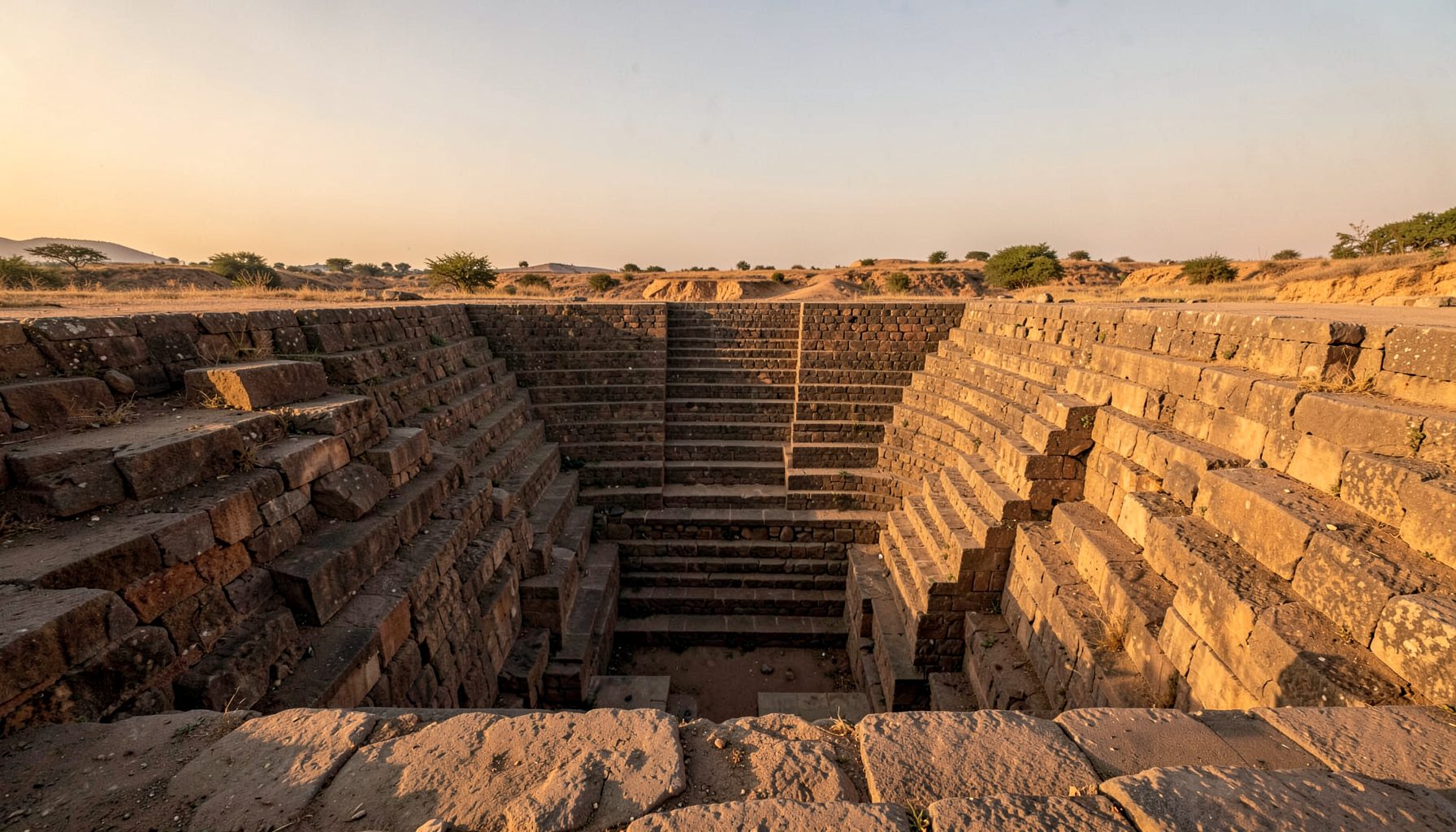
Solapur district in Maharashtra lies on a sun-bleached stretch of the Deccan Plateau where summer temperatures regularly climb past forty degrees. Scattered across its arid villages are dozens of subterranean structures that locals call "water temples" — stepwells carved deep into basalt bedrock, descended through stone staircases that spiral into cool shadow. These are not ordinary wells but architectural compositions that fuse hydraulic engineering with devotional iconography, places where communities once gathered to draw water, perform rituals, and shelter from the heat.
The phrase "underground water temples" captures something distinctive about Solapur's heritage. Unlike the grand carved stepwells of Gujarat or the imposing baolis of Delhi, the structures here tend to be quieter and more intimate. Their pillars are often unadorned, their walls dressed in rough-hewn stone, and their depths rarely exceed four or five storeys. What they sacrifice in surface ornament they gain in atmosphere — dim shafts of light filtering onto still green water, with the faint echo of dripping condensation softening the chamber walls.
A current documentation project aims to record these structures before further decay claims them. Working alongside village elders in towns such as Pandharpur, Barshi, and Akkalkot, field researchers are assembling the first comprehensive photographic and architectural survey of the district's subterranean heritage. The findings suggest that Solapur holds one of the densest concentrations of working stepwells in Maharashtra, many entirely unknown outside their immediate neighbourhoods.
Solapur's hidden hydrological heritage
The district sits astride the Bhima and Sina river basins, two watercourses that fed agricultural prosperity for centuries but could not be relied upon year-round. Before modern borewells transformed the region, every village of consequence relied on catchment ponds, earthen embankments, and stepped reservoirs to bridge the dry months. Solapur's medieval water systems formed the connective tissue of rural life, storing seasonal rains in deep stone cisterns that remained accessible even when surface sources evaporated.
Local tradition attributes many of the surviving wells to wealthy merchants, deshmukhs, or religious orders that funded construction as a form of merit-making. Inscriptions, where they survive, often record the year of construction, the patron's name, and a short formula dedicating the well to the village deity. The shift away from stepwells began in the late nineteenth century when colonial engineers introduced tube wells and canal irrigation. Generation by generation, the underground structures lost their central role in daily life, yet many continue to function as emergency reserves, and a handful remain in active ritual use.
Architectural features of the subterranean sanctuaries
Solapur's stepwells share a family resemblance but vary considerably in plan. The most common type is the rectangular stepped tank, entered through a sloped ramp cut into one wall, with platforms on either side at successive depths. These platforms served as resting places, washing stations, and gathering spots during festivals. Walls are typically lined with roughly squared basalt blocks, while the floor descends in regular courses of dressed stone.
A more elaborate variant incorporates a pillared pavilion at the water's edge, often with a small shrine niche carved into the eastern wall. At sites near the Bhima riverbank, these pavilions rise on slender columns with simple capitals, their geometry echoing the trabeate style common across the Deccan. Decorative programmes tend toward restraint. Floral medallions, geometric rosettes, and the occasional figural panel appear at a handful of sites, but the overriding aesthetic is functional and devotional. The light itself is treated as an architectural material: narrow shaft openings cast defined beams of sun onto the water at specific times of day, marking seasonal transitions and ritual calendars.
The pilgrim's descent: ritual and water
For many communities, a stepwell remains a place of pilgrimage even when its water is no longer drawn for daily use. Annual rituals, often timed to the bright half of the lunar month, send small processions down the stone steps to perform abhishekam — the ceremonial bathing of a deity's image — at the water's edge. The descent itself carries symbolic weight: stepping downward into the earth represents a return to source, a gesture of humility before the waters that sustain life.
At several sites, the well is dedicated to a local goddess whose cult predates the Islamic patronage responsible for many of the district's surviving monuments. Hindu, Muslim, and Jain communities have all left marks at different stepwells. Inscriptions in Devanagari, Persian, and occasionally Marathi modi script appear side by side at certain locations, evidence of patronage networks that cut across religious boundaries. Field researchers have documented festival calendars at more than thirty stepwells, ranging from intimate gatherings to larger events that draw pilgrims from neighbouring talukas.
Solapur in the wider stepwell landscape
India's stepwell heritage extends across Rajasthan, Gujarat, Madhya Pradesh, and the Deccan, with regional schools that developed distinctive vocabularies of form. Solapur's subterranean reservoirs belong to what scholars sometimes call the Deccan-Adilabad tradition, characterised by deep rectangular shafts, restrained ornament, and frequent use of basalt masonry. This style links them visually to the vavs of Bidar, the baoris of the northern Deccan, and certain sites in northern Karnataka.
The contrast with Gujarat's UNESCO-listed monuments could hardly be sharper. Sites like Rani ki Vav in Patan represent the high ornamentation of a later, courtly phase, with extensive figural sculpture, multi-storey colonnades, and integrated temple architecture. Discussions about preservation priorities at such celebrated monuments focus on tourism management, structural stabilisation, and the challenges of maintaining carved surfaces. Solapur's stepwells face entirely different problems — primarily abandonment, encroachment, and the absence of formal heritage recognition.
Photographic documentation and field research
The documentation effort began as a single photographer's weekend project and has grown into a multi-season field campaign. Over the past three years, more than ninety subterranean structures have been recorded across Solapur and neighbouring districts, each receiving a standardised photographic brief: wide-angle exteriors at dawn, medium-format interior views under available light, architectural sketches of plan and section, and drone imagery of the surrounding catchment area where access permits.
Lighting conditions underground are unforgiving. Most wells are too deep for natural light alone, and flash photography flattens the texture of weathered stone. The team's preferred method involves long exposures on a stabilised tripod, supplemented by a diffused LED panel bounced off the walls. Every site receives a coded identifier, GPS coordinates, a condition report, and a short oral history recorded with consenting villagers. The resulting archive will be made available to researchers and heritage students, including those based at Australian universities that maintain active South Asian studies programmes.
Conservation challenges facing Solapur's wells
Conservation in Solapur is complicated by the structures' working status. Many wells still hold water, and several continue to serve as informal reservoirs for cattle or emergency household supply. This complicates standard preservation approaches, which usually assume a monument can be drained, cleaned, and stabilised as a single operation. Active wells require ongoing management plans negotiated with the communities that depend on them.
Encroachment poses a separate threat. As villages expand, builders sometimes construct directly over the stone openings of older stepwells, unaware of what lies beneath. In at least three documented cases, residential compounds now sit atop unrecognised reservoirs whose integrity is gradually compromised by septic seepage. A third challenge is administrative: Solapur's stepwells rarely appear on official heritage lists maintained by the Archaeological Survey of India. Without formal recognition, restoration funding is difficult to secure, and there is little legal recourse against damage caused during routine construction work.
Why Australian travellers and researchers should care
For readers in Australia, the appeal of Solapur's underground water temples lies partly in their unfamiliarity. Few heritage tours from Australia currently reach the Deccan's lesser-known stepwell districts, and the standard Rajasthan-Gujarat circuit still dominates travel writing about India's water architecture. Visitors from Melbourne, Sydney, Brisbane, Perth, or Adelaide who venture further south are rewarded with sites that feel genuinely off the beaten path, often unvisited by international tourists.
Australian scholars have long contributed to South Asian heritage research, with strong programmes at the Australian National University in Canberra and the University of Queensland. The Indian diaspora in cities such as Sydney and Melbourne includes many families with roots in western Maharashtra, and several community organisations have expressed interest in supporting documentation of ancestral stepwells. After long days underground, researchers sometimes unwind with a few hands of multi-hand blackjack, a pastime many Australian travellers enjoy during downtime between flights and field sessions. Whatever the balance between research, ritual, and relaxation, Solapur's water temples offer something rare: a chance to encounter a living, fragile, and largely unrecorded dimension of India's architectural heritage.
Get in Touch
Have information about a stepwell that is not yet on our map? We would be glad to document it and give you full credit. Whether it is a Barav, Kund, Vihir, or any other form of stepwell, every contribution helps preserve India's water heritage.
Call or message us with details about the location, and we will follow up.
#9372496819
Send a Message
What People Say
"The Maharashtra Stepwells campaign has brought attention to structures that were nearly forgotten. The architectural documentation and drone photography are invaluable resources for researchers and students alike."
"Collaborating with the Indian Stepwells team gave our architecture students hands-on exposure to traditional water-harvesting structures. The presentations were insightful and inspiring."
"I shared details of a stepwell near my village that was not on any map. The team visited, documented it beautifully, and credited me. It felt wonderful to contribute."