 Explore Maharashtra
The stepwells of the Malwa Plateau: A regional style
The Malwa Plateau is best understood as a cultural landscape rather than a neatly bounded architectural province. Its northern reaches cross north-western Maharashtra and continue into adjoining parts of Madhya Pradesh and Rajasthan, although boundaries vary. Within Maharashtra, baolis, bawdis, vavs and kunds describe related but locally distinct works. Their shared purpose is to turn access to water into civic, devotional and everyday space.
Across the region, the summer monsoon, seasonal streams, black cotton soils and varying aquifers shaped settlement. Stepwells are often described as drought response, yet many also gathered runoff, exposed groundwater and created shaded public rooms. Their engineering was bound to social order: access could be regulated by custom, privilege or religious observance, while the descent toward water supported ritual, conversation and rest.
For Australian readers, water scarcity makes the subject familiar, but Malwa’s wells resist simple lessons from old technology. They joined climate adaptation with craft, governance and public life. Their regional character emerges from those relationships, expressed through different materials, routes and degrees of ornament rather than a single template.
Water shaped the regional idiom
The monsoon did not simply supply water; it arrived in concentrated bursts, followed by long dry periods. A stepwell’s exact hydrology depended on its site. Some drew from springs or fissures, some intercepted runoff, and others combined storage with aquifer recharge. This variety explains why similar-looking wells can perform very different functions within one district.
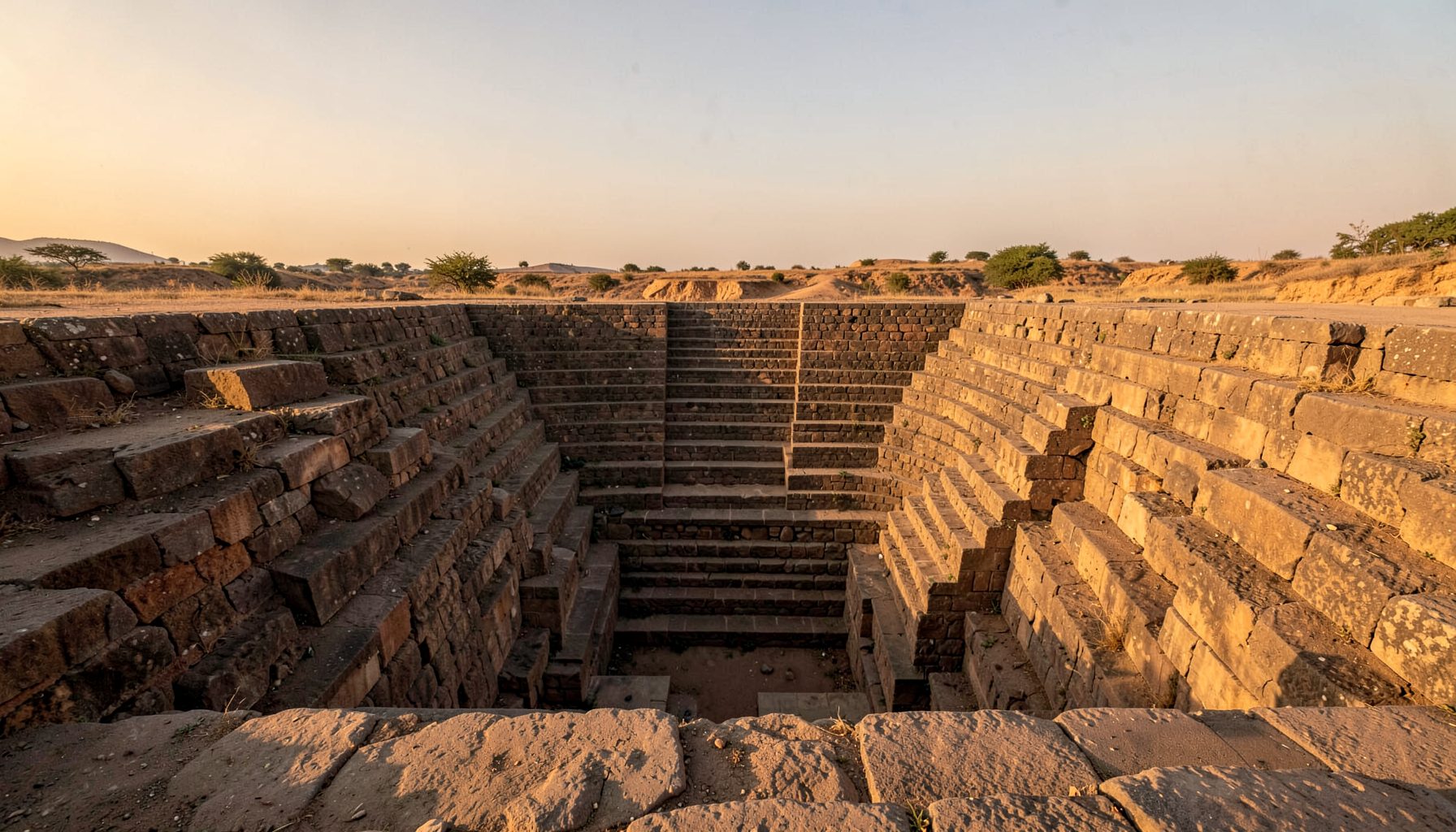
Across many examples, a recurring spatial sequence becomes visible: an entrance above ground, descending flights, landings and corridors, then a lower chamber or water surface. Thick walls hold back earth and temperature, while arches and columns organise shade. Yet width, depth and elaboration vary with terrain, available stone and patronage, leaving a regional family rather than uniform school.
Stone, slope and seasonal flow
Material choices sharpen this sense of place. Northwestern Maharashtra crosses basaltic formations associated with the Deccan Traps, while sandstone and other local stone occur elsewhere. Builders used masonry, carved rock, lime mortar and plaster to create durable, repairable surfaces. Colour, tooling and the treatment of parapets can therefore help specialists place a well more precisely within the Malwa tradition.
Modern Australia provides useful weather comparisons without making the architecture identical. Melbourne’s household rain tanks and strict summer watering rules, Sydney’s sandstone civic fabric and sudden downpours, and Brisbane’s subtropical cloudbursts each involve water management. Malwa’s gravity-fed wells, local quarrying and civic maintenance belong to another technological and cultural setting.
The architecture of descent
Descent gave the stepwell its social character. Flights allowed visitors to pause, meet and move between street, shrine and water; niches offered places for small shrines, lamps or resting figures. The changing light and cooler levels made the journey meaningful in itself. Water was therefore not stored behind a wall, but encountered through a gradual public route.
A comparison with Hampi’s forgotten water system shows how a stepwell can belong to a larger chain of tanks, channels, dams and settlements. Hampi lies on a different Deccan plateau, so the parallel is structural rather than classificatory. Keeping the systems connected prevents isolated monuments from concealing the labour behind urban water supply.
Stepwells in art and visual memory
Visual records reveal a second layer of meaning. The Indian Stepwells account of stepwell miniatures shows how painters selected stairways, worshippers, water and architecture to communicate status, devotion and movement. Such images are not measured surveys, yet they preserve social details and changing ideas about the ideal stepwell that masonry alone cannot provide.
On site, original photography, architectural sketches and carefully planned drone imagery work together. Close views reveal carving and repair; measured drawings clarify geometry; aerial images show relationships to streets, fields and catchments. Seasonal pairs are especially valuable, recording a high and low water condition. Australian local-history societies and public museums can translate this visual evidence into exhibitions that make conservation legible to broad audiences.
Ornament, exchange and local identity
Ornament is where regional identity becomes most visible. Carved bands, brackets, niches, deity figures and donor inscriptions may share motifs with temples and nearby dwellings, while later additions record changing patrons. Motives are clues to artistic exchange, but they should not be read as a fixed ethnic signature. Material, workmanship, setting and documented history are needed before assigning a motif to a community or period.
The archaeological emphasis on Neolithic precious beads offers a useful methodological parallel: objects gain meaning through raw material, manufacture, use, repair and movement. It supplies no direct lineage for Malwa stepwells, but it demonstrates why decorative traces deserve close recording. A carved bracket may connect several communities even when no written explanation survives.
Living heritage under changing conditions
These structures remain vulnerable to groundwater extraction, siltation, altered drainage, encroachment, vegetation and insensitive tourism. Climate variability can intensify runoff while wells lose their historical relationship with the landscape. Conservation must protect the functioning catchment as well as the masonry; a photogenic staircase cannot substitute for the recharge and governance that once made its water system work.
Adelaide’s dry summers and the daily rhythms of its Central Market offer a local point of comparison. A market depends on hidden water, waste and heat systems, just as a historic settlement depended on wells for more than a single household. The comparison turns water from scenery into civic infrastructure while showing how climate-shaped customs continue in modern Australian cities.
In Australian heritage work, water knowledge also demands respect for Country. Responsible practice acknowledges Traditional Owners, follows local protocols and recognises custodians as knowledge holders rather than treating Indigenous history as scenery. For Malwa research, the equivalent standard means listening to residents, craftspeople and descendants, and recording their priorities alongside official records.
Documenting and protecting the Malwa stepwells
Systematic survey can combine geotagged photographs, measured sketches, condition notes, drone plans where lawful, and oral histories gathered with consent. Indian Stepwells can provide an open point through which villagers and local researchers can report undocumented wells, correct place names and share changing water knowledge. Such records should distinguish direct observation from later memory.
Heritage value also develops beyond original function. Research on oak memorial symbolism offers a comparative reminder that landscape features can gather communal meanings over time. The physical parallel is limited, yet the interpretive lesson fits Malwa: a baoli can be a water work, a place of worship, a boundary marker, a meeting place and a focus for memory at once.
These field priorities translate close observation into practical heritage action:
- Establish a contact register for each settlement, recording residents, historical societies, temple trusts, craftspeople and landowners, with permission before publishing personal histories.
- Give every structure a unique identifier, location record, measured sketch and condition baseline, then update corrections through a community-reviewed archive.
- Photograph the same points in wet and dry seasons, note water presence and flow, and keep environmental observations separate from unverified historical claims.
- Repair with compatible lime-based materials and trained local craftspeople, avoiding hard cement and drainage changes that trap moisture within historic masonry.
- Assess groundwater and catchment impacts with specialists and planners before restoration, so heritage work supports functioning water systems rather than only stabilising walls.
- Publish photographs, drawings, translations and exhibition content in accessible formats, giving residents final review and a visible role in the public record.
Get in Touch
Have information about a stepwell that is not yet on our map? We would be glad to document it and give you full credit. Whether it is a Barav, Kund, Vihir, or any other form of stepwell, every contribution helps preserve India's water heritage.
Call or message us with details about the location, and we will follow up.
#9372496819
Send a Message
What People Say
"The Maharashtra Stepwells campaign has brought attention to structures that were nearly forgotten. The architectural documentation and drone photography are invaluable resources for researchers and students alike."
"Collaborating with the Indian Stepwells team gave our architecture students hands-on exposure to traditional water-harvesting structures. The presentations were insightful and inspiring."
"I shared details of a stepwell near my village that was not on any map. The team visited, documented it beautifully, and credited me. It felt wonderful to contribute."