 Explore Maharashtra
The Stepwells of Hampi: A Forgotten Water System
Hampi, the ruined capital of the Vijayanagara Empire, draws visitors who come to marvel at its temples and bouldered skyline along the Tungabhadra River in Karnataka. Yet the same landscape holds another inheritance: a network of stepwells, pushkaranis, and stone-lined channels that once sustained a city of perhaps half a million people. For Australian travellers who have grown up around the Indian diaspora in Melbourne and Sydney, or who have traced the engineering ambitions of the Great Artesian Basin, Hampi's water systems offer a different kind of pilgrimage, one that speaks to ingenuity, faith, and survival in a dry interior.
Long before Portuguese chroniclers sketched the city's towers, engineers under Krishnadevaraya and his successors carved catchment channels out of granite and laid out stepped tanks that filled and emptied with the monsoons. Scholars at the Australian National University in Canberra and at the University of Melbourne have revisited these structures in recent years, but most travellers still arrive knowing only the temples. The waterworks remain, for the international visitor at least, a forgotten system that deserves the same attention as the more photographed shrines.
A capital built on stored rain
Vijayanagara sat in a rain shadow. The Tungabhadra could flood in the wet months and shrink to a sluggish thread by February, so the city's planners treated every drop as an asset to be captured, stored, and released. Across the metropolitan core, they excavated roughly fifteen major tanks, supplemented by dozens of smaller kalyanis and stepwells fed by a twenty-kilometre network of stone-lined canals. The system was not merely utilitarian; tanks such as the Pushkarini near the Vittala Temple were sacred geometry, aligned with the movement of the sun and the ritual calendar of the empire.
Water here was also political. The capacity to flood-fill a royal tank on command demonstrated the reach of the crown, and inscriptions record the dedication of specific reservoirs to deities, queens, and military victories. When the Deccan sultans sacked the city in 1565, the destruction of bunds and channels was as much a symbolic act as the smashing of idols. The empire fell, but the hydrology remained, and many of those tanks still hold water eight months of the year. Recent heritage documentation work has begun to record these systems in detail, and readers can learn more about the work of Indian Stepwells and its focus on such reservoirs across the Deccan.
Granite steps and hidden reservoirs
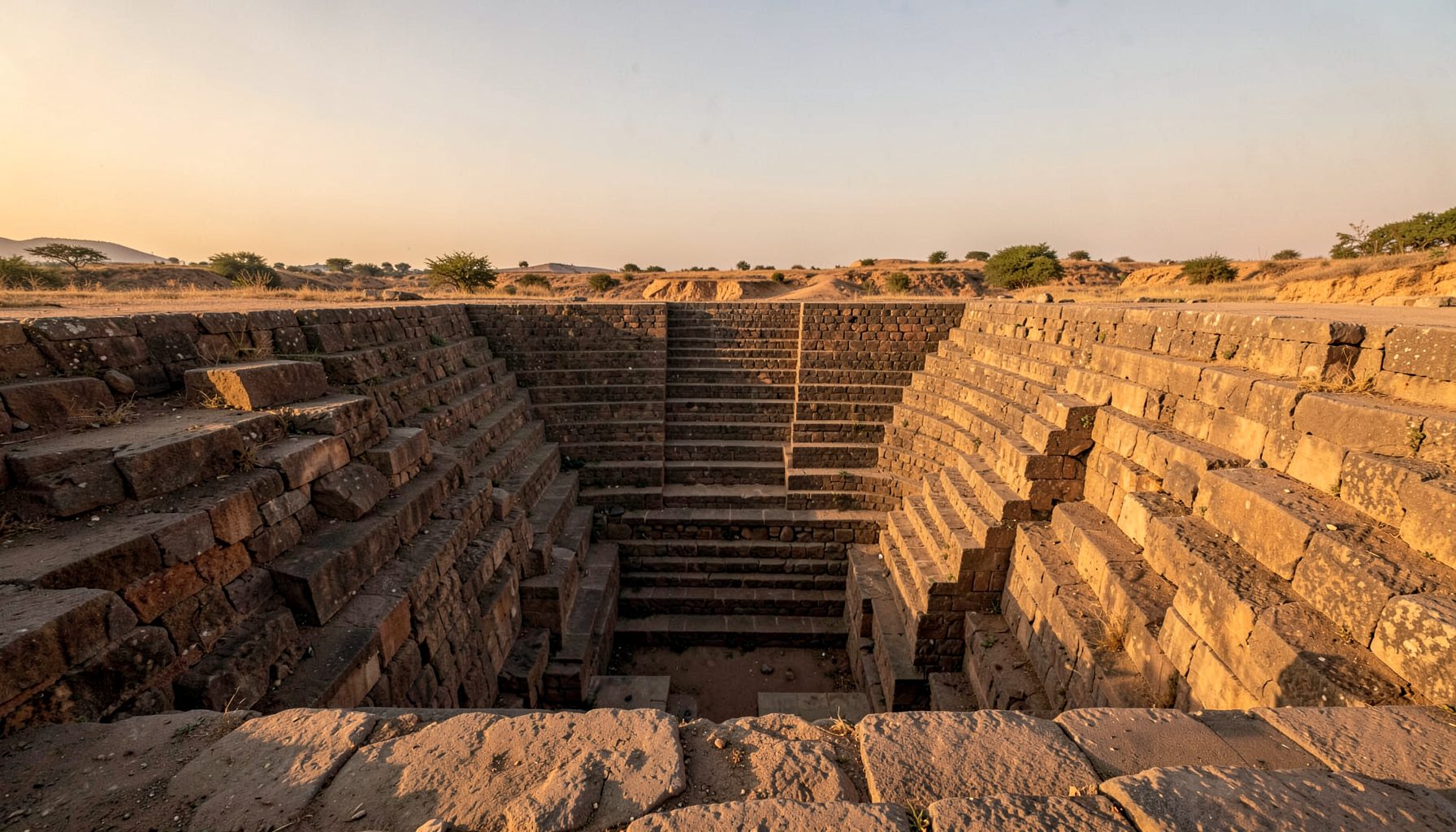
Walking among the boulders today, the stepwells of Hampi are easy to miss. They are not the soaring, multi-storied vavs of Gujarat, nor the ornately carved baoris of Rajasthan; instead, they tend to be modest, rectangular cuts in the rock, reached by flights of five to nine steps descending from a paved platform. The sides are dressed in tight granite blocks, and the corners often have square pillars that once supported a wooden railing or a small shrine. At their deepest, these wells reach down through fractured gneiss to tap the water table, an engineering choice that speaks to the patience of the builders.
The underground water temples of Solapur show a related but distinct tradition, where pavilions and idols sit within a subterranean tank. Hampi's wells are plainer, yet they share the same logic of descent: the visitor steps down into a cool, echoing chamber that is both well and sanctuary. Several of the most intact examples lie near the Zenana enclosure, where the corridor of small pavilions hides a sequence of stepped cisterns that supplied the royal households. Drone surveys carried out in the past decade have revealed additional, undocumented wells tucked behind what were once taken for simple courtyards.
Royal baths and the theatre of water
The best-known hydraulic structures in Hampi are not strictly stepwells but the royal bathing tanks, the Queen's Bath, the Lotus Mahal tank, and the stepped ghats along the Tungabhadra. These were designed for display: lotus flowers floated on the surface, and the king's consorts and courtiers descended marble staircases to bathe while musicians played in surrounding galleries. The Lotus Mahal complex, with its arched pavilions and symmetrical water courts, shows how a stepwell vocabulary could be translated into an Islamic-influenced pleasure garden without losing its ritual function.
Closer to the river, the Vittala Temple's musical pillars and the riverfront bazaar sit above a series of stone ramps that once allowed boats to load directly from the ghats during the wet season. The ramps were calibrated to the river's flood levels, evidence of an empirical hydrology refined over generations. Visiting students from the University of Sydney's heritage conservation program have used these ghats as case studies in adaptive design, noting that the builders accepted seasonal change rather than fighting it, an approach now echoed in Australian approaches to managing the Murray-Darling system.
Pressures of stone, sand, and tourism
The same qualities that make Hampi extraordinary also make it fragile. The granitic soil is poor, and surrounding villages have long relied on the old tanks for drinking water and irrigation. As groundwater extraction has intensified around the site, several smaller stepwells have dried up for the first time in living memory. Encroachment from the expanding township of Kamalapur and from informal guesthouses has put pressure on the catchment slopes, while unregulated foot traffic on the Vittala precinct has worn down the original plaster of the tanks.
Indian federal and Karnataka state heritage law protects the core archaeological zone, and the Archaeological Survey of India maintains a buffer that limits new construction. Comparable legislation in Australia, such as the Environment Protection and Biodiversity Conservation Act, faces similar challenges in balancing local livelihoods with conservation. Researchers interested in contributing field notes or photographs of lesser-known wells can share information through the project's contact page, while on the ground the most effective guardians of the stepwells are often the priestly lineages and panchayats who still perform monthly water rituals at the larger pushkaranis.
A wider world of water heritage
Hampi's waterworks are not unique; they belong to a global family of ancient hydraulic monuments, from the qanats of Persia to the Bronze Age passage tomb of Newgrange and its solar alignment, where the rising sun on the winter solstice still floods an inner chamber with light. Like Newgrange, the Hampi stepwells are aligned to celestial events, though in a southern sky and against a tropical sun. Both sites remind visitors that pre-industrial societies could plan and execute monumental works of alignment and engineering without metal tools or fossil fuel.
For Australian readers planning a heritage trip, or for scholars designing comparative courses on water and society, Hampi offers a dense, walkable field site. The forgotten water system of Hampi is not lost; it is simply waiting to be noticed again, one stepped tank at a time.
A traveller's and researcher's field checklist
- Visit in November or early December, after the northeast monsoon has refilled the tanks but before the tourist peak in January.
- Hire a local guide accredited by the Archaeological Survey of India, and ask specifically to see the Zenana enclosure wells and the area behind the Lotus Mahal.
- Carry a small notebook rather than relying on a phone for measurements; light levels inside the deeper stepwells are often too low for photography without a tripod.
- Compare your field notes with the Solapur documentation and with Australian analogues such as the Elsemere Street tanks in the Kimberley, where Indigenous communities manage similar seasonal water bodies.
- Support conservation by purchasing site maps and publications from the ASI bookshop rather than from unofficial vendors near the bazaar.
- Share your findings with open-access archives so that future researchers in Delhi, Pune, or Perth can build on the record.
Get in Touch
Have information about a stepwell that is not yet on our map? We would be glad to document it and give you full credit. Whether it is a Barav, Kund, Vihir, or any other form of stepwell, every contribution helps preserve India's water heritage.
Call or message us with details about the location, and we will follow up.
#9372496819
Send a Message
What People Say
"The Maharashtra Stepwells campaign has brought attention to structures that were nearly forgotten. The architectural documentation and drone photography are invaluable resources for researchers and students alike."
"Collaborating with the Indian Stepwells team gave our architecture students hands-on exposure to traditional water-harvesting structures. The presentations were insightful and inspiring."
"I shared details of a stepwell near my village that was not on any map. The team visited, documented it beautifully, and credited me. It felt wonderful to contribute."