 Explore Maharashtra
The Stepwells of Hyderabad: Deccani Elegance in Stone
Hyderabad’s old city is usually introduced through pearls, biryani and the Golconda fort. Its water heritage tells a quieter story. The stepwells of Hyderabad are stone reservoirs cut into the Deccan plateau, where descending flights carry people from street level toward groundwater. They are less numerous and less immediately visible than the celebrated baolis of Rajasthan or Gujarat, yet they illuminate how the Qutb Shahi and Nizam-era city managed heat, scarcity and movement.
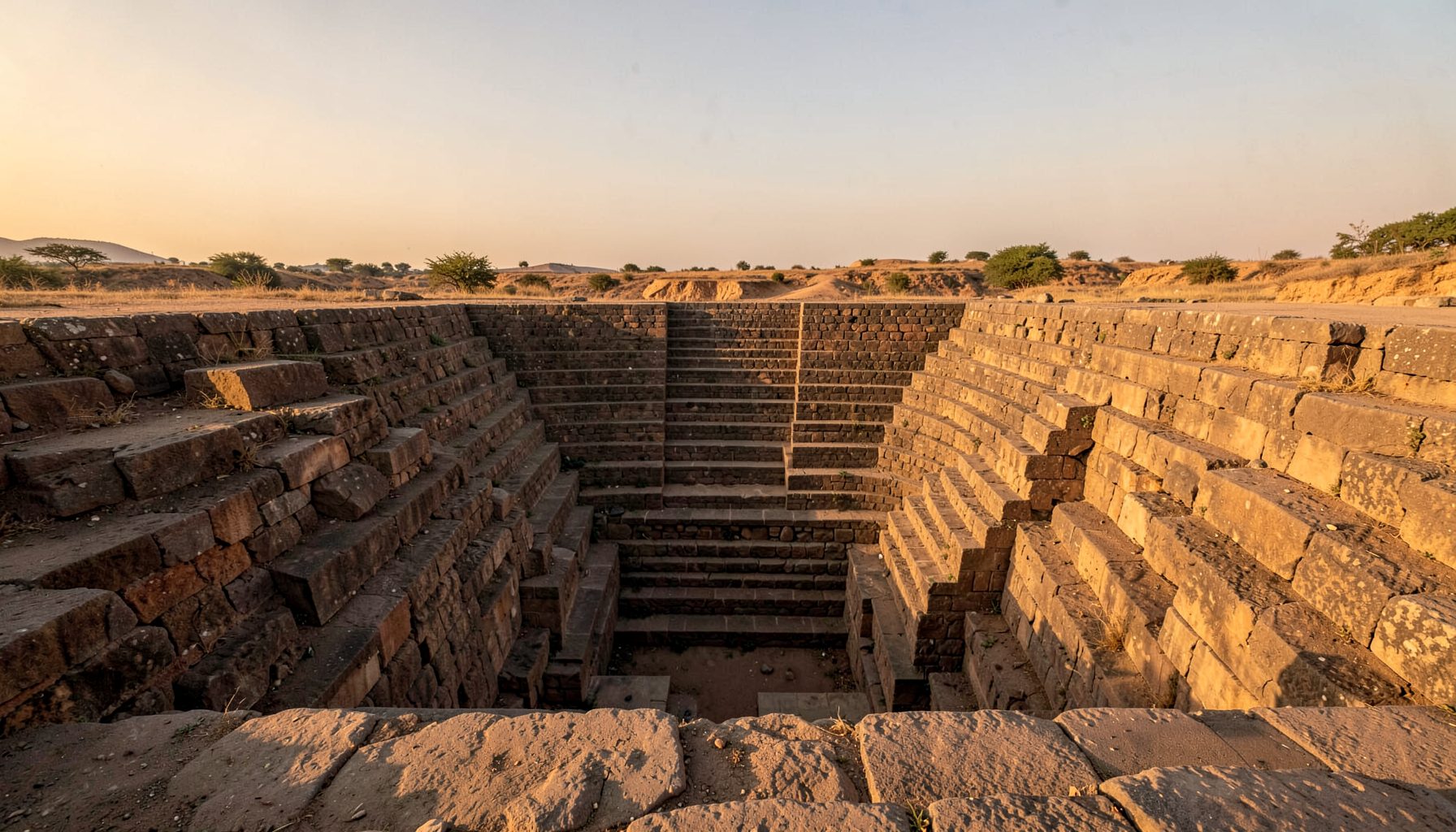
At their most recognisable, these wells combine practical access with careful geometry: long staircases, deep shafts, retaining walls, niches and shadowed chambers. Their scale ranges from neighbourhood structures to the substantial Badi Baoli and Chhota Baoli near the Qutb Shahi heritage area. Some served as gathering places as well as water sources, used for conversation, washing, ritual and ordinary street life.
For Australian readers, the value of these structures lies in difference and resonance. Sydney’s Tank Stream, Adelaide’s household rainwater tanks and Melbourne’s market laneways all belong to a culture shaped by water, weather and shared civic space. Hyderabad’s wells offer a distant parallel, but their Deccani carving, Islamic and Hindu building traditions, and monsoon setting remain distinctly local.
Wells Beneath the Deccan Sky
Hyderabad stands on the rocky Deccan plateau, where rain is concentrated into a short monsoon and the surrounding land is dry for much of the year. Water had to be stored, lifted and directed. Surface tanks collected runoff, while wells and stepwells reached groundwater through masonry-lined shafts. Together they formed a distributed system rather than a single monumental aqueduct.
The city around Fatehabad, founded near Golconda in the late sixteenth century, was planned with this resource in mind. Muhammad Quli Qutb Shah established the new capital, and later rulers strengthened its tanks, channels and wells. Across the Deccan, elevated watercourses called falak carried water from reservoirs to gardens, courtyards and fountains. Stepwells made stored and subterranean water accessible at the point of use.
Names shift with geography. Baoli and bawdi are common in the Deccan, while vav is more associated with western India; kund often describes a stepped or sacred tank, and barav is used in parts of Maharashtra. The labels can overlap, but they preserve distinct traditions. Hyderabad’s wells are Deccani forms that absorbed wider Indian ideas without becoming exact copies of northern baolis.
Architecture of Descent
A stepwell is organised around a controlled journey downwards. Flights descend past landings, recesses and chambers, allowing users to collect water while the shaft remains ventilated and shaded. The arrangement is both engineering and choreography: architecture slows movement, concentrates coolness and turns an ordinary task into a passage from the exposed street into the earth.
Deccani workmanship gives this familiar grammar a particular character. Heavy masonry, pointed arches, vaulted spaces and finely cut stone bands appear alongside plain retaining walls. Geometry matters as much as ornament: repeated steps set a rhythm, deep shadow conceals the water, and a narrow opening can make a modest reservoir feel unexpectedly large. Nearby gates, mosques, tombs and dwellings extend this architectural conversation.
Water also shaped sacred design. A tank could support hospitality, bathing, donation, pilgrimage or neighbourhood worship. This relationship between access, water and sacred enclosure is examined through temple tank architecture, showing how hydraulic logic can serve practical and ritual needs. Hyderabad’s wells stand within that broad Indian tradition while retaining the compactness and craft of the Deccan.
Qutb Shahi Waterworks
The best-known Hyderabad examples are closely tied to the Qutb Shahi landscape. Badi Baoli and Chhota Baoli lie within the heritage zone near the Qutb Shahi tombs and the monumental approach to Fateh Darwaza. Their royal setting did not make them merely ceremonial. Water remained a practical concern in a growing capital, and a baoli joined infrastructure with a carefully staged public presence.
Badi Baoli’s broad descent draws the eye toward a deep, shadowed reservoir held by strong retaining walls. Chhota Baoli offers a more intimate scale, with the same reliance on enclosure, shade and stepped access. These contrasts show why one category cannot describe every Hyderabad stepwell. Dimensions, water levels, surrounding rooms and approach routes determine whether a well reads as a neighbourhood utility, a monumental void or a sheltered civic room.
Under Hyder Ali and the Asaf Jahi Nizams, the city expanded and older works were maintained within a broader network of reservoirs, canals, hamams and garden channels. The Nizam period strengthened the tank-and-channel system, especially around Husain Sagar, rather than creating a new class of stepwell. Hyderabad’s identity rests on both deep baolis and the open tanks through which the Deccan capital was supplied.
Wells in Everyday Life
A well was never simply a hole with water in it. Its edges served as seats, its shade as shelter, and its approach as a meeting place. People waited with vessels, exchanged news, washed smaller items and moved through the day’s work. The deepest chambers might be reserved for water, while upper landings handled company. Architecture recorded a social order through distance, access and visibility.
Gender shaped that order. Drawing on women’s daily lives, we can see how fetching water, cleaning, social exchange and care were organised around the hours and spaces available to women. The burden was not imagined by later historians; it was built into routes, queues and rules of use. Recognising that history prevents the baoli from becoming a picturesque monument detached from the people who sustained it.
There is a contemporary Australian echo in the way shared sites become social infrastructure during community celebrations. Eid gatherings in Parramatta and Diwali gatherings in Melbourne turn streets, parks and halls into temporary meeting places, much as a well could gather activity around it. The comparison concerns civic use, not equivalence: the Hyderabad structures carried the sharper realities of water access and gendered labour.
Stone, Craft, and Atmosphere
The visual appeal of Hyderabad’s stepwells rests on contrast. Stone changes colour under raking sunlight; stair treads create bands of shadow; moisture and age soften sharp edges. Carved details reward a close look, while the overall geometry remains legible from above. This combination of monumental form and intimate workmanship gives the wells their Deccani elegance.
Photography, architectural sketches and aerial views record different aspects of that character. A photograph captures texture, light and scale, while a measured sketch clarifies steps, levels and structural relationships. Drone imagery can reveal a shaft’s plan, but it cannot replace ground-level observation of access, drainage, vegetation and present-day use. Together, these records support conservation without turning a working landscape into an isolated visual object.
Australian audiences may recognise the attraction of water-related stonework in Sydney, where sandstone facades, hidden laneways and the old Tank Stream connect architecture with climate. Melbourne adds narrow laneways and the lively Queen Victoria Market, where market stalls sell locally made prints and design objects. Adelaide is Australia’s driest capital, and its familiar household rainwater tanks make water storage part of ordinary domestic design. Hyderabad’s baolis served another purpose, yet both settings reveal how dry climates shape masonry and shared space.
Preserving a Quieter Heritage
Conservation begins with understanding how each well works, not simply how it looks. Groundwater movement, seasonal filling, drainage, salt deposition, plant roots and visitor wear can affect fragile masonry. Structural cracks may sit beneath decorative surfaces, while modern roads and utilities can redirect runoff. Heritage listing protects recognition, but long-term care also requires regular inspection, local knowledge and repairs that do not erase evidence of age.
Field research can join measured drawings and condition photography with community testimony. Residents may remember a blocked flight, a changed water level or a vanished room that archival plans omit. Indian Stepwells’ invitation to share information about undocumented wells is valuable because local memory can reveal structures before they are damaged or built over. Such records matter in Hyderabad’s old city, where reused buildings can conceal archaeological traces.
Responsible stewardship balances access with preservation. Some wells may need restricted entry, others interpretation or drainage care, while restoration should keep authentic materials and repair histories visible. Australian public-history projects, from local historical societies to museum exhibitions, show the value of combining objects, images and spoken memory. Kept legible through conservation and shared memory, Hyderabad’s wells can reveal a city built around descent, shade, water and encounter.
Get in Touch
Have information about a stepwell that is not yet on our map? We would be glad to document it and give you full credit. Whether it is a Barav, Kund, Vihir, or any other form of stepwell, every contribution helps preserve India's water heritage.
Call or message us with details about the location, and we will follow up.
#9372496819
Send a Message
What People Say
"The Maharashtra Stepwells campaign has brought attention to structures that were nearly forgotten. The architectural documentation and drone photography are invaluable resources for researchers and students alike."
"Collaborating with the Indian Stepwells team gave our architecture students hands-on exposure to traditional water-harvesting structures. The presentations were insightful and inspiring."
"I shared details of a stepwell near my village that was not on any map. The team visited, documented it beautifully, and credited me. It felt wonderful to contribute."