 Explore Maharashtra
Women's Lives at the Edge of the Well
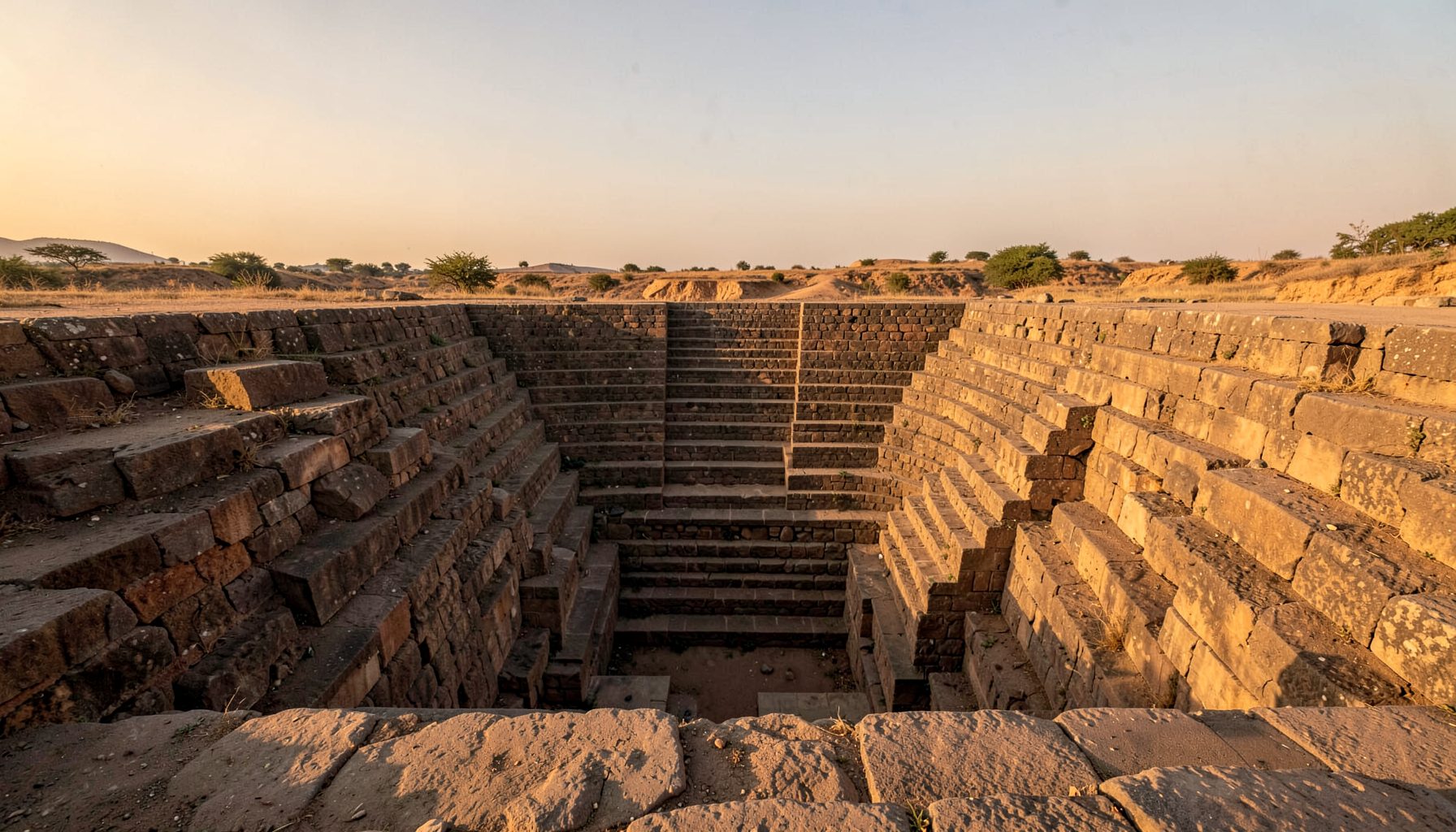
Stepwells carved their way into the Indian landscape across many centuries, descending past tiered stone walls down to the water table. These structures, known variously as baoris, vavs, kund, or barav depending on region and form, served far more than hydraulic purposes. They stood at the centre of community life, shaping how people met, worked, and rested. For women especially, these monuments framed the rhythm of each day, providing space for labour, conversation, and quiet reflection in landscapes where the sun pressed hard for most of the year.
The gendered history of stepwells remains under-explored in many survey volumes, which tend to emphasise dynastic patrons, engineering innovation, or sculptural programmes. Yet women appear in nearly every photograph, sketch, and oral account. They fetched water for households, washed clothing at lower ledges, bathed in private corners, and gathered with female neighbours while children played nearby. Australian readers familiar with the resourceful water harvesting of Aboriginal communities in the Western Desert, or with the shared wells that once served remote outback cattle stations, will recognise patterns of gendered labour around communal water sources, even though the climate and architecture differ sharply.
Water carriers and the morning routine
Dawn at an active stepwell began long before the sun cleared the upper walls. Women walked down the stone steps balancing brass pots, sometimes three or four stacked, with a metal ring placed at the base to keep balance. The same women may have visited the well five or six times a day for cooking, washing, drinking, and ritual needs. This physical task occupied a substantial part of their daily energy and shaped conversations with other women heading to and from the water.
In Rajasthan and Gujarat, women from different households often timed their visits to coincide, creating an unspoken rota. The walk down provided a moment of cool air even when ground temperatures were punishing. In Maharashtra, the Marathwada region holds several distinctive stepwells where female water carriers used side passages to avoid the gaze of men gathering near the surface. These segregated routes reflect how architecture responded directly to gendered codes of modesty and movement.
Photographers working on heritage projects often capture these women as silhouettes against the deep blue of a shaded well shaft. There is a recurring composition of figure descending steps with pots, an image that recurs across album covers, conservation reports, and travel photography. For researchers familiar with the vast archive of the State Library of Victoria and the National Library of Australia's pictorial collection, which hold detailed photographs of water infrastructure from arid zones worldwide, the visual language of stepwells reads as both specific to India and part of a broader global story.
Conversation, gossip, and news exchange
Stepwells functioned as outdoor parlours. While men congregated near village chaupal or temple courtyards, women used the well as their main space for informal discussion. Births, marriages, illnesses, market prices, and family tensions were all aired in these shaded galleries. An oral history from a village in Uttar Pradesh, recorded during fieldwork and shared through comparative heritage studies carried out by international teams, describes how a particular stepwell served as the only meeting point for women from three neighbouring hamlets who otherwise had little reason to cross paths.
The acoustics of these multi-storey structures amplified voices in unexpected ways. Architectural analyses note that the reversing levels created natural sound channels that carried conversation both upward and across landings. Women used this to their advantage, sometimes signalling to relatives on different levels without raising their voice. Scholars at the University of Melbourne have drawn comparisons with the way underground cisterns in colonial-era Australian homesteads functioned as gathering points, although the social coding was rather different.
In contemporary documentation, oral recordings of these conversations form a valuable but fragile archive. Much of it remains unpublished or held privately by families. The shift from oral tradition to recorded testimony means that younger women may not encounter these stories of the well unless researchers deliberately seek them out, which is why community-led projects often yield richer material than outside surveys alone.
Cool comfort in the hot months
The temperature inside a deep stepwell can drop by ten degrees or more compared to the exposed ground above. For women wearing heavy saris, bangles, and jewellery, the lower pavilions offered rare physical relief. During the peak of summer, when temperatures in cities like Nagpur or Bhopal soar past forty-five degrees, women spent hours at the well, not only to fetch water but to escape the heat. Some brought small stools, snacks, and embroidery, creating a seasonal retreat that lasted weeks.
British colonial officers and early surveyors often commented on this cooling effect, with some commissioning sketches of women sheltering in the underground galleries. Similar observations appear in accounts of Australian pastoral life, where homesteads in the Pilbara depended on shaded verandahs and cool underground tanks to make summer bearable for women managing isolated households. The two climates, Indian and Australian, developed different architectural solutions to a shared problem: extreme heat and the need for female-friendly cool spaces.
Family records from the nineteenth century sometimes mention women who refused to move to newer bungalows further from the well because they valued the cooling ritual so highly. The attachment to place ran deep, anchored in physical relief and social connection rather than sentiment alone. Even today, several restored stepwells in Gujarat and Rajasthan see older women returning in the hottest months to sit in the familiar shade.
Ritual purity and spiritual tasks
Stepwells held sacred status in many regions. Women performed daily puja at the water's edge, made offerings to the water goddess, and observed menstrual taboos that kept them away from the well during certain days. Some wells had specific female deities associated with them, and women maintained small shrines in niches along the carved walls. These religious practices blended Hindu, local, and regional traditions, often surviving long after the dynastic patrons were forgotten.
Tasks related to ritual purity fell largely to women. They ensured that water for cooking was drawn from the purest level, that brass pots were cleaned at designated ledges, and that offerings to ancestors were made at specific hours. A photograph from the town of Adalaj, in Gujarat, shows a woman pouring water at a niche shrine, an image that recurs across documentation projects. The same act can be photographed a hundred times and still feel quietly new each time.
Marriage processions often paused at stepwells for symbolic blessings, and women returning to their natal homes after childbirth would visit certain wells as part of their confinement rituals. These practices added layers of meaning to what outsiders might see as routine architecture. Readers with family memories, photographs, or field notes about wells in active use can contact the documentation team to contribute to ongoing research and public archives.
Carvings of women and female divinity
The walls of many stepwells carry elaborate sculptures. Goddesses, celestial dancers, and female figures adorn every level. The most famous example, the Rani ki Vav at Patan, includes over eight hundred sculptures, many of them female, arranged across nine levels. These carvings were not merely decorative. They honoured water as feminine, recognising the well itself as a maternal body that gave life.
Other examples include the Chand Baori at Abhaneri, where panels of deities and female attendants appear between the deep geometric steps, and the well at Champaner, where relief carvings show women engaged in music, dance, and domestic work. Each image tied the act of water drawing to broader cosmic and social orders.
Travel writers and photographers who study these spaces often note the contrast between hard geometry and soft figural carving. The descending steps represent control, order, and the disciplined descent into the earth. The female figures carved into those walls soften the space, introducing movement, intimacy, and warmth into an otherwise austere stone environment. The deeper one walks into a stepwell, the more intricate the carving tends to become, hinting that artisans reserved their finest work for the levels closest to the water itself.
Recommendations for readers and fieldworkers
- Seek out stepwell field studies by Indian researchers published through university presses rather than relying solely on glossy travel publications.
- Read oral history projects from regions like Kutch, Bundelkhand, and Marathwada, where female voices are central to the archive.
- When visiting, carry field notebooks and ask local women about their memories of wells, offering small tokens of thanks for their time.
- Support conservation efforts that prioritise community documentation over purely architectural restoration.
- Encourage Australian educational institutions to include stepwell studies in comparative heritage courses, perhaps through exchange programmes with Indian universities.
- Look for reading that places stepwells within global conversations about water, gender, and climate, such as a guide compiled for Australian users that broadens the travel experience.
- Cross-reference field photographs with archival sketches whenever possible, since drawings often show details that later restoration work has altered.
Get in Touch
Have information about a stepwell that is not yet on our map? We would be glad to document it and give you full credit. Whether it is a Barav, Kund, Vihir, or any other form of stepwell, every contribution helps preserve India's water heritage.
Call or message us with details about the location, and we will follow up.
#9372496819
Send a Message
What People Say
"The Maharashtra Stepwells campaign has brought attention to structures that were nearly forgotten. The architectural documentation and drone photography are invaluable resources for researchers and students alike."
"Collaborating with the Indian Stepwells team gave our architecture students hands-on exposure to traditional water-harvesting structures. The presentations were insightful and inspiring."
"I shared details of a stepwell near my village that was not on any map. The team visited, documented it beautifully, and credited me. It felt wonderful to contribute."