 Explore Maharashtra
Where Stepwells Meet the Sacred Water Landscapes of India
Across India, water has often been gathered, stored and sanctified in the same architectural landscape. Stepwells descend into the earth through flights of stairs, while temple tanks spread as broad, reflective reservoirs beside shrines. Both forms respond to seasonal rainfall, fluctuating groundwater and the cultural importance of water, yet they create very different experiences of movement, ritual and public space.
A stepwell may be called a baoli, bawdi, vav, kund or barav depending on its region and language. A temple tank may be known as a pushkarini, kalyani, tirtha or sarovar. These names reflect local traditions, but the structures frequently share builders, patrons, stoneworkers and water-management knowledge. Their relationship is especially visible in western and central India, where religious buildings were part of wider settlement systems rather than isolated monuments.
For Australian readers, the subject has a familiar environmental resonance. Rainwater tanks, creek corridors and urban reservoirs remain part of daily planning in places such as Adelaide, Perth and regional New South Wales. Indian water architecture goes further by combining storage with shade, ceremony, public gathering and carefully controlled access, offering a rich way to think about infrastructure as civic and cultural space.
The Indian Stepwells archive documents these places through field photography, architectural sketches, aerial views and research, with particular attention to Maharashtra. Examining the connection between stepwells and temple tanks reveals how practical water conservation and sacred geography have long supported one another.
Shared Water Systems And Sacred Geography
Stepwells and temple tanks were often positioned within the same settlement because they served connected needs. A tank could collect monsoon runoff across a wide open basin, while a stepped shaft offered access to groundwater after the surface reservoir had receded. Channels, drainage paths and stone-lined edges sometimes linked these systems, allowing water to move through the settlement according to seasonal conditions.
The temple tank was commonly associated with purification, festival bathing and ceremonial processions. The stepwell was more likely to support everyday activities such as collecting drinking water, washing, resting and meeting travellers. The distinction was never absolute. A stepwell could have shrines, sculptures and ritual platforms, while a tank could be a major source of domestic water for nearby residents.
This shared geography is important in dry regions where water could not be treated as an invisible utility. In Maharashtra, Gujarat, Rajasthan and parts of Karnataka, the location of a reservoir shaped roads, markets and religious precincts. The architecture made water visible, measured and socially meaningful.
Different Forms Of Descent And Reflection
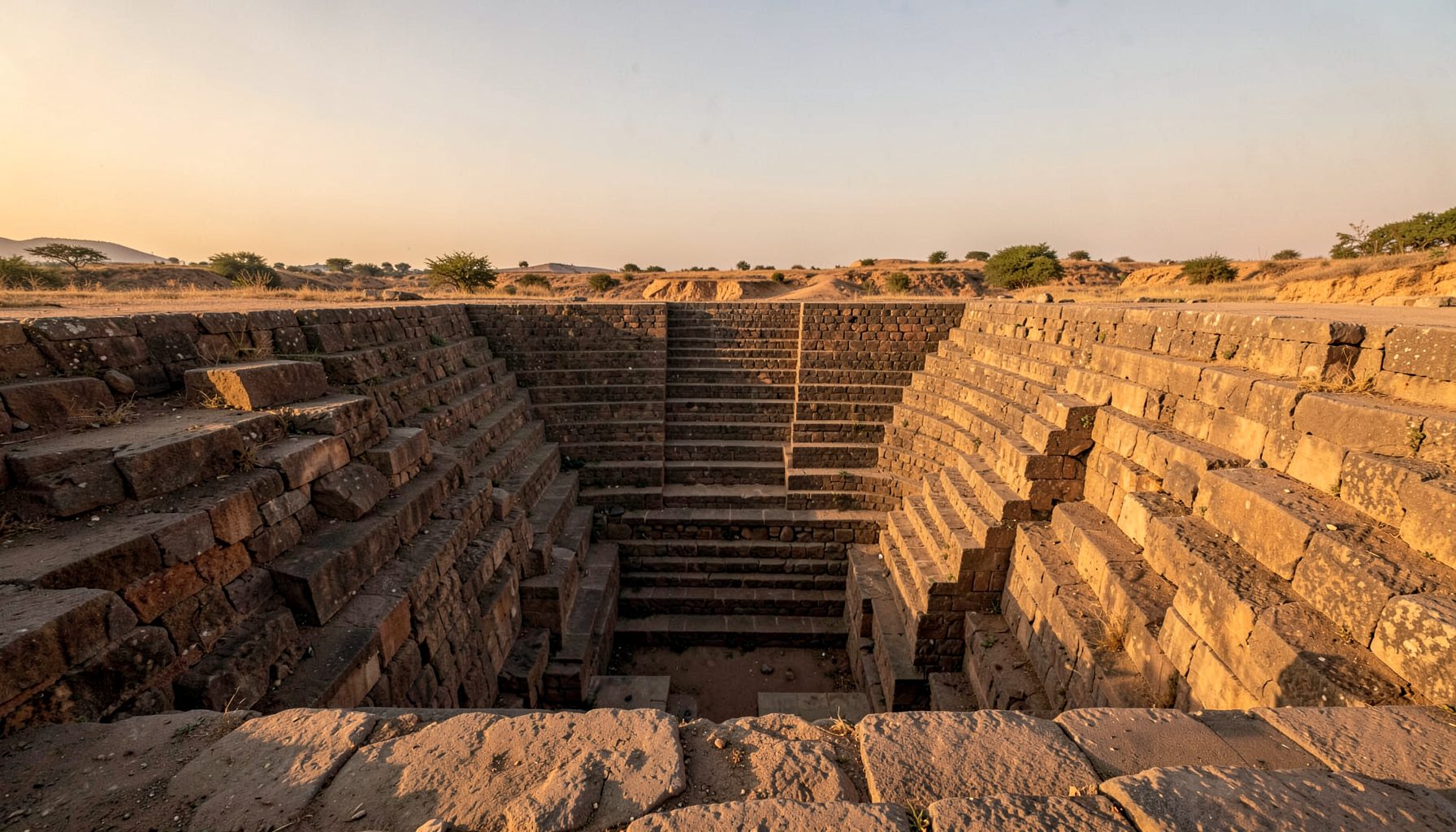
A stepwell is an architecture of descent. Its stairs lead visitors progressively below ground, often through pavilions, galleries and landings that provide shade during the hottest months. As the water level changes, the usable depth of the monument changes with it. The structure therefore records the rhythm of the monsoon and the gradual depletion of the aquifer.
A temple tank presents a different spatial idea. Its large rectangular or square basin establishes an open horizontal field, often edged by symmetrical steps on every side. The water reflects towers, trees and ceremonial structures, creating a strong visual relationship between the reservoir and the temple. Instead of drawing people into a protected underground world, the tank often gathers them around a shared centre.
Both forms choreograph movement. A visitor to a stepwell travels downwards through shadow, temperature changes and framed views. A visitor to a tank approaches across a courtyard or street and encounters a broad, public expanse. These contrasting experiences explain why the two structures could coexist: one is intimate and subterranean, the other expansive and ceremonial.
Monsoon Engineering And Seasonal Use
The connection between the two types of water structure becomes clearer when their engineering is considered. Temple tanks generally depend on catchment areas, stone paving and controlled inflows. Their embankments and steps help withstand repeated wetting and drying. Stepwells rely on deep excavation, retaining walls, groundwater recharge and durable masonry capable of resisting pressure from surrounding soil.
Neither structure was designed for a single season. During the monsoon, a tank might fill rapidly and become the focus of religious observances. In the dry season, the steps allowed people to approach the remaining water. A stepwell could remain cooler and usable when surface sources had become muddy or empty. Shade, ventilation and stone mass improved comfort as well as access.
A useful regional overview appears in Deccan stepwell guide, where the variety of forms across the plateau demonstrates that water architecture cannot be reduced to one standard model. Local geology, rainfall, patronage and building materials all affected the final design.
Ritual, Community And Everyday Life
Temple tanks were central to ritual calendars. Pilgrims might bathe before entering a shrine, priests could draw water for ceremonies, and festivals could bring processions, music and temporary stalls to the tank edge. The reservoir was therefore both a sacred threshold and a public square. Its steps provided seating, circulation routes and places for observation.
Stepwells also accommodated social life beyond water collection. Their shaded landings offered relief to travellers, meeting spaces for local residents and settings for informal commerce. In some regions, elaborate columns and carved niches suggest that patrons intended the well to communicate status, devotion and generosity. A water structure could be a charitable foundation, a landmark and a practical service at the same time.
This combination has an interesting parallel in Australia, where a heritage site may become a venue for school excursions, walking tours, photography exhibitions or a weekend market. A historic tank in Melbourne or a restored water feature in Adelaide can acquire renewed civic value when people are given reasons to gather there, rather than viewing it only as an old object behind a fence.
Reading The Landscape Through Fieldwork
Documentation helps recover relationships that are difficult to see from a map or a single photograph. A survey may reveal that a stepwell aligns with a temple gateway, that a tank receives runoff from a higher street, or that a now-dry channel once connected two water sources. Stone repairs, deposits, vegetation and changes in ground level can also indicate how a monument has been used over time.
Fieldwork requires patience and respect for local knowledge. Residents may know an alternative name, remember seasonal water levels or identify a blocked entrance that is absent from official records. The Satara field notes show how careful observation can bring attention to a rare structure that might otherwise remain overlooked.
For researchers and heritage photographers in Australia, this approach offers a practical model. A visit to a historic reservoir, tank or irrigation structure near Perth or regional Victoria can include interviews, measured sketches, drainage observations and seasonal photography. Records should distinguish original fabric from modern repairs and avoid publishing sensitive details when a site is vulnerable to vandalism.
Preservation Informed By Living Water
The future of stepwells and temple tanks depends on understanding them as living water landscapes, even when they no longer supply a town. Clearing rubbish, repairing steps and stabilising masonry are important, but conservation must also consider drainage, groundwater recharge, vegetation and the needs of nearby communities. A polished restoration that ignores the hydrology can preserve an appearance while destroying the system that gave the place meaning.
Climate change makes this work more urgent. Erratic monsoons, intense rainfall and longer dry periods place pressure on historic masonry and traditional water practices. Australian experience with drought planning, stormwater capture and rainwater tanks can create useful conversations, although conservation decisions must remain grounded in local ecology, customs and community authority.
Visual records have a role in that process. Drone imagery can show catchments and alignments, while close photography records tool marks, inscriptions and erosion. Exhibitions and carefully produced prints can reach audiences beyond academic circles, including visitors who encounter heritage through galleries, cultural festivals and the local tourism market.
Practical priorities for documenting and caring for connected water sites include:
- Map the relationship between wells, tanks, temples, streets, drains and natural catchments.
- Record water levels and vegetation across wet and dry seasons rather than relying on one visit.
- Consult residents, custodians and local historians before interpreting ritual or social use.
- Photograph architectural details alongside wider landscape views and measured sketches.
- Support low-impact access, clear signage and conservation training for local organisations.
- Connect heritage interpretation with responsible tourism, schools and community exhibitions.
Comparative heritage work can also sharpen public understanding. The Mount Jerome obelisk history demonstrates how a monument can carry cultural associations far beyond its immediate function and setting. In the same way, a stepwell or temple tank should be read through architecture, memory, belief, landscape and the people who continue to give it significance.
Get in Touch
Have information about a stepwell that is not yet on our map? We would be glad to document it and give you full credit. Whether it is a Barav, Kund, Vihir, or any other form of stepwell, every contribution helps preserve India's water heritage.
Call or message us with details about the location, and we will follow up.
#9372496819
Send a Message
What People Say
"The Maharashtra Stepwells campaign has brought attention to structures that were nearly forgotten. The architectural documentation and drone photography are invaluable resources for researchers and students alike."
"Collaborating with the Indian Stepwells team gave our architecture students hands-on exposure to traditional water-harvesting structures. The presentations were insightful and inspiring."
"I shared details of a stepwell near my village that was not on any map. The team visited, documented it beautifully, and credited me. It felt wonderful to contribute."