 Explore Maharashtra
Stepwells of the Western Ghats Where Water Meets Mountains
Across India’s Western Ghats, water has always shaped settlement, agriculture and movement. The mountain range runs along the western edge of the subcontinent, crossing Maharashtra, Goa, Karnataka, Kerala and Tamil Nadu, with steep escarpments, heavy monsoon rain and long dry seasons. In this setting, a stepwell was more than a reservoir. It was an architectural response to changing water levels and a social place built into the landscape.
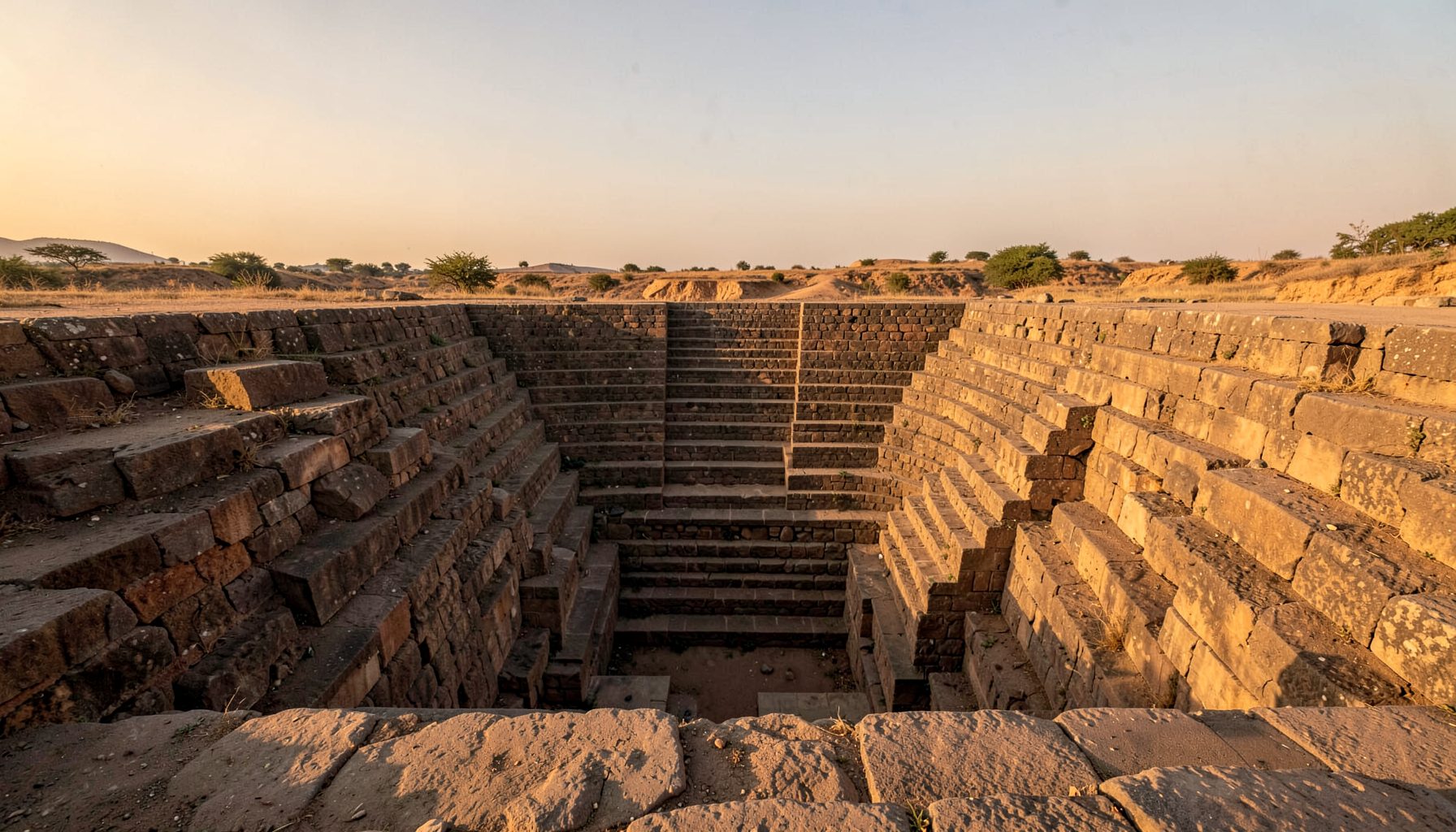
The structures discussed under names such as bawdi, baoli, vav, kund and barav vary widely. Some descend through dressed stone towards a narrow pool; others are compact village tanks reached by flights of steps. Their forms reflect local geology, available materials and patterns of rainfall. In the Deccan uplands east of the Ghats, basalt provided a durable building material, while laterite and granite shaped water architecture further south.
For Australian readers, the seasonal logic may feel familiar. Communities in Perth, Adelaide and regional New South Wales have long had to think carefully about storage, drought and the value of reliable groundwater. Yet stepwells make this practical concern visible through courtyards, galleries, carved retaining walls and shaded landings. Every descent records a relationship between climate, engineering and community life.
Indian Stepwells documents these places through field photography, architectural sketches, drone imagery and local research, with particular attention to Maharashtra. The work is valuable because many stepwells sit outside major tourist routes, hidden behind newer construction or remembered only by residents. Recording their condition and stories can help bring neglected water heritage into public discussion without reducing it to a picturesque ruin.
Monsoon landscapes and seasonal water
The Western Ghats receive some of the heaviest rainfall in India, especially on their western slopes. Rain runs quickly down forested hills and rocky valleys, while settlements on the Deccan side may face a much drier climate. A water structure therefore had to capture runoff, hold it safely and remain accessible after the monsoon had passed. Steps allowed people and animals to reach the water as the level fell.
This changing depth explains the distinctive geometry of many baolis and baravs. Broad upper flights could lead to narrower, cooler chambers below. Thick masonry reduced erosion, and shaded recesses offered relief during hot months. In places where the surrounding terrain was uneven, a stepped tank could be cut into a slope, joining natural drainage with carefully controlled storage.
The comparison with Australia is useful, although the climates are not identical. Sydney’s stormwater systems, Melbourne’s reservoirs and community rainwater tanks respond to the same broad problem: intense rainfall does not automatically produce secure year-round supply. Stepwells reveal an older approach in which water infrastructure was placed directly within daily life, rather than hidden entirely beneath roads or behind fenced utility sites.
Stone, shade and mountain engineering
Basalt is central to the character of many historic structures in Maharashtra. Formed from ancient volcanic flows, it is hard, dark and well suited to substantial retaining walls when carefully quarried and dressed. Builders used the natural strength of the rock to create long stairways, platforms and subterranean chambers. The resulting spaces can feel austere from above, then unexpectedly intricate as the eye adjusts to the depth.
Architecture also moderated heat. Deeply recessed steps, overhanging edges and enclosed corridors created cooler conditions around the water. Pillars and pavilions were not merely decorative features; they supported circulation, shade and pauses for conversation. In larger examples, the descent becomes a carefully choreographed journey from bright open ground to a dim, protected water edge.
The details matter for contemporary documentation. A drone image may show how a stepwell fits into a village, field system or valley, while a measured sketch records wall thickness, alignment and damaged masonry. Photographs taken at different times of day can reveal how sunlight reaches the lower levels. Together, these methods show a structure as a working piece of landscape architecture rather than an isolated monument.
Hidden wells in changing towns
Urban growth has placed many stepwells under pressure. Roads, housing, rubbish dumping and altered drainage can disconnect them from the water systems that once sustained them. In Pune, some historic wells have become difficult to recognise amid dense development, even though their position can reveal earlier settlement patterns. A photographic journey through the city’s overlooked sites offers a useful account of Pune’s hidden wells and the challenge of seeing heritage within an expanding urban fabric.
The same tension appears in many Australian cities. Old wells, tanks and industrial waterworks around Melbourne or Adelaide can be overshadowed by apartment construction, transport upgrades and rising land values. The local heritage market often favours grand residences and civic buildings, while modest water infrastructure receives less attention. Yet these smaller sites can explain how ordinary households, farms and neighbourhoods survived dry periods.
Documentation gives residents a way to connect physical evidence with memory. A name used by older villagers, a festival once held near a tank or a path followed by women collecting water may not appear in official records. Such information should be gathered respectfully, with communities treated as custodians of knowledge rather than sources to be mined for attractive details.
Community care and living heritage
Restoration is most effective when it responds to local use and local priorities. Near Nashik, volunteers have helped bring attention and care to a neglected village structure, showing how local restoration work can begin with practical community action. Clearing vegetation, removing waste, repairing access and sharing historical knowledge may achieve more than a distant intervention designed without local involvement.
Such projects need careful guidance. Cement repairs can trap moisture in older masonry, while aggressive cleaning may erase tool marks, inscriptions or traces of past repairs. Water quality, public safety and access for older people should be considered alongside visual appearance. A preserved stepwell should remain legible as a water structure, not become a polished backdrop detached from its original purpose.
Heritage work also involves difficult histories. Sites can carry memories of caste, gendered labour, pilgrimage, conflict and unequal access to water. Interpreting them for school groups requires age-appropriate language and space for complexity. Resources on speaking with children demonstrate the wider value of careful historical education: difficult subjects can be approached honestly without overwhelming young learners or turning suffering into spectacle.
Reading the Ghats through photographs
Photography can make a hidden stepwell visible to people who may never travel to the Western Ghats. A wide image establishes the relationship between the structure and its terrain; a close view reveals worn steps, moss, inscriptions, roots or the texture of basalt. Seasonal photographs are especially valuable because a dry chamber and a monsoon-filled tank can appear to be entirely different places.
A strong visual record also resists the temptation to present ruins as timeless. People carrying out repairs, children passing along a path, agricultural fields surrounding a tank and fresh marks left by recent use all belong in the frame. The aim is to show continuity and change, including the pressures that threaten a site.
Comparisons with other heritage places can sharpen this approach. A burial site such as the Red Hugh O’Donnell site demonstrates how landscape, memory and interpretation can intersect around a place whose meaning extends beyond its physical remains. Stepwells likewise require more than architectural description; their stories involve movement, devotion, labour, water management and belonging.
For Australians, exhibitions of this work could connect Indian water architecture with local conversations about drought resilience, Indigenous water knowledge, historic irrigation and adaptive reuse. A community display in Brisbane, Canberra or Fremantle could place field photographs beside maps, oral histories and drawings, encouraging audiences to see water infrastructure as cultural heritage. The most important records may also come from people who know an undocumented stepwell near their own village, and whose testimony can help guide future research and preservation.
Get in Touch
Have information about a stepwell that is not yet on our map? We would be glad to document it and give you full credit. Whether it is a Barav, Kund, Vihir, or any other form of stepwell, every contribution helps preserve India's water heritage.
Call or message us with details about the location, and we will follow up.
#9372496819
Send a Message
What People Say
"The Maharashtra Stepwells campaign has brought attention to structures that were nearly forgotten. The architectural documentation and drone photography are invaluable resources for researchers and students alike."
"Collaborating with the Indian Stepwells team gave our architecture students hands-on exposure to traditional water-harvesting structures. The presentations were insightful and inspiring."
"I shared details of a stepwell near my village that was not on any map. The team visited, documented it beautifully, and credited me. It felt wonderful to contribute."