 Explore Maharashtra
Water, austerity and the Jain stepwell tradition
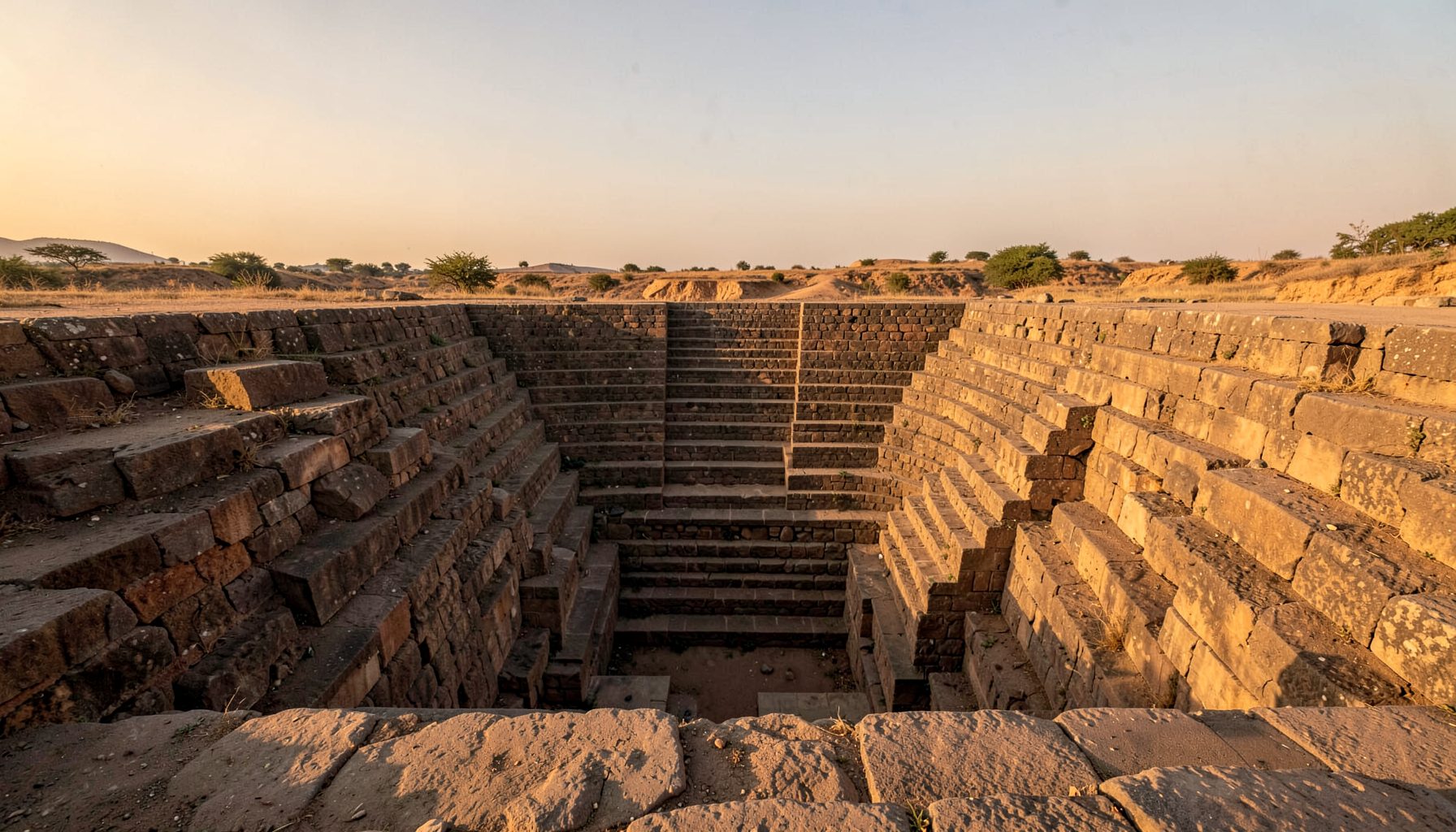
Stepwells turned groundwater into stepped public landscapes. Across arid and semi-arid India, baolis, bawdis, vavs, kunds and baravs gathered seasonal runoff in underground tanks, creating places for water access, gathering and ritual. Their architecture joined climate adaptation with sacred geography, often linking wells to temples, monasteries, markets and travel routes.
Jain monastic communities belonged to this water-rich yet resource-sensitive world. Ascetic teachers, sannyasins, lay devotees and donors established maths or upashrayas and supported works that served resident monks and travellers. Their relationship with stepwells was meaningful, but not exclusive: many wells were shared by people of several faiths and later changed hands.
Water carries special significance in Jain ethics, where ahimsa extends to care for minute life and cleanliness supports disciplined living. Yet a historical Jain connection must be demonstrated, not assumed. Inscriptions, images, architecture, local testimony and patterns of access need to converge before a well is described as belonging to a Jain community.
For Australian readers, this history offers a way into familiar debates about drought, ageing infrastructure, heritage plumbing and public water use. Similarities can sharpen questions about preservation without making Australian experience a substitute for Indian evidence. The strongest approach remains observational: document architecture and water, listen to custodians, and test every attribution against its physical setting.
Monastic life and reliable water
Jain ascetics often organised life around a matha, a monastery, or a travelling sangha. A dependable water source supported resident monks, workers and visitors, and enabled drinking, washing, food preparation and hospitality. Monastic settlements therefore treated wells as practical infrastructure rather than decorative scenery: without reliable access, neither regular discipline nor care for guests could continue.
That dependence also had a religious dimension. Jain practice gives priority to ahimsa and bodily discipline, making the careful use of water a moral concern. Monastic rules for bathing, foot washing and drawing water make access arrangements especially revealing. Historians examine whether a well had separate draw points, whether users entered the tank, and whether a monastic kitchen, shrine or boundary controlled access. Such details can reveal whether a structure served a sangha, a neighbourhood or both.
Architecture that records sacred use
Architectural surveys should record more than a tank's profile. The relation of a baoli to a Jain temple, upashraya, shrine or pilgrim route can be as informative as its depth. Stairs, columns, landings and lifting points show how people moved towards the source, while photographs of shade, ventilation and current access reveal whether a stepwell remains a functioning commons rather than an isolated monument.
Inscriptions and images require equal caution. A tirthankara figure, tirtha chakra or nandavarta can point towards a Jain association, but religious emblems were sometimes borrowed, reused or placed beside images of other deities. A comparison with wheat-sheaf memorial symbolism is instructive: a simple harvested motif acquires meaning through repeated communal use. The same logic applies to water architecture, where a familiar basin or step may acquire a Jain history that the masonry alone cannot prove.
Wells, routes and the edge of town
A useful account of stepwells outside city walls explains how access, flooding, waste management and travellers shaped their location. A well beside a road or settlement edge could be more useful than one confined within fortifications. This mattered to ascetics whose journeys followed trade routes, pilgrimage paths and wooded corridors.
The wall, however, was not a hard cultural divide. A monastic well might stand beyond it yet remain tied to a nearby matha, while a well inside could serve a mixed sacred quarter. In Maharashtra, mapping those relationships is especially valuable: a baoli beside a shrine should not be labelled Jain solely because it is religious, nor overlooked because it lies beyond the historic core.
Deccan stone and changing patronage
Research on Deccani stepwell architecture shows how deeply water structures belonged to the cultural fabric of the Deccan. Carved corridors, stone steps and sheltered platforms turned access into a layered social experience, while inscriptions connected individual patrons to rulers, holy places and public works. The broader architecture supplies context for tracing Jain communities without serving as proof of their authorship.
Deccan cities housed Jain merchant and monastic networks alongside Hindu, Muslim and other communities. A stepwell's elegance does not establish Jain patronage, but proximity to a Jain institution, a donor inscription or a route used by sadhus can make an association plausible. Documentation of Maharashtra's baolis, vavs, kunds and baravs should record such networks without turning every shared source into an exclusive Jain relic.
Clues for a Jain association
Attribution requires converging evidence gathered slowly. A field notebook should preserve exact wording, location and uncertainty, separating what is visible from what is inferred.
- Inscriptions should be copied verbatim, including donor names, titles, dates and references to a matha, sangha or monastic teacher.
- Iconography should be sketched in context, showing Jain symbols alongside neighbouring deities because shared shrines and later reuse can blur sectarian boundaries.
- Spatial setting should be mapped against temples, ascetic shelters, courtyards, roads and settlement limits, with a clear date for each feature.
- Water access should be recorded, including steps, platforms, chains, pumps and restrictions on entry, because physical access may reveal the intended community.
- Oral history should capture the words of residents and Jain organisations about names, rituals, repairs and changes in water supply, with consent.
One completed dossier still demands caution. A Jain name may identify a donor rather than the builder; a tirthankara image may have been added later; and a well may have shifted from monastic to municipal or domestic use. Labels such as Jain stepwell should explain their basis and remain open to revision.
Australian parallels for water stewardship
Australian cities offer useful, if imperfect, parallels. Sydney and Melbourne have faced severe drought, water restrictions, rain tanks and recycled-water networks, while shorter showers and dual-flush toilets have become ordinary household habits. Melbourne's old commercial buildings and Sydney's expanding suburbs also place heritage plumbing and water systems within familiar planning debates.
The bathroom market makes water visible in another way. Australian retailers offer stone basins, brass taps and fittings inspired by South Asian craft, and coverage of Australian tapware design shows how these objects move between showrooms, renovations and online marketplaces. This setting raises questions about how imported heritage styles are sourced, represented and adapted for local homes.
- Climate and supply: water-saving stages, garden restrictions and pressure-management rules in Sydney, Melbourne, Adelaide and Perth show the political importance of every source.
- Daily practice: rain tanks, greywater systems and efficient appliances are sold as normal household upgrades, not merely emergency infrastructure.
- Local trade: plumbing merchants, bathroom showrooms and online sellers stock basins and fittings for new homes and heritage-inspired renovations.
- Regulation: installations must comply with AS/NZS 3500 and relevant state plumbing codes, with local rules on backflow prevention, drainage, tanks and approvals.
- Heritage protection: state heritage laws and council planning processes affect alterations, demonstrating why accurate baseline records matter before repairs.
These parallels should sharpen, not distort, attention to India. Stepwells remain distinct responses to their own geology, rainfall, settlement patterns and faiths. Australian experience can inform documentation, water scarcity and community stewardship, but it cannot replace Jain history or the testimony of people living beside an Indian well.
From shared source to shared stewardship
Preservation works best when a well remains useful and legible. Dry tanks, damaged stairs, altered access and declining groundwater can erase relationships that once connected a monastic settlement with its water source. Conservation therefore needs more than picturesque photography: hydrology, masonry, ritual use and local memory belong in the same record.
Jain communities can be partners in this work, not merely a source of historical associations. Monastic authorities, lay organisations, residents, municipal engineers and heritage specialists each hold different evidence. Recording shared custodianship acknowledges that a structure may have moved through devotional, domestic and civic phases without losing every earlier meaning.
Field photographs and measured sketches preserve what is disappearing, while careful captions prevent a site's history from being reduced to visual appeal. By tracing water access, patronage and changing use, independent archives keep the record open. A complete account of an ascetic water source is itself a form of protection for the place and the knowledge held around it.
Get in Touch
Have information about a stepwell that is not yet on our map? We would be glad to document it and give you full credit. Whether it is a Barav, Kund, Vihir, or any other form of stepwell, every contribution helps preserve India's water heritage.
Call or message us with details about the location, and we will follow up.
#9372496819
Send a Message
What People Say
"The Maharashtra Stepwells campaign has brought attention to structures that were nearly forgotten. The architectural documentation and drone photography are invaluable resources for researchers and students alike."
"Collaborating with the Indian Stepwells team gave our architecture students hands-on exposure to traditional water-harvesting structures. The presentations were insightful and inspiring."
"I shared details of a stepwell near my village that was not on any map. The team visited, documented it beautifully, and credited me. It felt wonderful to contribute."