 Explore Maharashtra
A stepwell with a garden on top: rooftop greenery in baolis
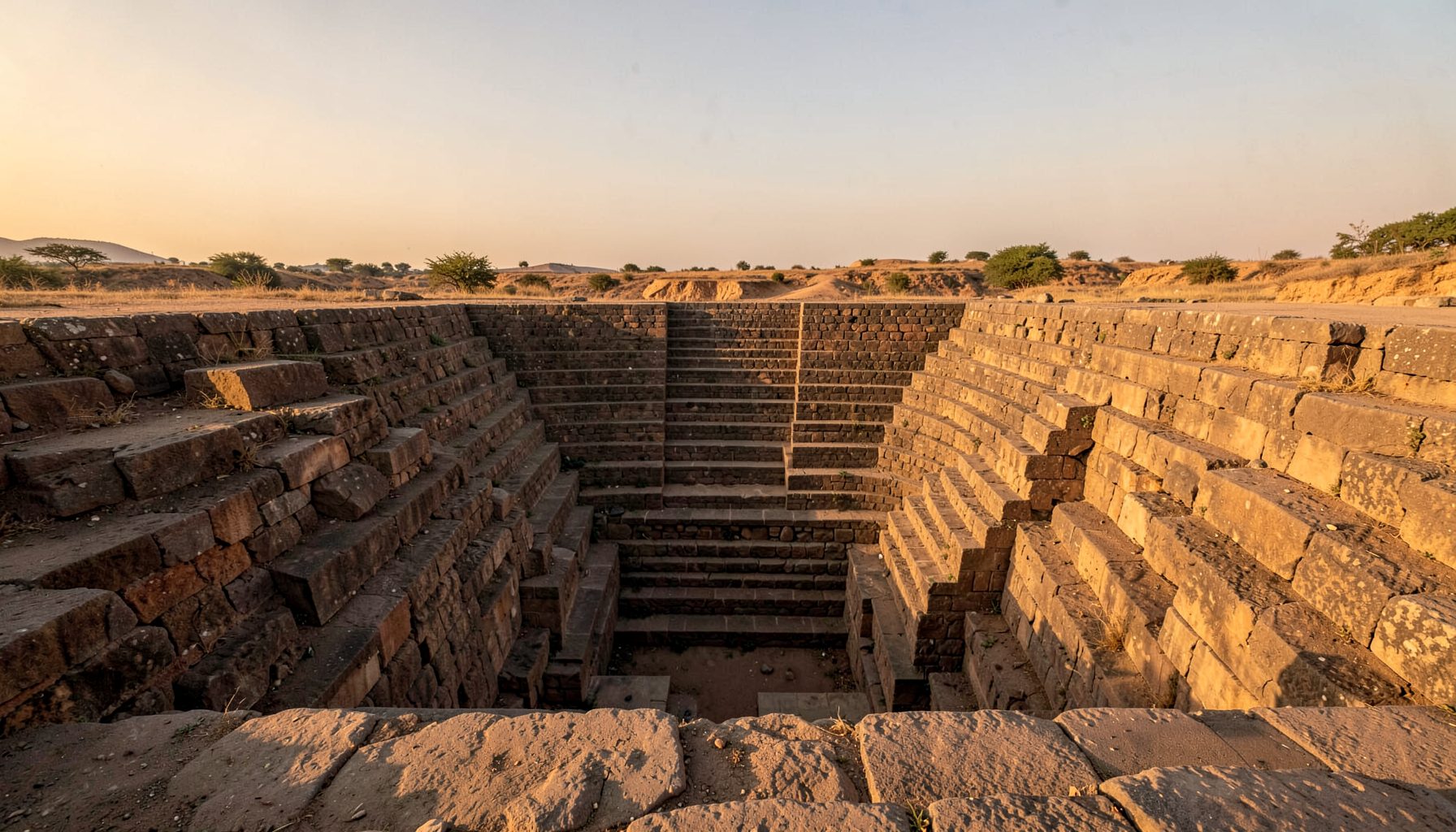
A planted stepwell sits at the meeting point of water engineering and living architecture. In many baolis, the visible entrance leads downwards through stone steps to a cool reservoir, while the surface above the well may hold trees, groundcovers or a cultivated terrace. The result rewards close observation rather than a quick photograph.
Baoli, bawdi, vav, kund and barav are regional names for related forms of groundwater and monsoon-water architecture. Their steps provide access for drawing water, lifting buckets and resting during heat. A planted roof can shade the upper structure, slow rainwater and create habitat, adding a living layer to an often subterranean civic space.
These features connect architecture to ecology and public life. Original photography, measured sketches and carefully planned drone imagery can reveal catchment channels, overflow outlets, silt traps, stone joints, shade and vegetation. Yet greenery can conceal structural decay, so recording what grows above a baoli must be paired with careful knowledge of what happens below it.
For an Australian audience, the comparison with rooftop gardens and drought-aware landscaping is useful, but it needs care. Melbourne and Sydney offer lessons in conserving water through dense cities; they also show the limits of borrowing an old form without its climate, craft and community context. The baoli remains primarily a water and heritage system.
Water architecture and planted roofs
The type begins with its anatomy. Most stepwells combine a vertical or terraced well with flights of stone steps descending to the water. Pillars, colonnades and recessed landings make a cool passage between street and reservoir. At the upper level, a roofed gallery or planted terrace may span only part of the structure, leaving a substantial void beneath.
A rooftop garden is therefore more than a decorative cap. Foliage can shade the entrance, slow small rain events and create habitat for birds and insects. Seasonal leaf cover also acts as a barometer: unusual wilting or vigorous growth may point to changed drainage, irrigation or neglect around historic masonry.
New planting requires measured intervention. Heavy wet soil can overload old vaults; roots can open joints; irrigation can raise humidity against vulnerable stone. A structural survey, water-quality assessment and root-management plan should precede landscape work. Reversible containers, shallow beds and locally suitable species offer a cautious approach.
Maharashtra's baoli landscapes
Maharashtra gives the idea a varied setting. Across the Deccan, seasonal streams, hard basalt and long hot periods shaped wells, tanks and stepwells used for storage, percolation and livestock. Forms differ by district, from masonry vavs to open kunds and deep baolis reached by narrow stairs.
A wider comparison appears in a Delhi baoli field report, which describes abandoned and reused sites where sediment, encroachment and missing stone affect access and hydrology. Its account helps frame Maharashtra without assuming that every neglected-looking monument has the same history or restoration needs.
Fieldwork at each site should map roof levels, water access, vegetation and present-day use before a garden is called original or recent. Interviews with residents can reveal former washing places, festival routes and informal paths. Indian Stepwells’ Maharashtra research can combine such testimony with measured records, photographs and sketches, preserving evidence that may be absent from official inventories.
Water, faith, and shared ritual
An overview of stepwells in folk traditions shows how reservoirs supported community life through associations with temples, saints, animal care and seasonal rites. People met while drawing water, and local customs shaped access patterns and upkeep. These social uses belong beside the technical story of catchment, shade and conservation.
A planted upper terrace can reinforce that relationship when it provides shade, seating or a route to a shrine without blocking the working well. Fragrant plants and flowers may also carry symbolic associations. Interpretation should identify the site's particular customs rather than attach a generic ritual label to every baoli.
Community participation also affects conservation priorities. Local users may value a place for gathering, passage or worship before they value it as a picturesque ruin. Documenting those priorities can guide maintenance schedules and prevent restoration from removing the everyday life that gives a monument its character.
Lessons from Australian cities
Australian cities provide a practical comparison. Melbourne's expanding suburbs and Sydney's large catchments face hot summers, episodic drought and intense rain, pressures that make stored monsoon water compelling in India. Rainfall timing, soils and governance differ, however, so a baoli cannot be treated as an oversized rain tank.
Everyday habits are already changing. Across Australia, residents water gardens early, fit shower timers, collect roof runoff in tanks and follow municipal restrictions during dry periods. These habits demonstrate how water awareness enters ordinary homes. A baoli offers a more communal and seasonal model, linking a daily chore to a shared public work.
The local market reflects this shift. Garden centres and nurseries stock drought-tolerant shrubs, drip-irrigation parts and recycled planters, while hardware stores sell water-saving fittings for bathrooms. Rooftop-garden kits now sit beside ordinary garden materials, showing how environmental ideas travel through familiar retail channels rather than as specialist conservation technology.
Regulation adds another local reality. Victoria's Water Act 1989 governs entitlements and restrictions, while the Planning and Environment Act 1987 and local heritage overlays influence what owners may build or alter. In NSW, the Water Act 1914, Sydney Water's operating rules and BASIX water-saving requirements affect new work and household use. A heritage rooftop garden would sit within several overlapping systems.
Conservation before beautification
For a baoli, conservation must begin with water rather than the garden. A restoration team needs to understand seasonal recharge, overflow routes, sediment movement and the condition of vaults before choosing plants. Decoration that conceals leakage or changes runoff can turn an education project into a source of damage.
Climate change sharpens this need. More erratic downpours can wash soil from upper terraces, while longer dry spells increase irrigation and stress planted areas. Salt accumulation, biological growth and temperature changes can all accelerate decay. Climate data should inform the planting palette and the monitoring schedule, not simply dictate a picturesque appearance.
Long-term care also needs names and budgets. Municipal teams, local craftspeople and nearby residents can share knowledge of masonry repairs, safe access and seasonal use. A simple log of moisture, plant health and drainage conditions often reveals more than an occasional grand inspection. Maintenance turns preservation into a continuing relationship with the site.
Seeing the garden and the water
Photography can make the two layers of a planted stepwell legible. A frontal view records the garden as a roof; an elevation or sectional sketch reveals the reservoir below; a carefully authorised drone view can clarify channels and roof geometry. Together, these images resist the common confusion between an open tank and a covered baoli.
This approach also applies to public interpretation, as a heritage storytelling platform can pair archival images with oral histories, conservation drawings and short community accounts. Digital stories extend an exhibition beyond the site and allow visitors to understand water use before seeing the architecture. Context matters more than dramatic imagery alone.
Image-making carries obligations around access, safety and authorship. Drone flights over monuments require permissions and should avoid disturbing worshippers or wildlife. Photographs should be credited, and residents should decide how sensitive histories are shared. A responsible visual record can support advocacy while keeping the community in control of its story.
A durable future for planted stepwells
A workable future begins with selective pilots rather than landscaping every known baoli. A small group with sound structures, clear ownership and a strong community connection can test planting methods, irrigation controls and interpretive signs. Monitoring should compare planted and unplanted roofs, recording heat, moisture, runoff and plant survival over several seasons.
Where public access permits, exhibitions and guided walks can explain the baoli as infrastructure, habitat and community space. Neighbouring schools, garden clubs and heritage groups can contribute observations without turning the site into a theme park. Residents' reports of undocumented structures can also begin careful research files, preserving local knowledge before a site is altered or lost.
The most convincing green baoli will not hide the water it protects. It will reveal the clever relationship between a shaded threshold, a working reservoir and a cultivated surface above. Preserving that relationship gives rooftop greenery a deeper meaning: a contemporary layer built on centuries of careful responses to heat, scarcity and collective need.
Get in Touch
Have information about a stepwell that is not yet on our map? We would be glad to document it and give you full credit. Whether it is a Barav, Kund, Vihir, or any other form of stepwell, every contribution helps preserve India's water heritage.
Call or message us with details about the location, and we will follow up.
#9372496819
Send a Message
What People Say
"The Maharashtra Stepwells campaign has brought attention to structures that were nearly forgotten. The architectural documentation and drone photography are invaluable resources for researchers and students alike."
"Collaborating with the Indian Stepwells team gave our architecture students hands-on exposure to traditional water-harvesting structures. The presentations were insightful and inspiring."
"I shared details of a stepwell near my village that was not on any map. The team visited, documented it beautifully, and credited me. It felt wonderful to contribute."