 Explore Maharashtra
From stepwell to sacred ground
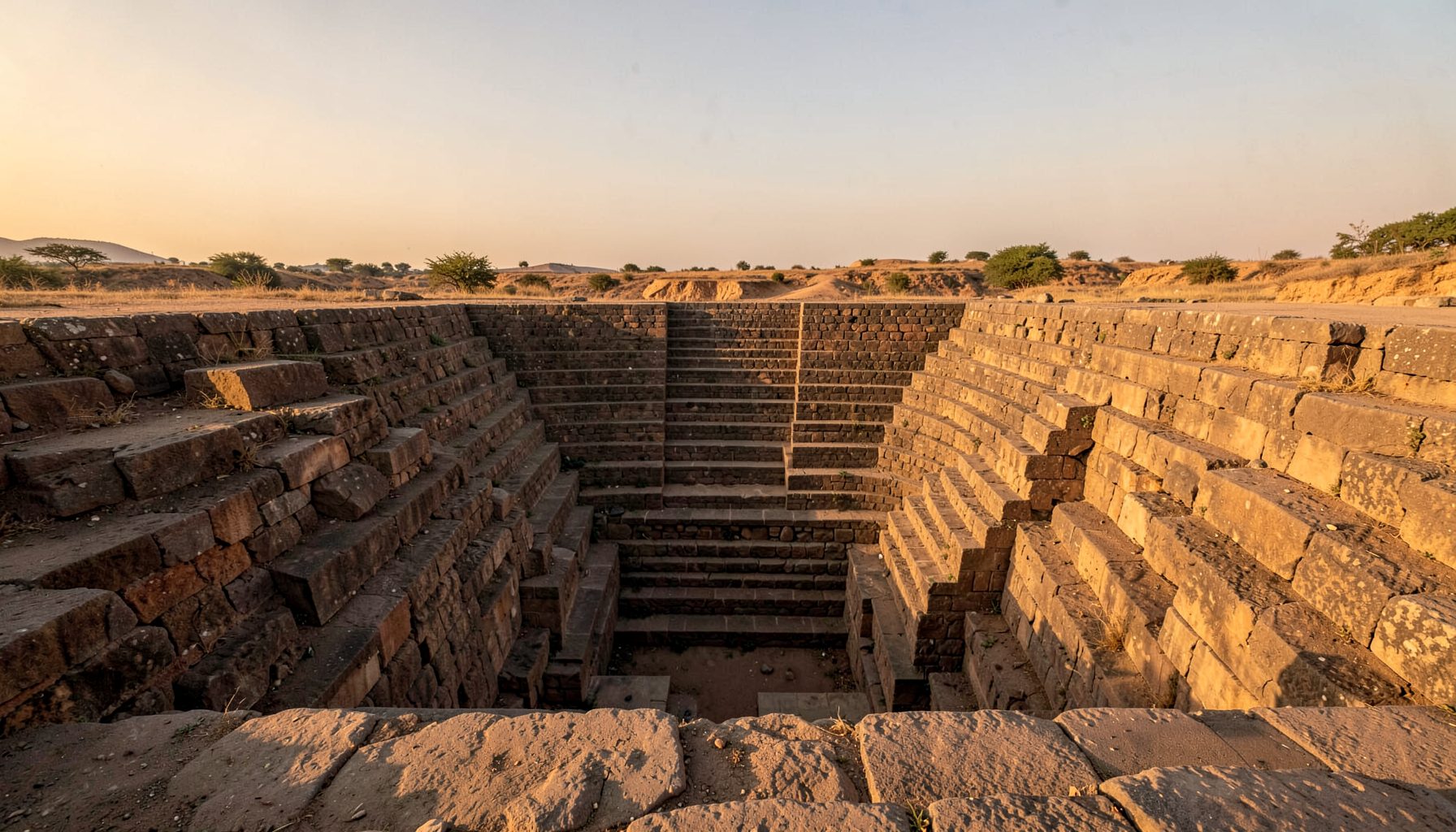
At the hottest hour of a Maharashtrian summer, the descent into a stepwell can feel like entering another climate. Stone steps darken below the rim, air cools near the water, and a city’s traffic recedes. These structures are often introduced as architectural wonders, but their first achievement was practical: keeping water available through a long dry season. Their sculptural form grew from that purpose, not from a wish to create a monument.
Across India, the same basic idea appears under names such as bawdi, baoli, vav, kund and barav. Builders cut descending flights into wells, terraces, reservoirs and sometimes subterranean galleries so that groundwater could be reached and seasonal rain could be stored. A stepwell was therefore a water system, a workplace and a public threshold. The way its architecture guided people toward the water explains why it could later gather religious and social meanings.
A stepwell’s journey from functional to sacred was rarely a clean break. A temple might overlook a reservoir; a procession might use its steps; local custom might regulate drawing water. Worship could add a shrine, restriction or an annual observance without erasing the structure’s daily role. Sacred meaning accumulated around a working system, turning water management into a shared sacred geography.
That layered history is the focus of Indian Stepwells, where original photography, architectural sketches, drone imagery and field research document surviving sites, especially in Maharashtra. This record matters because a stepwell cannot be understood from a façade alone, nor saved by appearance alone. Conservation must account for water, masonry, community memory and present-day access. The story also carries a lesson for Australia, where heat, drought and concern over household water use make old water-saving ideas newly visible.
Engineering a relationship with rain
Monsoon rainfall made design essential, but reliability depended on more than catching a downpour. Wells were positioned to meet groundwater, while terraces and storage tanks managed variable inflows. Builders also had to shape steps for safe ascent and descent as water levels changed. The apparent ornament of pillars, niches and repeated flights often encodes those practical decisions.
These structures also had to survive movement of the ground beneath them. The account of seismic resilience in stepwells shows how careful geometry, masonry bonding and the stepped form can help a structure absorb and redistribute stress. That does not turn a historic stepwell into a modern earthquake certificate; it shows that resilience was part of the architectural vocabulary from the beginning.
Function continued after construction. People drew water, waited out heat, rested, exchanged news and performed small acts of devotion. The architecture coordinated these uses without separating engineering from ritual. This is why a dry basin can remain culturally active: the sacred associations may outlast the precise task for which a particular flight of steps was built.
How sacred meaning entered the water
Sacredness often arrived through proximity. A temple tank, shrine or pilgrimage route could draw a stepwell into a wider sacred landscape. In some places, a naga image, deity figure or decorated platform made the reservoir a focus of worship; in others, reverence was carried by custom rather than an obvious icon. Water’s purity and life-giving force gave these associations a natural logic.
Changing this relationship could also change who could use the site. Rules about ritual priority, gender, caste or access to the water have affected stepwells in different periods and regions. Any account of spiritual elevation needs to ask whose access was widened, whose use was constrained and whether ordinary water collection continued. Reverence and exclusion can occupy the same staircase.
The richest interpretation therefore treats the stepwell as a living institution rather than a finished relic. A repaired flight, a newer shrine or a contested access point can reveal more than a stylistic survey. Field observation, oral testimony and records of changing water levels help reveal when use shifted from necessity to observance, and when the two continued together.
Famine, refuge and the ethics of heritage
Stepwells also entered the history of hardship. Their cool spaces and available water made them places of refuge during scarcity, as discussed in the history of refuge during famine. Accounts of stepwells serving as refugee shelters during famines complicate images of these sites as secluded retreats. A reservoir could be both sanctuary and crowded survival infrastructure.
That dual role raises a present-day ethical question: who has the right to claim a monument as heritage when nearby communities still need its water or shelter? Conservation that removes everyday uses may protect stone while severing meaning. Conversely, unrestricted access can damage steps, water quality and fragile surfaces. Good documentation records both values and helps communities negotiate practical limits without dismissing either.
Fieldwork across the Maharashtra landscape
Documenting this complexity begins with close observation. A photographer records the angle of a shadow on worn steps; a sketch clarifies a vaulted gallery; drone imagery places the structure within a settlement or floodplain. Each method answers different questions, and none replaces local knowledge. The ongoing Maharashtra campaign combines visual evidence with reporting from communities to locate and understand little-known sites.
Community participation is essential because official maps and historical texts rarely capture every baoli or bawdi. Residents may know a seasonal path, a vanished shrine or a well no longer visible in satellite imagery. They may also know which steps are unstable, which stones still hold water and when festivals draw people. Such knowledge can guide research priorities and prevent restoration from becoming an exercise in imposing a single historical narrative.
Photography is powerful because it attracts attention, yet photographs must not freeze a stepwell into an unchanging image. A dry-season portrait and a monsoon view may show entirely different relationships between water and architecture. Campaigns should document changing conditions, explain access restrictions and make consultation visible. Original records can then support exhibitions, education and locally appropriate preservation instead of simply producing picturesque images for a distant audience.
Lessons for a hotter Australian context
Australian readers encounter the familiar pressures of hotter summers, longer dry spells and scrutiny of household water consumption. Sydney’s sandstone garden settings, Melbourne’s drought-aware gardening culture and Adelaide’s intense summer heat offer different starting points. Even Brisbane, with its subtropical rainfall, experiences dry periods and storm runoff that challenge stormwater control. The visual perspective of Sud in Europa offers another way to approach such sites: not as isolated objects, but as parts of lived landscapes.
The local market already offers Australian households rain tanks, water gardens, mulch, shade cloth and drought-tolerant planting. Stepwell thinking adds depth rather than a ready-made product. The relevant questions are how a place catches rain, how water moves safely, who maintains the system and how people encounter it. Public art, school projects and neighbourhood walks can make invisible water cycles tangible without reconstructing a historic form in an inappropriate setting.
Australian adaptation should therefore borrow principles, not superficial motifs. An old stepwell’s steps, symmetry and temple-like ornament may look striking, but they answer particular climate, groundwater and social conditions. The better transfer is a process: observe water, consult users, test restoration ideas and plan for maintenance. In this way, heritage becomes a practical civic resource as well as an object of contemplation.
Useful parallels for Australian communities
- Use summer heat as a design prompt for shaded, accessible public space, as in Adelaide and inland Australian towns.
- Treat rain capture as part of the whole landscape, complementing tanks and waterwise gardens common in Melbourne and Sydney.
- Record local memory alongside photographs, echoing community-led documentation of Maharashtra’s stepwells.
- Make water visible in exhibitions and schools without turning heritage sites into theme-park replicas.
Limits on direct comparison
- Stepwells rely on groundwater geology, monsoon patterns and long-established water rights that differ from Australian conditions.
- Sacred restrictions may carry caste and gender histories that should be interpreted, not exported as atmosphere.
- Drought does not automatically erase a site’s practical use or justify removing community access.
- Digital imagery can identify sites, yet it cannot substitute for field observation and local consultation.
Get in Touch
Have information about a stepwell that is not yet on our map? We would be glad to document it and give you full credit. Whether it is a Barav, Kund, Vihir, or any other form of stepwell, every contribution helps preserve India's water heritage.
Call or message us with details about the location, and we will follow up.
#9372496819
Send a Message
What People Say
"The Maharashtra Stepwells campaign has brought attention to structures that were nearly forgotten. The architectural documentation and drone photography are invaluable resources for researchers and students alike."
"Collaborating with the Indian Stepwells team gave our architecture students hands-on exposure to traditional water-harvesting structures. The presentations were insightful and inspiring."
"I shared details of a stepwell near my village that was not on any map. The team visited, documented it beautifully, and credited me. It felt wonderful to contribute."