 Explore Maharashtra
Stepwells as refugee shelters during India's historic famines
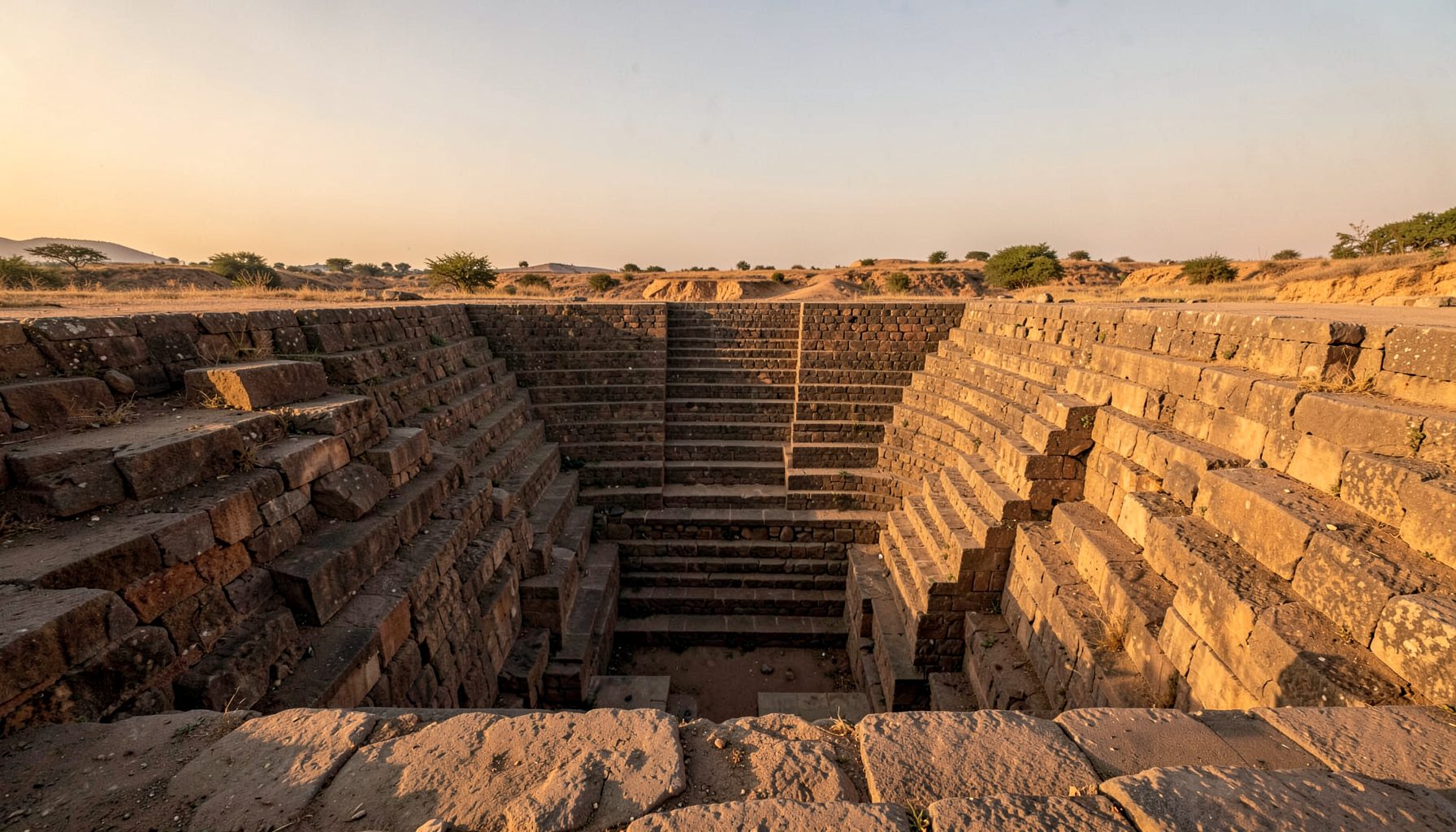
Below the sun-baked plains of western and central India lies a network of subterranean monuments that sustained civilisation for nearly a millennium. Stepwells, known regionally as baolis, vavs, kunds, bawdis, and baravs, have long been celebrated for their hydraulic ingenuity, yet their quieter role as sanctuaries during periods of mass starvation deserves equal attention.
Travellers' accounts, district gazetteers, and local oral traditions recorded in heritage archives describe how these multi-storeyed structures absorbed entire communities when crops failed and village ponds dried. The deeper pavilions offered shade when above-ground life became unbearable, and the surrounding courts served as informal relief distribution points.
For modern readers, particularly in Australia where drought cycles and water allocation policy are live political questions, the Indian precedent offers a humbling template of how vernacular architecture doubled as survival infrastructure.
Architecture that welcomed the displaced
The genius of a stepwell lies in its vertical layering. Staircases descend through a series of pavilions, each one sheltered from the sun, creating a stack of cool chambers that could accommodate dozens, sometimes hundreds, of people. During the great famines of the nineteenth century, villagers from surrounding districts walked for days to reach the nearest reliable vav, knowing that even if the well shaft had dropped low, the surrounding galleries would still provide shade, drinking water from adjacent cisterns, and a defensible position against bandits.
Carved pillars, bracket figures, and corbelled brackets often delineated small niches where families could settle for weeks. Local records from northern Maharashtra describe how Adivasi and Dhangar communities used these ledges as temporary hearths, cooking sparse millet on portable griddles while waiting for the next rains.
The deeper a family could climb down, the more stable the temperature. The most elaborate stepwells maintained a constant fifteen to twenty degrees Celsius even when outside temperatures exceeded forty-five. This thermal stability, combined with reliable access to groundwater seeping through sandstone strata, made the structures uniquely suited to prolonged refuge.
Famine chronicles in the districts
British-era administrative reports from the Bombay Deccan, Berar, and Rajputana repeatedly mention stepwells in the same breath as relief camps. The Ahmadabad district gazetteer of 1879, for instance, notes that during the preceding scarcity, the vavs of Adalaj and Dada Hari gave shelter to upwards of three hundred persons nightly for several months. Similar language appears in the Jaipur settlement reports, where the covered kunds of Amber are described as havens for women and children fleeing the countryside.
The field notes gathered through the Maharashtra campaign include interviews with elderly residents of Solapur and Osmanabad districts, both of whom recalled family stories of grandmothers taking shelter in the local vav during the 1899-1900 famine. These testimonies align with a broader pattern: wherever a stepwell existed, it functioned as a kind of informal community hall, and during crises, that civic function intensified.
The food itself was rarely stored in the well, but the structure served as a gathering point where grain carts could unload, where colonial relief officers could distribute chapatis, and where families could wait for the next monsoon. In this way, the stepwell became a node in a survival network rather than a solitary monument.
Echoes in Australian conversations about heritage and drought
Australian audiences may find this history less foreign than expected. Cities such as Adelaide and Perth have experienced severe water stress within living memory, and the Murray-Darling Basin Plan remains one of the country's most contested pieces of legislation, governing how water is shared between New South Wales, Victoria, South Australia, and Queensland. Heritage architects in Melbourne and Sydney have begun drawing explicit comparisons between Indian stepwell design and Aboriginal water-holes, which similarly combined practical access with social gathering space.
Australian universities, including the University of Sydney and the Australian National University in Canberra, now offer coursework on comparative water heritage. Travellers visiting Rajasthan frequently write of the visual shock of descending three storeys into cool air, an experience that resonates with Aboriginal guides' descriptions of walking into a deep rockhole.
The same instinct that drew famished Indian villagers into a vav operates wherever a culture must adapt to an arid continent. In Perth, where household rainwater tanks became mandatory under local building code amendments in the mid-2000s, similar logic drove medieval Indian builders to capture and store every drop of monsoon runoff. Recognising this shared logic strengthens the case for documenting Indian structures before further encroachment claims them.
Why the refuge function faded
Several factors eroded the stepwell's role as a refuge across the twentieth century. The spread of piped municipal water, particularly after Independence, reduced dependence on groundwater sources. Concurrently, many wells were filled in or fenced off due to safety concerns, with local councils citing drowning risks and liability under newly framed public works regulations.
Religious and ritual use also declined as pilgrimage patterns shifted toward temple complexes with their own lodging. A vav that once hosted wedding processions, devotional singing, and seasonal fairs gradually became a curiosity rather than a living space. Younger generations stopped gathering at the well, and the social muscle that had supported famine refuge atrophied.
The loss is not merely architectural. When a community no longer gathers at its well, the layered memory of how previous generations survived scarcity fades as well. Heritage researchers connected to the about page of the Indian Stepwells project have emphasised this intangible dimension, arguing that conservation must include the oral histories attached to each structure.
What modern communities can learn
A stepwell designed for refuge is a piece of climate-adaptive infrastructure. Its passive cooling, social geometry, and hydraulic resilience embody principles that contemporary architects in water-stressed regions are only beginning to rediscover. In Perth, where household rainwater tanks became mandatory under local building code amendments in the mid-2000s, similar logic drove medieval Indian builders to capture and store every drop of monsoon runoff.
Visitors to the surviving vavs of Maharashtra often note how the dim interior spaces feel almost womb-like, a deliberate sensory experience that helped displaced people recover from the shock of loss. Contemporary refugee shelter design increasingly draws on this kind of environmental psychology, recognising that a safe space must also feel restorative.
Scholars tracing how ancient built environments sheltered the dispossessed can find relevant parallels in monastic settlement studies such as St Kevin's at Glendalough, where Irish round towers and early Christian sites preserved their own traditions of refuge. The Indian examples deserve sustained attention from field researchers, photographers, and visiting students.
Practical elements that made refuge possible
Before listing the specific design features that enabled mass refuge, it helps to remember that no single element did the work alone. The combination of factors is what gave these structures their resilience during the worst famines of the colonial era.
- Multi-level pavilions with shaded landings that could shelter entire families for weeks
- Adjacent cisterns and channels that captured monsoon runoff for year-round use
- Carved niches and ledges that functioned as informal sleeping and cooking spaces
- Deep shafts that maintained cool temperatures even during peak summer heat
- Defensible entrances, often narrow and gated, that offered protection from bandits
- Proximity to trade routes, allowing relief grain to reach displaced populations
Defining moments in the refuge tradition
Beyond physical design, the stepwell's role in famine response depended on social habits and regional governance. The following episodes, drawn from gazetteers and oral testimony, illustrate how the refuge function operated in practice.
- The 1630-32 famine in Gujarat, when Adalaj and nearby vavs hosted displaced communities from surrounding districts
- The 1899-1900 Deccan famine, documented in Bombay Presidency relief reports naming specific baolis as shelter nodes
- The 1943 Bengal crisis, when travellers' diaries mention the contrast between dry rural conditions and the relative safety of covered wells en route
- Recurring nineteenth-century scarcities in Rajputana, where royal kunds were opened to commoners by proclamation
- Community-led grain storage traditions in western Maharashtra, where selected vavs served as emergency depots alongside their refuge role
Get in Touch
Have information about a stepwell that is not yet on our map? We would be glad to document it and give you full credit. Whether it is a Barav, Kund, Vihir, or any other form of stepwell, every contribution helps preserve India's water heritage.
Call or message us with details about the location, and we will follow up.
#9372496819
Send a Message
What People Say
"The Maharashtra Stepwells campaign has brought attention to structures that were nearly forgotten. The architectural documentation and drone photography are invaluable resources for researchers and students alike."
"Collaborating with the Indian Stepwells team gave our architecture students hands-on exposure to traditional water-harvesting structures. The presentations were insightful and inspiring."
"I shared details of a stepwell near my village that was not on any map. The team visited, documented it beautifully, and credited me. It felt wonderful to contribute."