 Explore Maharashtra
Stepwells of the Deccan Plateau: A comparative study with North India
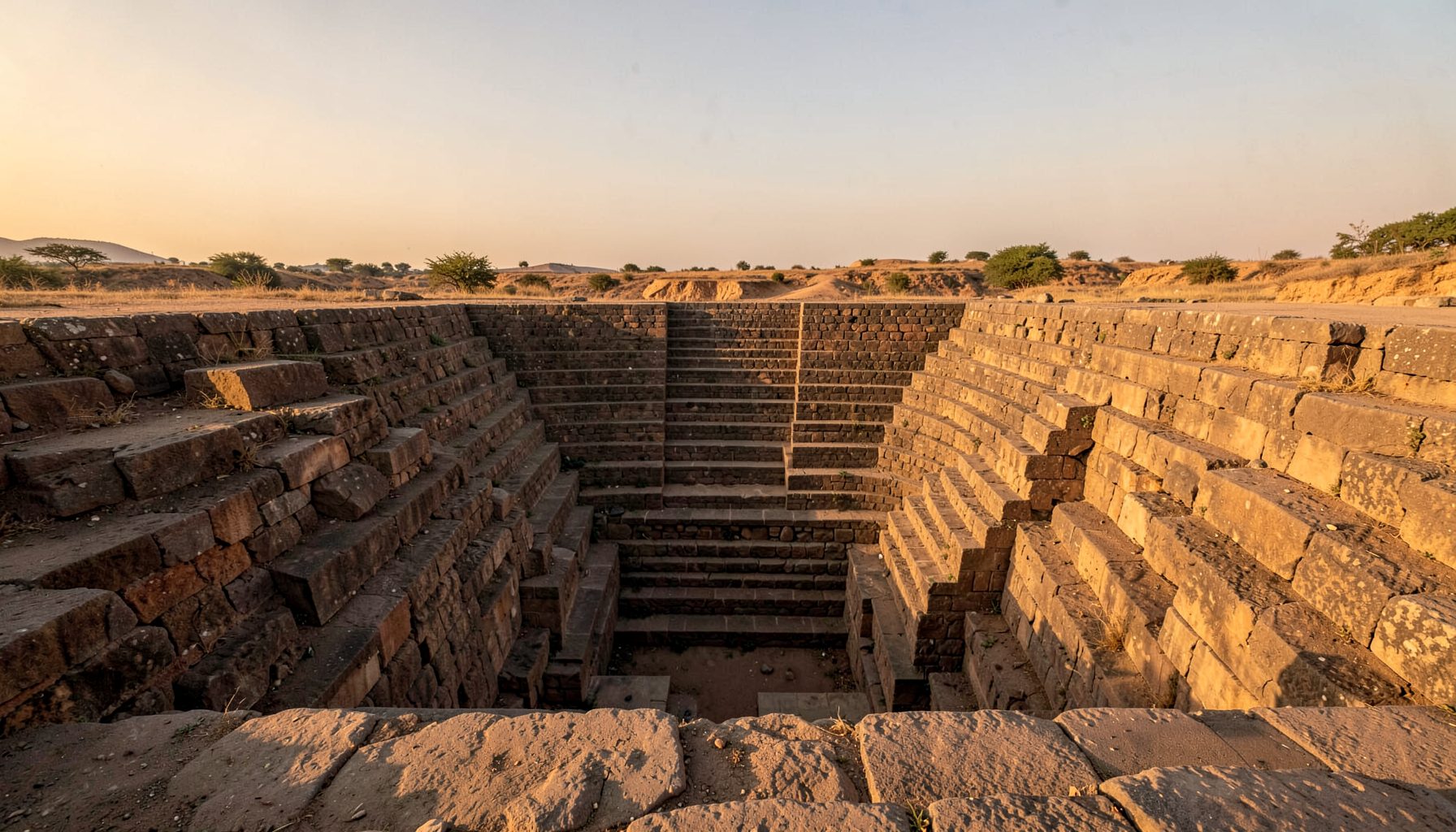
Stepwells are among India’s most atmospheric waterworks: reservoirs cut below ground and reached by flights of steps, galleries and sometimes roofed pavilions. Deccan examples are called vavs, kunds, baolis and baravs; northern India uses baolis, baoris, bawdis and kunds as well. The overlapping names signal a common hydraulic purpose, while their forms record different rain, geology, patrons and routines.
A comparison must therefore look at more than visual similarity. It should ask how each structure gathered water, who could descend to it, how sediment and groundwater affected it, and why later generations valued it. Australian readers have useful reference points in rain tanks, public baths and swimming holes, but those familiar forms should open inquiry rather than flatten distinct Indian histories.
Water before the pipe
The basic sequence begins with a catchment: rain runoff enters a masonry or excavated reservoir, where some water is stored for dry months and some infiltrates toward groundwater. Steps make the remaining water reachable. The proportions vary, so a reservoir designed chiefly for percolation should not be described as a large domestic tank without evidence.
On the Deccan Plateau, seasonal streams, village catchments and layers of basalt shape the relationship between surface flow and groundwater. A Maharashtra vav or kund may sit within a wider tank landscape, sometimes connected to a temple or settlement. In Rajasthan and adjoining western India, sandy ground and scarce settlements make groundwater access especially prominent, producing deep stepped shafts and long galleries.
These distinctions matter in Australia too. When Melbourne restricts garden watering, residents talk about tank water and household tanks; in Adelaide, where hot, dry summers are routine, stored rain remains part of household planning. Such examples illuminate the social value of water infrastructure, although Australian drought rules and modern piped supplies operate in a different legal and social system from historic Indian reservoirs.
Regional names and shared systems
Regional names are working descriptions, not museum labels that fit neatly one to one. Vav often suggests a south-western or Deccan reservoir, kund is used across much of India, baori is common in Rajasthan, and barav and bawdi can indicate western Indian stepwell forms. Local informants may also use the name of a deity, saint or village, preserving a social history that generic terms can erase.
Form reveals another layer. Northern examples such as Chand Baori at Abhaneri and the monumental Rani ki Vav at Patan employ long sequences of steps, columns and sculptural programs. Many Deccan sites are more compact, with a stepped well head, pillared pavilion or surrounding chambers, though Maharashtra ranges from restrained utilitarian structures to highly worked monuments. Gujarat provides a bridge between the two traditions.
Neither region offers a pure type. A Deccan reservoir may have a long stepped approach, while a northern baoli may terminate in a simple shaft. Comparative drawings should therefore compare components—the reservoir profile, access stair, gallery, pavilion and water chamber—rather than treating regional names as fixed architectural categories.
Architecture, climate and material
Monsoon intensity and local stone turn climate into structure. Dark basalt gives many Deccan monuments their severe geometry, while Rajasthan and Gujarat commonly use sandstone, limestone, brick and lime mortar. Corbelled passages, thick walls and shaded platforms moderate heat. Open courts and perforated screens draw air through a well, making movement through a stepwell part of a deliberate sequence of cooling, light and revelation.
The height of each flight also records the expected water level. High steps protected supply from contamination, while lower flights offered easier access as the reservoir emptied. Carved thresholds, changes in direction and framed views of water gave dignity to ordinary acts of drawing and storage. The resulting architecture is both infrastructure and a carefully staged public landscape.
Australian heritage design offers a partial material comparison. Sydney’s sandstone buildings acquire character from local geology and long quarry traditions, while engineers and architects elsewhere debate whether repaired fabric should retain original stone. For stepwells, photographs, measured sketches and drone images can reveal comparable joints, drainage paths and later alterations without requiring visitors to enter unstable chambers.
Public life and royal display
At working water levels, a stepwell served many purposes. People fetched household water, washed vessels and cloth, cared for animals and met neighbours. Religious bathing and pilgrimage added another layer, while some structures were controlled by courts or temples. Daily use depended on labour that elite inscriptions rarely name, making access rules and spatial divisions as important as royal titles.
Northern examples make the ceremonial dimension especially visible. Pavilions above or beside the water provided a formal threshold for changing, bathing and approaching the reservoir. The Indian Stepwells account of Rajasthan bathing pavilions shows how such spaces joined utility to courtly theatre, transforming a technical waterwork into an ordered experience of privilege.
Across the Deccan, the same elements could belong to temple landscapes, forts, courtly gardens and pilgrimage routes rather than a single royal bathing tradition. Pavilion scale, guarded stairways and costly carving usually signalled authority, yet construction and upkeep depended on craft workers, water keepers and local communities. Comparing patronage therefore means asking who commanded the work, who used it and who maintained it.
Landscapes revealed through fieldwork
Stepwells are habitats as well as machines. Their damp floors, shaded niches and relatively stable temperatures support insects, reptiles, plants and bats, while openings frame sky and birds. Sediment records floods, drought and changing catchment use. A structure that appears dry in a photograph may still influence a local groundwater system or a seasonal ecology that a structural survey alone cannot capture.
This is why the current field emphasis in Maharashtra is valuable. Original photography can record surface condition and setting; architectural sketches clarify inaccessible profiles; carefully planned drone imagery can map a reservoir and its later intrusions. The same approach suits northern baolis, where archival plans often outnumber recent site records. Each image should be dated, oriented and linked to local testimony.
Australian field vocabulary offers a useful prompt for this work: a bore in inland drilling, a billabong in northern Australia, a soak in western Australia and a swimming hole are all locally specific names for relationships with water. They should not be used as exact translations of vav or baoli, but they show how precise local language can preserve water history, ownership and seasonal change.
Preservation markets and shared stewardship
Conservation problems in India include groundwater extraction, siltation, monsoon damage, encroachment and insensitive concrete repairs. Some sites remain embedded in living settlements; others stand beside roads, quarries or new construction. Restoration must address water catchment and structural movement as well as missing sculpture. A picturesque cleaned façade can conceal the very drainage defects that caused decay.
Australian heritage conservation runs through a mixed market of state and territory agencies, local councils, National Trust branches, Landcare groups, consultants, philanthropic trusts and tourism-funded projects. Heritage reports, engineering surveys and community grants are paid or commissioned services, not merely volunteer activity. That institutional mix can support sustained work, although imported policies may miss the obligations of temple trusts, village councils and residents around a well.
An Irish comparison highlights the value of ordinary cultural landscapes. The record of Rosenallis Quaker graveyard treats a meeting-house burial ground as history held in stone, memory and community association, rather than as background scenery. The transferable lesson is to document a site’s relationships and custodians before selecting a repair recipe; legal models from Ireland or Australia cannot replace Indian local knowledge.
A wider future for water heritage
A stronger comparative study would combine each structure’s architectural record with a water history. That means recording aliases in local languages, catchment conditions, flood marks, groundwater use, ownership, oral accounts and the dates of repairs. Uniform metadata can make the Deccan and northern groups searchable without flattening them, while measured sections and ecological notes would show how each design met its own climate.
Exhibitions and school programmes can translate that research for Australian visitors through photographs, tactile models and short films of monsoon water movement. Regional museums, historical societies and camera clubs already organise field outings and road trips, offering ready networks for public interpretation. The goal is not to make a stepwell look like an Australian swimming hole, but to let visitors understand why its form feels different in its own setting.
The next phase should pair archival research with community-led recording, especially for lesser-known wells and changing access routes. Exhibitions can return local findings to the towns from which they came, while public photography gives unusual structures a route into conservation campaigns. Local knowledge remains essential, and the Indian Stepwells site contact page provides a direct route for sharing place names, photographs and field observations that can support future study.
Get in Touch
Have information about a stepwell that is not yet on our map? We would be glad to document it and give you full credit. Whether it is a Barav, Kund, Vihir, or any other form of stepwell, every contribution helps preserve India's water heritage.
Call or message us with details about the location, and we will follow up.
#9372496819
Send a Message
What People Say
"The Maharashtra Stepwells campaign has brought attention to structures that were nearly forgotten. The architectural documentation and drone photography are invaluable resources for researchers and students alike."
"Collaborating with the Indian Stepwells team gave our architecture students hands-on exposure to traditional water-harvesting structures. The presentations were insightful and inspiring."
"I shared details of a stepwell near my village that was not on any map. The team visited, documented it beautifully, and credited me. It felt wonderful to contribute."