 Explore Maharashtra
Stepwells that served as royal bathing pavilions in Rajasthan
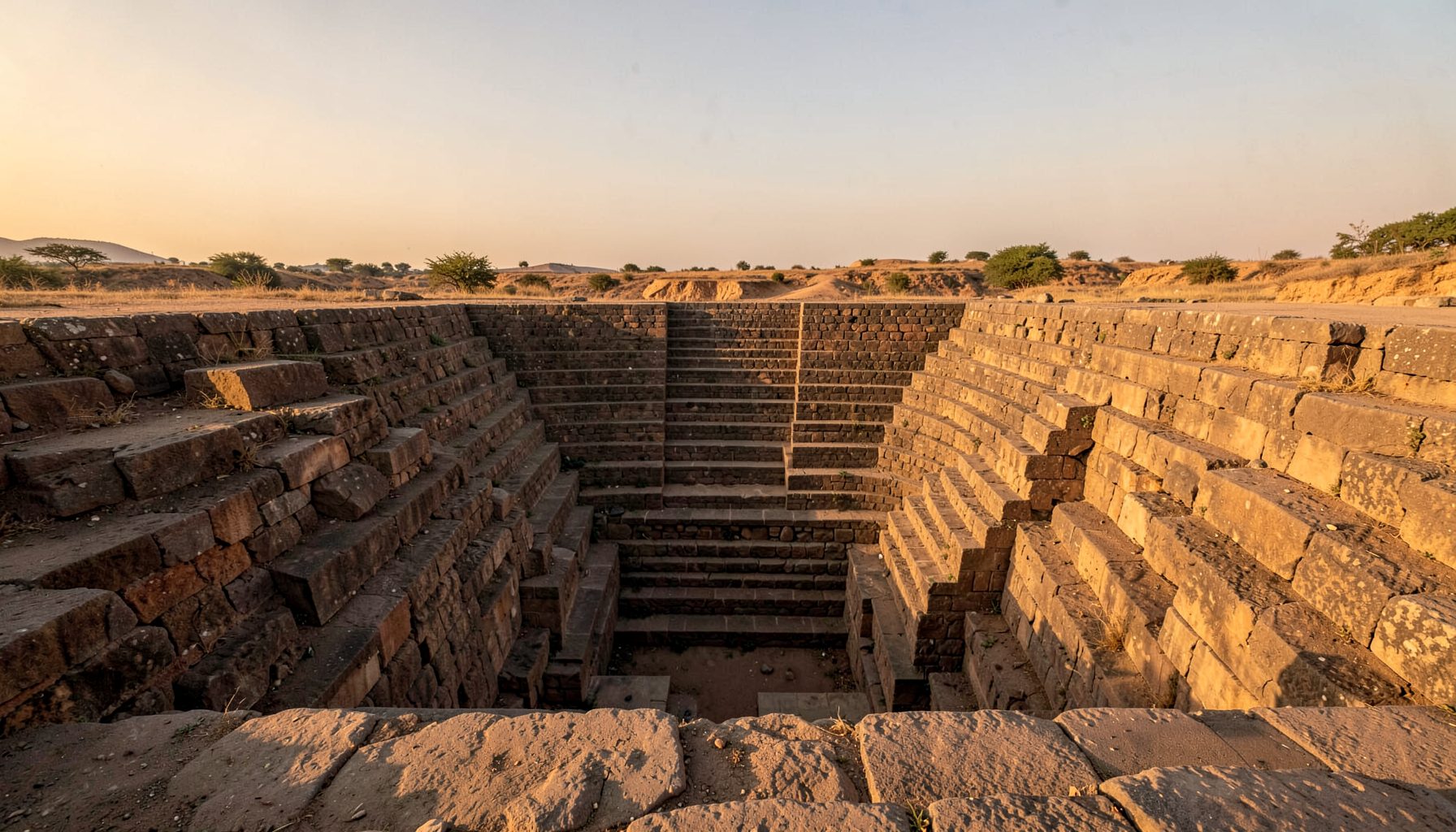
Across Rajasthan, a stepwell was often more than a water source. The baol, bawdi, vav and kund combined a reservoir with descending stairs, colonnaded galleries and platforms where people could meet the groundwater. In a royal precinct, that architecture could become a bathing pavilion: a sheltered place used by rulers, queens and attendants while also feeding temples, gardens and nearby homes. “Pavilion” here describes the roofed edge or chamber attached to the water, not necessarily a detached pleasure building.
Such sites are best understood through layers. A well might have been built to secure water, consecrated to a deity, linked to a palace and later gathered stories of royal bathing. Those layers are visible at Abhaneri, Amer and Bundi, although surviving records do not give every structure an official function. For Australian readers, the comparison may feel familiar: sandstone civic architecture, changeable city weather, dry summer heat and heavy rain all shape how public water infrastructure is designed and remembered.
Water, status and courtly life
Rajasthan’s courtly culture did not separate architecture from water management. A ruler who controlled a dependable well could support a palace, a temple town and a garrison at once. Stepwells inverted the usual relationship between street and reservoir: water sat below grade, reached by stairs and framed by arcades. During court ceremonies, a shaded gallery could separate a royal party from attendants while retaining direct access to the pool.
The function is sometimes clearer in movement than in labels. Water was carried to elephants, kitchens, gardens and shrine floors; queens could use sheltered routes to bathe; servants maintained the steps and drew water. Names such as Hathi Pol, or “elephant gate,” preserve the role of royal animals entering for washing and watering. The Kilkenny Wild Geese tomb offers a useful parallel from another culture: a monument’s meaning grows through stories attached by generations, not only through its original purpose.
Chand Baori and the princess’s bath
Chand Baori at Abhaneri is the most monumental example. Its long descent passes 15 galleries and 21 pillars before reaching a square tank, with rows of carved niches rising behind it. The structure was a major reservoir for the settlement and a sacred focus associated with the goddess Chandika. Its best-known account concerns King Chanda’s daughter, whose regular bathing in the water was linked to divine protection and to the founding of the baol.
That story makes bathing central to the site’s memory, while the practical design reveals a broader purpose. The tank stored precious groundwater, and the lower galleries offered shade and a controlled place for ritual immersion or washing. Careful interpretation matters because a royal story does not prove that every visitor was a member of the court. Chand Baori shows how a reservoir, temple and royal bathing narrative could occupy the same architectural frame.
Panna Meena ka Kund at Amer
Panna Meena ka Kund, meaning the “emerald-coloured well,” sits beside Amer’s palace and the Jagat Shiromani temple. Twenty-one steps descend on each side, and twenty-one sculpted female figures traditionally described as devadasis appear along the walls. Underground connections helped move water and people through the palace precinct. Such a location could support bathing within a controlled, screened environment: a queen might reach the water without crossing the public street.
Nearby Nagrai ka Kund and the Hathi Pol complex strengthen the courtly connection. Water routes served royal elephants and helped connect the palace to the sacred landscape beyond the fort walls. These wells were not isolated spa rooms. Their galleries, service areas and chambers also supported everyday palace work, and nearby communities formed their own relationships with the same water network. Amer demonstrates the narrow space in which private royal ritual and shared civic life could overlap.
Badi Chaupar and Bundi’s bawdis
Badi Chaupar, or the Haveli stepwell in Jaipur, makes the royal function especially explicit in local memory. Its stepped levels descend toward twin shafts, while an underground passage links the complex with the Haveli and the Gauri Shankar temple. Stories describe queens using the route to bathe and reach the shrine with greater privacy. The bold nineteenth-century structure therefore functioned as both hydraulic infrastructure and a sheltered courtly pavilion.
Bundi adds a broader setting. Its palace, forts, shrines and dense network of bawdis formed a connected water system rather than a single monument. Wells near the palace supplied court demand; others gathered pilgrims, sustained neighbourhoods or protected strategic routes. The broader Indian Stepwells project offers a useful model for comparing these systems through original photography, architectural sketches and field notes. Although its current field focus is in Maharashtra, the same methods can deepen a Rajasthan record. Its invitation to local communities to identify undocumented wells could uncover evidence that broad historical summaries overlook.
The design logic of a bathing pavilion
A royal bathing pavilion relied on a carefully graded sequence. Broad stairs accommodated processions; columns and beams carried deep shade; lower chambers moderated heat; and pools stored water below the hottest street level. Screens, turns and service corridors could manage privacy. Bathing was therefore both physical comfort and court protocol, with attendants, clothing, timing and rank influencing how the space operated.
For Australian visitors, the climate comparison is revealing. Adelaide’s dry summers make shade essential public infrastructure, much as in Rajasthan. Brisbane’s subtropical downpours test drains and erosion; Melbourne’s changeable skies reward covered walkways; Sydney’s sandstone civic buildings show why local material and conservation rules shape identity. The comparison concerns design pressure rather than identical customs. A modern Australian pool or landscaped fountain offers no direct explanation for the religious meanings embedded in Rajasthani bathing.
Field methods for reading and photographing stepwells
Good heritage work starts with close observation. Fieldworkers record orientation, levels, carved inscriptions, water conditions and changing access, then test oral histories against plans and photographs. Reflected light and rising water can reveal details that disappear in dry-season sun. The monsoon photography field guide offers practical ways to approach that changing surface while protecting stepped masonry and keeping local activity unobstructed.
Drone imagery can clarify a stepwell’s geometry, yet flights near historic masonry or crowded lanes require permission. Australian operators also follow CASA rules and state or council requirements, while community consent remains essential in Rajasthan. Interpretation can travel well beyond museums: a small exhibition beside a Melbourne makers’ market or at an Adelaide school fete can place photographs beside conservation information. Such displays work best when local partners shape the narrative and any proceeds support community-led recording rather than simply supplying imagery.
Practical support for Rajasthan’s stepwell heritage
Preserving these sites means caring for both architecture and use. Routine cleaning, safe access, water management and clear agreements with residents matter as much as consolidating stone. Indian Stepwells’ documentation approach is relevant because photographs and sketches create a record against which damage, restoration or seasonal change can be compared. The aim is a living record that can guide practical decisions.
Support can be practical and modest, and should respect the communities whose knowledge makes the work possible. Several actions are especially useful:
- Commission local guides and residents to lead research walks, explain water use and identify changes that photographs alone cannot show.
- Fund measured conservation surveys before cosmetic work, including drainage, masonry, biological growth and visitor safety.
- Support documentation of lesser-known bawdis through field teams, local archives and carefully governed image collections.
- Use exhibitions, school events and community markets to share photographs without treating a living monument as a decorative backdrop.
- Share verified findings and local contacts through Indian Stepwells so that gaps lead to respectful, collaborative fieldwork.
Taken together, royal bathing pavilions are valuable because they join engineering, ritual, climate and memory. Keeping them legible, safe and connected to their communities protects a tradition that belongs both to palace history and to the towns that sustained the water network for generations.
Get in Touch
Have information about a stepwell that is not yet on our map? We would be glad to document it and give you full credit. Whether it is a Barav, Kund, Vihir, or any other form of stepwell, every contribution helps preserve India's water heritage.
Call or message us with details about the location, and we will follow up.
#9372496819
Send a Message
What People Say
"The Maharashtra Stepwells campaign has brought attention to structures that were nearly forgotten. The architectural documentation and drone photography are invaluable resources for researchers and students alike."
"Collaborating with the Indian Stepwells team gave our architecture students hands-on exposure to traditional water-harvesting structures. The presentations were insightful and inspiring."
"I shared details of a stepwell near my village that was not on any map. The team visited, documented it beautifully, and credited me. It felt wonderful to contribute."