 Explore Maharashtra
Stepwells of Madhya Pradesh and the Paramara Legacy
Deep within the Malwa plateau, a network of subterranean stone galleries still waits beneath modern towns and fields, holding the cool of centuries. These are the stepwells of Madhya Pradesh, many rising from the medieval patronage of the Paramara dynasty that ruled central India from roughly the ninth to the fourteenth century. For travellers familiar with the sandstone chambers of the underground water temples of Solapur, the Paramara wells offer a parallel conversation about how communities shaped water into something architectural and sacred at once.
In Australia, where summer heat in December tests water reserves from Brisbane to Perth, the logic of these structures feels surprisingly close to home. Old stone tanks and nineteenth-century water cisterns still dot parts of the Sydney basin, evidence that colonial settlers also experimented with subterranean storage. Indian stepwells simply took the idea further, carving multi-tiered pavilions deep into the earth and turning the descent into a daily social ritual.
The Paramaras, also called the Parmars, ruled from their twin capitals of Dhar and Mandu, leaving behind a stone vocabulary that blended temple architecture, hydraulic engineering, and civic pride. Stepwells, locally known as baoris, kunds, or vavs, became their preferred way of marking territory and offering water to pilgrims, traders, and farmers along the regional routes of the Malwa heartland.
This article traces that influence from the dynasty's early capitals through to the villages where their wells still survive, and considers how Paramara architecture compares with the better known Chand Baori in neighbouring Rajasthan.
Origins of the Paramara Stepwell Tradition
The earliest stepwells in Malwa predate the Paramaras by several centuries, with rock-cut cisterns already appearing across the western Deccan in the early historic period. What the Paramaras brought, beginning with rulers such as Raja Bhoj and Udayaditya in the eleventh century, was systematic imperial patronage that turned scattered local wells into a recognisable regional style. Their capital at Dhar contained at least one monumental vav whose plan survives in scholarly drawings, and Mandu's hilltop complex still bears the marks of a society that took water infrastructure seriously.
Royal grants recorded on copper plate inscriptions describe donations of villages specifically to maintain a baori's cleanliness, lighting, and access. In a country where the Australian mining towns of Kalgoorlie once built elaborate company reservoirs to hold scarce water, the idea that a community would fund a single structure for generations resonates with audiences used to collective infrastructure. The Paramara period also coincided with a flowering of temple building across central India, and craftsmen moved freely between temple and well commissions, carrying a shared design vocabulary across both sacred architectures.
Architecture of the Malwa Vavs
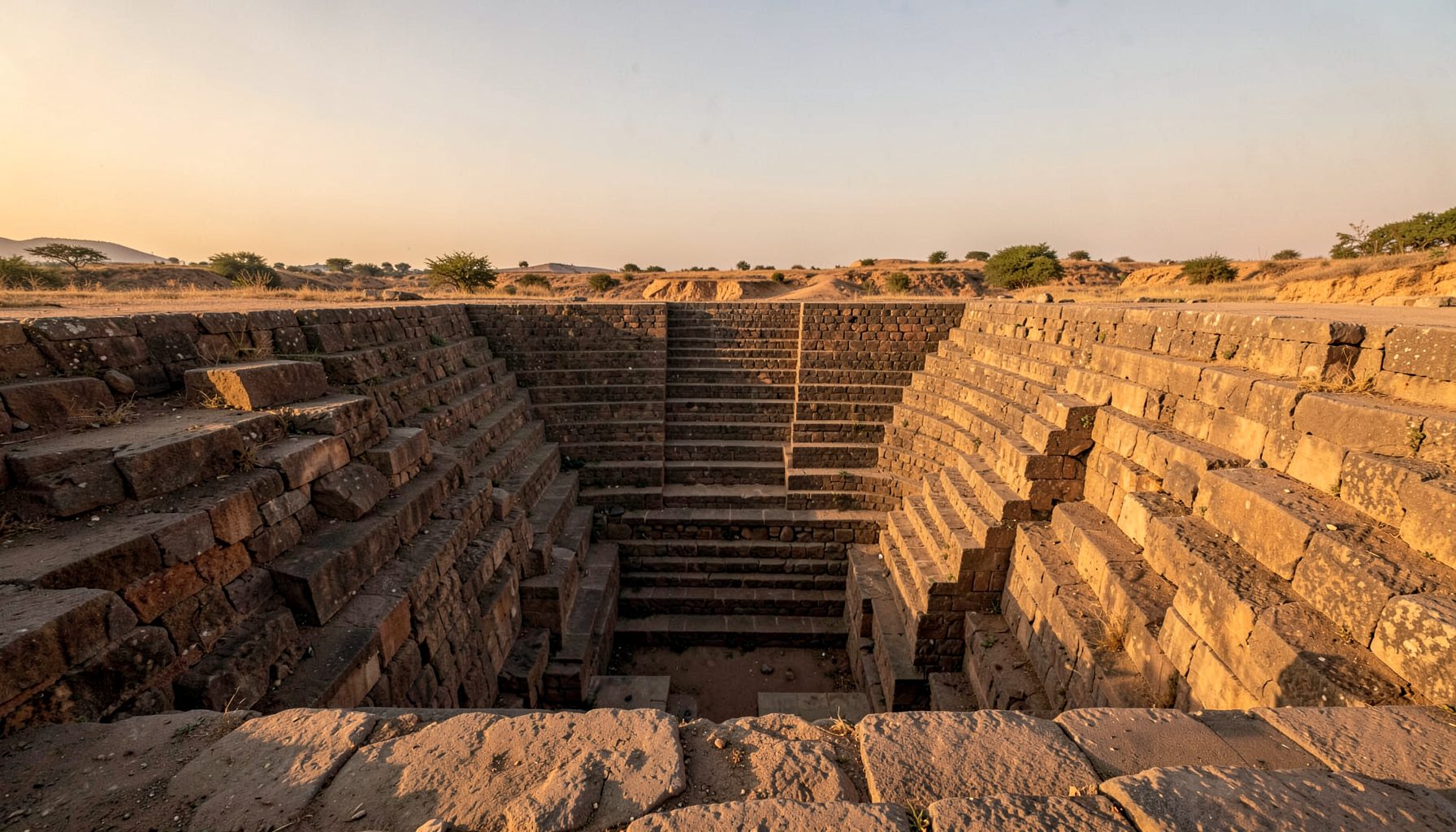
A typical Paramara stepwell descends through a sequence of storeyed landings supported on rows of ornate pillars. The walls are pierced with small niches that once held oil lamps during festivals, while deeper levels gather at a rectangular well shaft cut directly into the bedrock. The deeper you go, the more dramatic the play of light becomes, with shafts of sunlight picking out carved deities and lotus medallions on the upper platforms.
Pavilions called kuta and sala, square and rectangular in plan, frequently punctuate the descent. They served as rest points, prayer spaces, and shaded gathering rooms during the long hot months. Architects in Melbourne studying passive cooling in colonial buildings have noted similar logics at work, where deep verandas and cross ventilation replaced mechanical air conditioning for well over a century.
The carving programme often includes river goddesses such as Ganga and Yamuna, along with local deities tied to rain and fertility. Dancers, musicians, and floral scrolls run along the dado levels, while structural pillars sometimes carry small temple-style shikhara towers as finials. The cumulative effect is closer to a subterranean mandir than a utilitarian water point, an impression that aligns with the popular name for some of the grander examples as vav-mata-mandir.
Sacred Geometry and Ritual Water
Paramara architects had a clear sense of how geometry shaped the spiritual experience of descent. Many wells were aligned so that on certain mornings, sunlight would strike a particular carved image at a precise depth. Others were oriented to face cardinal directions tied to seasonal festivals, much like the orientation of older temples in the region and the alignment of sacred tanks elsewhere on the plateau.
Water levels inside the wells marked the rhythm of the monsoon, and the surrounding galleries served as calendars, with stepped platforms doubling as seating for gatherings during the rains. Drawing water from a sanctified space was an everyday ritual rather than a chore.
Some sites also carried inscriptions invoking the protection of local tutelary spirits, claiming a piece of landscape for the dynasty and its gods. For Australian visitors accustomed to the heritage overlays attached to places like the Cistercian monks cemetery at Mellifont Abbey, the layered meaning of inscribed sacred wells may feel like a distant echo of similar ideas about religious geography.
Comparing Chand Baori and the Malwa Variants
Chand Baori at Abhaneri in Rajasthan is the stepwell most often reproduced in travel photography, its thirteen storeys of geometric steps making it one of the most visually arresting hydraulic monuments anywhere. Yet Chand Baori is not a Paramara foundation. It was built by the Chahamana ruler Chand Raja in the eighth or ninth century, well before the dynasty consolidated control over Malwa to its south.
The Malwa vavs share certain features with Chand Baori, including stepped sides, pillared landings, and a deep central shaft, but they tend to be smaller in footprint and more heavily sculpted. Where Chand Baori emphasises bold geometry, Paramara wells emphasise surface detail, with each pillar, niche, and bracket turned into a small narrative relief. Climatically, the two regions behave differently. Abhaneri sits in semi-arid Rajasthan with a brief, sharp monsoon, while Malwa receives a longer wet season spread over three months, and that difference is visible in the size of catchment galleries and the depth of storage shafts.
Rani ki Vav and the Broader Paramara World
Rani ki Vav at Patan in Gujarat is the most decorated stepwell on the subcontinent and a UNESCO World Heritage Site, yet it falls outside Madhya Pradesh. Its construction is traditionally credited to Queen Udayamati in the eleventh century, commissioned in memory of her husband Bhimdev I of the Solanki branch, a dynasty closely related to the Paramaras through marriage and political alliance.
The shared design vocabulary between Rani ki Vav and the Paramara wells of Malwa is unmistakable. Both rely on dense narrative carvings, descend through pillared pavilions, and treat water as the centre of a layered sacred landscape. Where Rani ki Vav is unrivalled in sheer surface richness, the Madhya Pradesh vavs often preserve the older structural skeleton more honestly, with carver's numerals and intact column bases more visible.
For researchers mapping this wider network, Gujarat, Rajasthan, and Madhya Pradesh together form a connected cultural corridor. Visiting more than one site in a single trip brings the regional style into focus, much as heritage tours out of Melbourne and Hobart routinely combine several historic townships to give visitors a sense of how a regional identity developed.
Forgotten Sites Across the Malwa Plateau
Beyond the famous examples, a quieter record of Paramara waterworks survives in smaller towns and villages. Wells at places like Un, Jobat, and Sondhi in the Malwa region, often unmentioned in guidebooks, preserve carved pillars and inscribed dedications that local communities still maintain. Some are still used for washing and drawing water, while others have silted up and grown over with banyan roots.
Field documentation is uneven. Photographers and historians have produced excellent records of a few headline sites, while dozens of smaller wells remain unmeasured. The contrast is familiar in heritage work, comparable to the way Australian regional libraries in Ballarat or Bendigo hold rich photographic archives while smaller towns still wait for someone to walk the streets with a camera.
Local memory often outlasts stone, with elders in some communities able to describe festivals once performed at a vavi, the families who endowed lamps, and the routes by which pilgrims approached during dry years. Where inscriptions have eroded, oral accounts sometimes supply the only surviving context for a well's original purpose.
Documenting and Preserving the Paramara Legacy
Documentation is only the first step. The sandstone used in many Paramara wells weathers quickly under monsoon rain and groundwater seepage, and several surviving wells show signs of structural distress. Conservation teams from the Archaeological Survey of India and state archaeology departments have begun targeted stabilisation at some of the more visited sites, but resources remain limited and smaller wells often receive only occasional attention.
Community participation makes a measurable difference. Where local residents take an active interest in clearing silt, repairing access steps, and reporting damage, wells tend to survive in better condition than those left unattended. This mirrors approaches used in Australian heritage towns, where volunteer-run organisations care for historic cemeteries, gaols, and courthouses without ongoing state funding.
Readers who know of a Paramara-era stepwell, kund, or baori that is not yet recorded in published sources are warmly invited to contact the project and share photographs, GPS data, or stories. Even small leads help build a fuller picture of how the dynasty shaped central India's water landscape and contribute directly to keeping these extraordinary structures alive for the next generation.
Get in Touch
Have information about a stepwell that is not yet on our map? We would be glad to document it and give you full credit. Whether it is a Barav, Kund, Vihir, or any other form of stepwell, every contribution helps preserve India's water heritage.
Call or message us with details about the location, and we will follow up.
#9372496819
Send a Message
What People Say
"The Maharashtra Stepwells campaign has brought attention to structures that were nearly forgotten. The architectural documentation and drone photography are invaluable resources for researchers and students alike."
"Collaborating with the Indian Stepwells team gave our architecture students hands-on exposure to traditional water-harvesting structures. The presentations were insightful and inspiring."
"I shared details of a stepwell near my village that was not on any map. The team visited, documented it beautifully, and credited me. It felt wonderful to contribute."