 Explore Maharashtra
Stepwells of Kutch after the 2001 earthquake
The stepwells of Kutch tell a story of architecture, water and social continuity, with resilience after the 2001 earthquake revealing the connections between them. Descending passages into groundwater were practical infrastructure, sacred spaces and meeting places. The quake disrupted those functions in some places, exposing how vulnerable monuments, roads and community networks become when a region’s settlement system is hit. Learn more about How Stepwells Were Financed Inscriptions And Endowments.html.
Kutch is semi-arid, with short, intense monsoons, high evaporation and groundwater that can turn saline near the coast. A vav, baoli, kund or deep masonry well could hold precious runoff and make it accessible through drought. Their value lies in climate as much as in carved stone.
The Bhuj earthquake of 26 January 2001, magnitude 7.7, devastated Bhuj, Anjar and Rapar. Buildings collapsed, water systems failed and reconstruction absorbed money and attention for years. For stepwells and related tanks, recovery meant asking whether conservation could restore more than fabric: whether people, skills and local knowledge would remain attached to the water sites.
In towns across inland South Australia and western New South Wales, people talk about tank water and bore water, while heritage grants offer another point of comparison for Australian readers. Kutch’s vavs still need their own social and environmental context, so comparisons work best when they transfer methods rather than assumptions.
Water and settlement in arid Kutch
Water shaped the spatial logic of Kutch’s settlements. Rain collected in tanks and wells, while scarce grazing and farmland depended on careful storage. A stepwell was not a decorative appendix to the village; it was part of the infrastructure that made dry-season life possible.
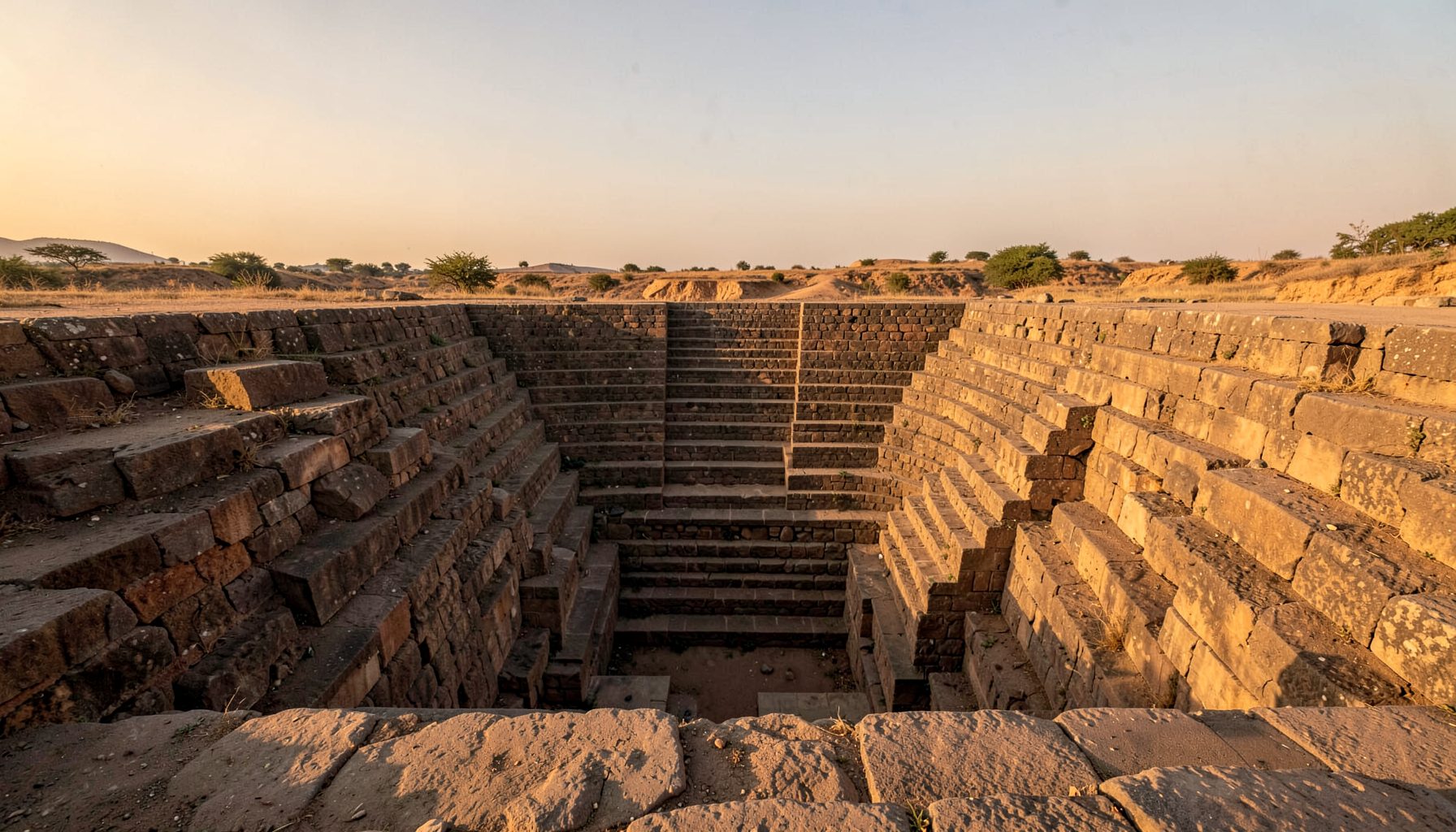
Its form joins engineering to ritual. Stepped terraces, pillared landings and a shaft descending below street level allowed people and animals to reach water as levels fell. Niches and carved chambers gave the descent a processional character, turning a practical journey into a shared public experience.
Conservation therefore follows two clocks. The masonry clock records cracks, missing stone and settlement of walls. The water clock records recharge, salinity, silt and changing use. A sound monument can still fail if its catchment is altered, its outlet is blocked or nobody maintains it.
Garidat and the wider stepwell network
Kutch’s historic vavs form a varied and incompletely documented family. Local knowledge identifies important examples, including Koteshwar and Garidat, within a wider network of wells, tanks, temples and settlement routes. Their value is enhanced by reading them alongside the living village rather than treating them as isolated carvings.
For Garidat, the Garidat heritage record provides a site-specific point of departure, joining older local knowledge with images and plans that can be checked against present conditions. Such a record can prevent a dramatic stairway from being mistaken for the whole monument; the surrounding well, access path and catchment matter too.
The 2001 earthquake did not mark a clean dividing line between damaged and undamaged sites. Some losses came from collapse and cracked masonry; others came from debris, altered drainage, damaged approaches or disruption of custodianship. A survey should separate earthquake injury from long-term wear so repair methods do not erase evidence of age.
Funding the water commons
Historic stepwells were paid for in several ways. Royal patrons, merchants, craft guilds and village users could combine cash, land and labour. The history of subscriptions and endowments shows why recurring income often mattered more than the original gift: someone had to sweep, repair, inspect and reopen the water structure.
After 2001, a one-off repair grant rarely could carry that burden. Emergency housing, water supply and roads competed for public money, while monuments remained vulnerable to monsoon damage after the cameras left. Sustainable funding therefore needs maintenance agreements, accountable trusts or ring-fenced community funds, not only headline restoration costs.
Australian heritage markets offer a partial comparator. Local councils in cities such as Melbourne and Adelaide, together with state heritage funds, often combine grants, engineering advice and philanthropic support. The transferable lesson is to fund inspection and routine maintenance alongside capital repairs, using agreements that name who owns, cares for and reports on the site.
Community documentation after disaster
The wider Indian Stepwells archive provides a model for combining original photography, drone imagery, architectural sketches and field research. Kutch material can be positioned within a wider typology of vavs, baolis, kunds and baravs, making it easier to recognise local building methods and distinguish them from later repairs.
Local residents are likely to know a lost stairway, a changed water channel, a family repair or the name of a custodian whose name never reached an archive. Interviews should record those details with location, consent and context. The project’s invitation to share information on undocumented stepwells gives such testimony a route into future research.
Conservation itself benefits from this combined record. Traditional masons can be shown a carved detail before cleaning or repointing, while drawings distinguish sound evidence from conjectural reconstruction. Conservation plans should also account for modern safety, drainage and climate adaptation without erasing the original logic of the stepwell.
In Sydney and Melbourne, many Gujarati and Rajasthani community associations already organise heritage walks and maintain family connections to western India. Those networks can connect Kutch’s monument campaigns with Australian audiences, research skills and fundraising, provided local ownership in Kutch guides the relationship.
Learning from other industrial heritages
Disaster recovery often treats heritage as a soft outcome: valuable, but deferrable until roofs, roads and livelihoods are secure. Long-term resilience asks whether a community can remember what mattered before emergency priorities erase it and keep that memory useful to the next generation.
A useful comparative case is the Ballyconnell mining landscape in County Cork, where the cemetery associated with former copper mines preserves the human story of extraction. Headstones, inscriptions and family memory reveal how an industrial place was lived, not merely how its machinery functioned.
The parallel lies in attention to ordinary records. For Kutch, wells and repaired after the earthquake, construction ledgers, water committee minutes, family photographs and village maps can show who used a stepwell and how access changed. Such evidence gives future repairs a social logic and helps residents challenge damaging simplifications.
A field checklist for resilient stepwells
Before choosing a repair method, field teams need a shared record of condition, water and community value. A practical site checklist can begin with:
- Structural movement: map cracks, displaced blocks, failed arches and settlement against fixed reference points.
- Water and salts: record recharge conditions, salinity, turbidity and depth, noting seasonal changes rather than a single reading.
- Access and safety: inspect stairs, parapets, openings and emergency routes while balancing conservation with present-day use.
- Drainage and silt: trace monsoon flow, erosion, sediment and vegetation around the well head and catchment.
- Evidential value: photograph carvings, repairs and alterations before intervention, and record stories tied to particular spaces.
Preservation then follows the evidence rather than a generic reconstruction recipe. The associated agenda should include:
- Community agreement: define ownership, access, decision-making and a named local point of contact.
- Minimum intervention: retain sound historic fabric and use compatible materials, with every new element recorded.
- Maintenance planning: schedule monsoon inspections, drainage clearance, salinity checks and safe access.
- Craft capacity: involve trained local masons and document traditional techniques for repair and maintenance.
- Public interpretation: combine clear signage, oral histories and digital access without crowding fragile spaces.
None of this work depends on a single project office. It links public records, local stewardship and specialist craft, allowing a monument to remain both useful evidence and part of daily life. Photographing a repaired arch or recording a committee decision can reveal whether promised care actually continued.
Alongside fieldwork, the Maharashtra campaign demonstrates how a focused regional programme can connect documentation with local knowledge and sustained public attention. That model speaks to an Australian audience familiar with community heritage walks, council and state grants, and regional museums that turn conservation into a local economy. It also needs care: where Country is involved, Traditional Owner groups set the terms of engagement, and their authority should shape access, interpretation and care. For Kutch, resilience means keeping water, craft and community memory together rather than treating each monument as a detached object.
Get in Touch
Have information about a stepwell that is not yet on our map? We would be glad to document it and give you full credit. Whether it is a Barav, Kund, Vihir, or any other form of stepwell, every contribution helps preserve India's water heritage.
Call or message us with details about the location, and we will follow up.
#9372496819
Send a Message
What People Say
"The Maharashtra Stepwells campaign has brought attention to structures that were nearly forgotten. The architectural documentation and drone photography are invaluable resources for researchers and students alike."
"Collaborating with the Indian Stepwells team gave our architecture students hands-on exposure to traditional water-harvesting structures. The presentations were insightful and inspiring."
"I shared details of a stepwell near my village that was not on any map. The team visited, documented it beautifully, and credited me. It felt wonderful to contribute."