 Explore Maharashtra
How stepwells were financed: inscriptions and endowments
Stepwells across India were funded through a mixture of royal patronage, aristocratic donations, trade wealth and village contributions. Some rulers proclaimed that they had built a well as a religious gift; others accepted help from merchants, landholders, religious institutions or local communities. The resulting structures are often presented as acts of royal benevolence, but their construction and survival usually depended on many arrangements recorded in inscriptions, administrative documents and local custom.
Inscriptions provide the clearest surviving account of these arrangements. They may name donors, describe the quantity of money or goods offered, record the appointment of caretakers and explain why water should remain available to particular communities. Such texts reveal that a stepwell’s financial history could span several generations. They also show that maintenance, repair and ritual use required continuing resources long after the opening ceremony.
Australian readers may recognise a parallel in the civic philanthropy behind reservoirs, parks, hospitals and public buildings. Melbourne’s and Adelaide’s sensitivity to dry summers, Sydney’s sandstone monuments and its culture of donor plaques all offer useful comparisons. Here, as in India, a prestigious gift could strengthen a donor’s reputation while providing a practical service. The difference lies in the records: Indian stepwell inscriptions often preserve unusually direct statements about water access and inherited obligations.
Local markets provide another point of comparison. A community history stall or fundraiser at Melbourne’s Queen Victoria Market or Adelaide’s Central Market can turn commercial activity into a setting for civic memory. Similarly, a stepwell inscription can transform a water structure into a public record of generosity, authority and collective responsibility. Both depend on observers understanding who gave, what was promised and why the gift mattered.
Reading the financial record in inscriptions
Inscriptions on stairways, gateways and water chambers commonly record dedications, construction dates and titles. A patron might describe a well as a gift to a deity, a guru, a city or a travelling community. Foundation texts sometimes explain that every visitor may draw water without payment, while later additions document extensions, deepening of the tank and repairs after flooding or neglect. These layered texts can reveal several campaigns of construction rather than a single building event.
Comparable evidence from other charitable institutions shows why context matters. The history of the medieval leper colony demonstrates how a place associated with illness, burial and public assistance could also depend on land, donations and an organised governing authority. A stepwell inscription likewise records more than masonry: it preserves the terms under which a community expected the institution to operate.
Translations require caution. Inscriptions employ royal titles, religious formulas and conventional praise that may exaggerate the donor’s role. A king’s name at the top of a text does not prove that the royal treasury paid every cost. Conversely, a modest donor’s name may appear only in a closing line. Researchers should compare the original script, surviving fragments, local chronicles and the physical remains of the structure before assigning a particular payment to a particular person.
Patrons beyond the ruler
Royal and aristocratic patrons supplied money, land, labour exemptions and access to skilled craftspeople. Queens and princesses are recorded at some stepwells, while nobles frequently describe wells as extensions of family piety or rule. In Maharashtra, inscriptions may reflect successive regional dynasties, Maratha administration and Peshwa-era patronage. Each authority used the monument to advertise continuity, religious merit and the ability to command resources for large hydraulic works.
Long-distance exchange networks also shaped elite wealth. Objects such as Neolithic precious beads illustrate how communities could move valued materials across considerable distances. Later patrons used imported goods, specialised labour and distant connections to display status. Their financial contribution to a stepwell therefore included economic relationships extending well beyond the village in which the water was stored.
A king’s project could still depend on collective finance. Merchants might guarantee a portion of the cost, village households contribute grain or labour, and hereditary officers collect small dues on the donor’s behalf. Some wells were enlarged through subscriptions resembling community fundraising, with names, sums or service obligations entered into a register. Women could contribute through land, money or devotional work, although their roles are sometimes obscured by official titles and male-authored summaries.
Endowments that sustained daily use
An endowment was more than a ceremonial gift. It was an intended stream of support for cleaning, guarding, repairing and staffing the structure. Resources might come from donated land, cash, grain, agricultural produce, shop income, tolls or rights to nearby trees and water. A pious donor could also fund lamps, festivals, feeding programmes or the maintenance of a shrine associated with the stepwell.
Foundation clauses sometimes appointed a priest, watchman, accountant or hereditary caretaker. These officials were expected to maintain channels, remove sediment, repair steps and keep the tank usable during dry periods. Some endowments specified inspections or transfers of responsibility after the death of a founder. The wording often expresses an ideal of perpetual care, although surviving inscriptions cannot prove that the promised payments continued for centuries.
The terms also reveal attitudes towards access. Certain wells reserved water for pilgrims, women, residents of particular neighbourhoods or people travelling with animals. Others imposed distinctions based on caste, status or religion. Such clauses provide rare evidence of how water was distributed and controlled. They also expose people omitted from the official narrative, including labourers whose contributions were essential even when their names never reached the stone.
Fieldwork, photography and local knowledge
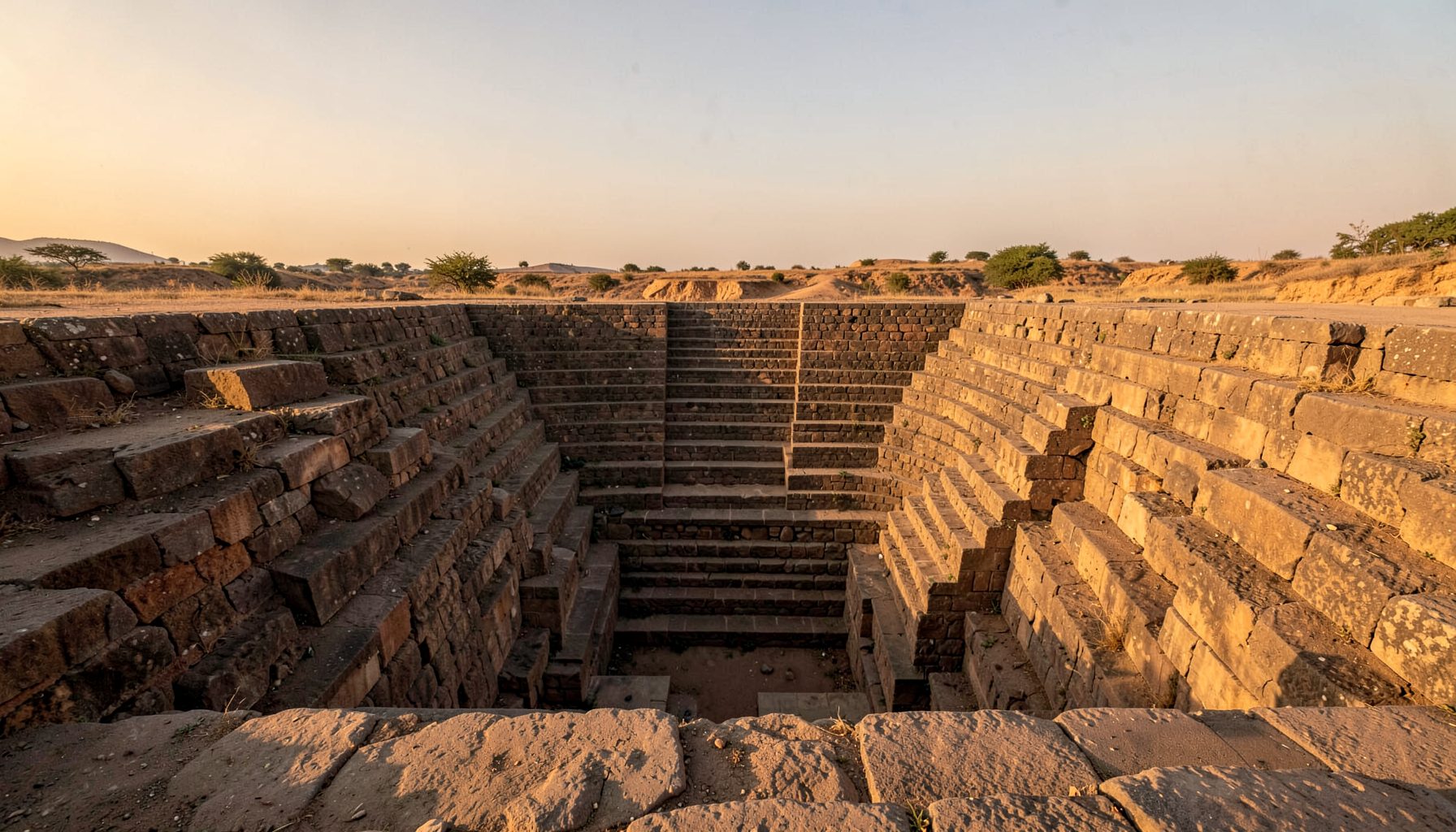
Fieldwork turns an inscription from a text into physical evidence. Researchers photograph each line, prepare rubbings, record damaged areas and compare lettering styles with securely dated inscriptions. Architectural sketches and drone imagery can show how a stepwell sits within a settlement, tank system or pilgrimage route. These records are particularly important when later construction has concealed parts of the original structure or access is difficult.
A photographic survey such as the hidden stepwells of Pune demonstrates the value of looking beyond official lists. Small or modified structures may survive behind homes, beneath vegetation or within altered courtyards. Repeated photography can track erosion, illegal dumping, structural movement and changes in water availability, while also preserving details that might otherwise disappear during restoration.
Local residents often possess information absent from government records. Oral histories may identify an old bathing place, a vanished shrine, a former caretaker’s family or the meaning of a local name. Such testimony does not replace epigraphic analysis, but it can guide researchers toward relevant sites and clarify how a monument was used. Careful documentation should retain the location, date and uncertainty attached to every photograph, sketch, translation and oral account.
Research priorities for threatened structures
Reliable documentation creates a practical foundation for conservation. It can support applications for listing, emergency repairs and community-led management. Discoveries and uncertainties can be shared with the project through the Indian Stepwells contact page, while records of undocumented structures help researchers prioritise fieldwork. In Australia, city councils, state heritage agencies, volunteer historical societies and philanthropic trusts offer comparable channels for linking research with conservation.
The following priorities help turn inscriptions into usable evidence:
- Photograph inscriptions in full and in detail, including damaged edges, later repairs and changes in the lettering.
- Record the name, date, location, translator and any uncertain readings associated with every inscription.
- Separate original foundation terms from later additions, restorations and commemorative texts.
- Map endowment income, appointed caretakers and promised access to water alongside the physical plan.
- Document surrounding tanks, channels, shrines and settlement patterns rather than studying the stepwell in isolation.
- Share findings with local communities while recording consent, contested interpretations and the provenance of oral histories.
A stepwell survives through water, stone and collective memory, yet each requires different forms of support. Inscriptions preserve the legal and moral promises attached to the structure; photographs and field records make those promises visible today. Their combined value lies in showing that historical water conservation depended on relationships between donors, workers, officials and communities, with those relationships renewed through responsible research and long-term stewardship.
Get in Touch
Have information about a stepwell that is not yet on our map? We would be glad to document it and give you full credit. Whether it is a Barav, Kund, Vihir, or any other form of stepwell, every contribution helps preserve India's water heritage.
Call or message us with details about the location, and we will follow up.
#9372496819
Send a Message
What People Say
"The Maharashtra Stepwells campaign has brought attention to structures that were nearly forgotten. The architectural documentation and drone photography are invaluable resources for researchers and students alike."
"Collaborating with the Indian Stepwells team gave our architecture students hands-on exposure to traditional water-harvesting structures. The presentations were insightful and inspiring."
"I shared details of a stepwell near my village that was not on any map. The team visited, documented it beautifully, and credited me. It felt wonderful to contribute."