 Explore Maharashtra
The Stepwells of Goa: Traces of a Watery Past
Goa conjures images of sunlit beaches, baroque churches, and spice-scented markets, but beneath the state's postcard surface lies a quieter heritage shaped by water. Long before Portuguese caravels anchored off the Mandovi, communities along the Konkan coast engineered ingenious systems to capture monsoon rains and store them through dry months. Stepwells, locally called bawdis or kulams, formed the backbone of this water wisdom, yet they remain largely absent from guidebooks and conservation lists.
For Australian readers accustomed to the sandstone culverts and earthen tanks of the colonial hinterland, the Goan equivalents offer a different lens on how tropical societies lived with scarcity. Travellers from Sydney or Melbourne who wander beyond the coastal strip often find that the most rewarding encounters with Goan history happen in the shade of a mossy well parapet, where centuries of communal life linger in stone.
Goa's water architecture before the Portuguese
The earliest documented water structures in Goa date to the Kadamba period, between the tenth and fourteenth centuries, when the kingdom's rulers oversaw temple towns, trade ports, and agricultural estates scattered across the western coast. Inscriptions and travellers' accounts describe reservoirs, stepped ponds, and wells that served pilgrims, traders, and villagers alike. The Chalukyas, who preceded and overlapped with the Kadambas, left rock-cut cisterns in the hilly interior, some of which still hold water long after the summer ends.
These were not isolated monuments but nodes in a landscape of bunds, channels, and sacred groves. Villages such as those in the Sattari and Sanguem talukas retain fragments of this network, where a stone-lined tank once irrigated rice paddies now converted to areca plantations. The kinship between Goan water structures and those further north in Maharashtra and Karnataka becomes clear when one traces the granite trade routes that carried artisans across the Sahyadri range. The Stepwells of Bidar: Unearthing Bahmani Engineering shows how Bahmani engineers refined similar traditions in the Deccan, hinting at the shared vocabulary of steps, pillars, and subterranean chambers that runs through western India.
Portuguese arrival and the reshaping of the waterscape
When Afonso de Albuquerque's forces captured Goa in 1510, they encountered a sophisticated hydraulic landscape and promptly began remaking it. Fountains and chafarizes modelled on Iberian prototypes appeared in the new capital, drawing water through ceramic pipes from sources such as the springs of Bainguinim. The colonial administration mapped aqueducts and wells, taxing them and in some cases diverting their flow to support the garrison, the churches, and the shipyards of Old Goa.
Indigenous wells were not erased but were often repurposed. A village bawdi might be cleaned, deepened, or rededicated to a Christian saint, its carved panels obscured by lime plaster but its function preserved. In areas where Muslim communities had built elegant vavs during the Adil Shahi interludes, the new rulers allowed many to fall into disuse, preferring surface fountains that suited European tastes. The result is a layered terrain in which a Goan heritage walk might pass from a fourteenth-century Hindu tank to a sixteenth-century Portuguese fountain within a single neighbourhood.
Notable surviving stepwells and wells
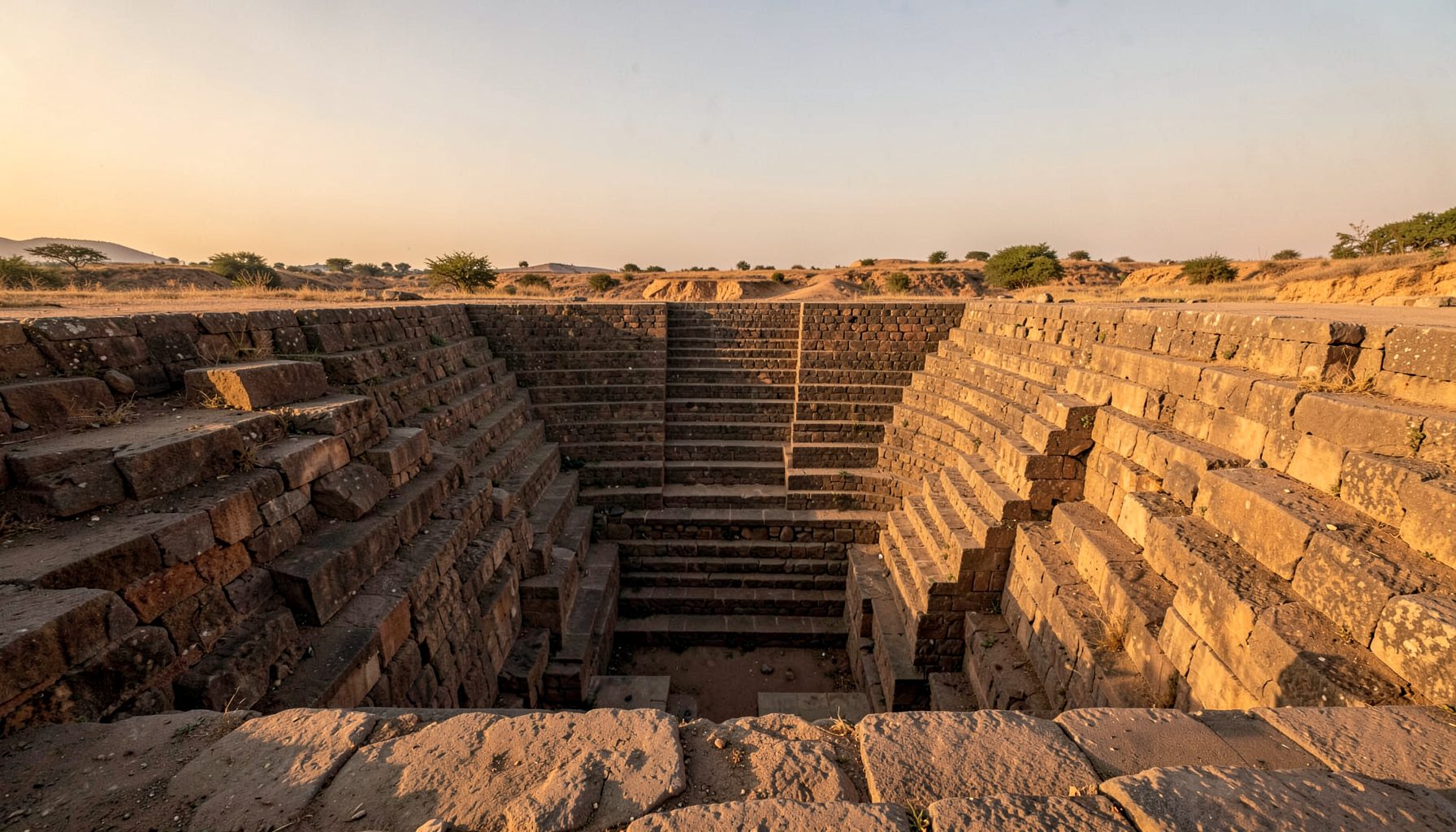
Among the most evocative survivors is the stepwell at Rivona, a multi-tiered structure with broad stone steps descending into clear water, framed by laterite walls and fig tree roots. Closer to the coast, the Bainguinim spring complex near Old Goa combines a colonial-era aqueduct with earlier catchment basins, illustrating the layering described above. In Quepem, a modest but beautifully proportioned well in the courtyard of a crumbling mansion reminds visitors that water structures were once central to domestic life, not just communal ritual.
Further south, the village of Loutolim hides a curious kund whose steps are interrupted by small shrines, a hybrid form that suggests patronage shared between Hindu and Catholic communities. Researchers from the Indian Stepwells project have sketched dozens of such features during monsoon field surveys, finding that the most intact examples often sit beside working farms, where they continue to serve a practical role in livestock watering and irrigation. For an Australian audience used to heritage sites managed by state agencies, the idea that a seven-hundred-year-old well still waters buffalo in 2026 may seem improbable, yet it reflects the quiet continuity of Goan village life.
Architectural features and construction methods
Goan stepwells display regional variants on a broader western Indian theme. Where Rajasthani vavs descend through cool, darkened galleries, Goan wells tend to be shallower and more open to the sky, taking advantage of the heavy monsoon and the high water table. Laterite, the soft reddish stone quarried across the Konkan, was the primary material, faced in places with imported basalt for steps and lintels. Carved motifs draw on temple iconography, with lotus medallions, serpentine brackets, and the occasional deity, though Christian crosses sometimes appear on later renovations.
Construction was a community affair, often funded by wealthy merchants, temple trustees, or village panchayats. Inscriptions record donations of lamp oil, of grain for the workers, and of land to maintain the well in perpetuity, a legal arrangement that resembles the inam grants documented in Portuguese administrative records. The engineering itself relied on simple but careful surveying, with masons aligning the descent to local gradients and ensuring that the lowest steps stayed submerged even at the driest part of the year. The parallels with traditional Australian pastoral bores and windmill-fed tanks are structural rather than stylistic, yet both speak to a settler society's negotiation with water scarcity.
Current condition, threats, and what is being lost
Today, many of Goa's stepwells face pressures familiar to heritage workers in Brisbane, Perth, or Hobart: urbanisation, neglect, pollution, and the conversion of historic structures into parking lots or building sites. Encroachment is particularly acute in coastal villages, where tourism development has accelerated since the 1990s. Silting from deforested catchments, sewage discharge, and the lowering of the water table due to borewells have all contributed to the decline of wells that once held water year-round.
Australian legislation such as the Environment Protection and Biodiversity Conservation Act 1999 offers one model for protecting nationally significant sites through listing and impact assessment. India operates its own frameworks, including the Ancient Monuments and Archaeological Sites and Remains Act, but enforcement at the village level remains uneven. A Goan bawdi may be centuries older than a Sydney sandstone cottage yet escape recognition on any official register, a disparity that conservation advocates are working to address. The loss is not only aesthetic; once a well is lost, the knowledge embedded in its siting, alignment, and maintenance tradition goes with it.
Documentation, communities, and the path forward
A small but growing group of researchers, photographers, and local volunteers is working to record what remains. Projects based in Panjim and Margão have begun systematic surveys, often partnering with university departments in Australia, the Netherlands, and Portugal to share methods and archival access. Drone imagery, photogrammetry, and crowd-sourced mapping are opening new ways of seeing, revealing the footprints of vanished tanks beneath laterite walls and banana groves. Cross-referencing with colonial-era records, including parish registers that sometimes mention wells by name, helps anchor oral histories and family stories.
Community involvement is central. Several panchayats have begun cleaning wells ahead of monsoons, motivated as much by practical water security as by heritage pride. Schoolchildren invited to sketch their village well often discover features adults have overlooked, from carved date panels to freshwater mussel colonies. A handful of tourism operators now include lesser-known wells in village walks, spreading both visitors and revenue. Sustaining this work requires diverse revenue streams, from academic grants and crowd-funding appeals to partnerships with heritage sponsors who help underwrite travel and equipment costs. The aim, echoing the ethos of heritage documentation initiatives elsewhere, is to build a living archive that grows with each field season and invites further contributions from those who live alongside these structures.
Practical guidance for recording and supporting Goan stepwells
- Photograph wells in early morning or late afternoon to avoid harsh midday glare on laterite surfaces and to capture reflections in still water.
- Note the four cardinal directions, marking any carved panels, inscriptions, or shrines on a simple sketch before measuring with a tape or laser rangefinder.
- Ask village elders about the well's name, the families who funded it, and any festivals once held there, recording responses in the local Konkani dialect where possible.
- Avoid entering water without checking depth, debris, and possible contamination, and never descend alone into wells deeper than chest height.
- Share field data with heritage researchers and local panchayats, crediting the community and respecting any sensitivities around sacred or private sites.
- Support organisations that lobby for listing on state or national heritage registers, and consider sponsoring clean-up drives during the pre-monsoon dry weeks.
- Plan visits to coincide with local festivals when wells are cleaned, garlanded, and brought back into public view, offering some of the richest opportunities for both photography and conversation.
Get in Touch
Have information about a stepwell that is not yet on our map? We would be glad to document it and give you full credit. Whether it is a Barav, Kund, Vihir, or any other form of stepwell, every contribution helps preserve India's water heritage.
Call or message us with details about the location, and we will follow up.
#9372496819
Send a Message
What People Say
"The Maharashtra Stepwells campaign has brought attention to structures that were nearly forgotten. The architectural documentation and drone photography are invaluable resources for researchers and students alike."
"Collaborating with the Indian Stepwells team gave our architecture students hands-on exposure to traditional water-harvesting structures. The presentations were insightful and inspiring."
"I shared details of a stepwell near my village that was not on any map. The team visited, documented it beautifully, and credited me. It felt wonderful to contribute."