 Explore Maharashtra
Bhuj Stepwells After the 2001 Earthquake
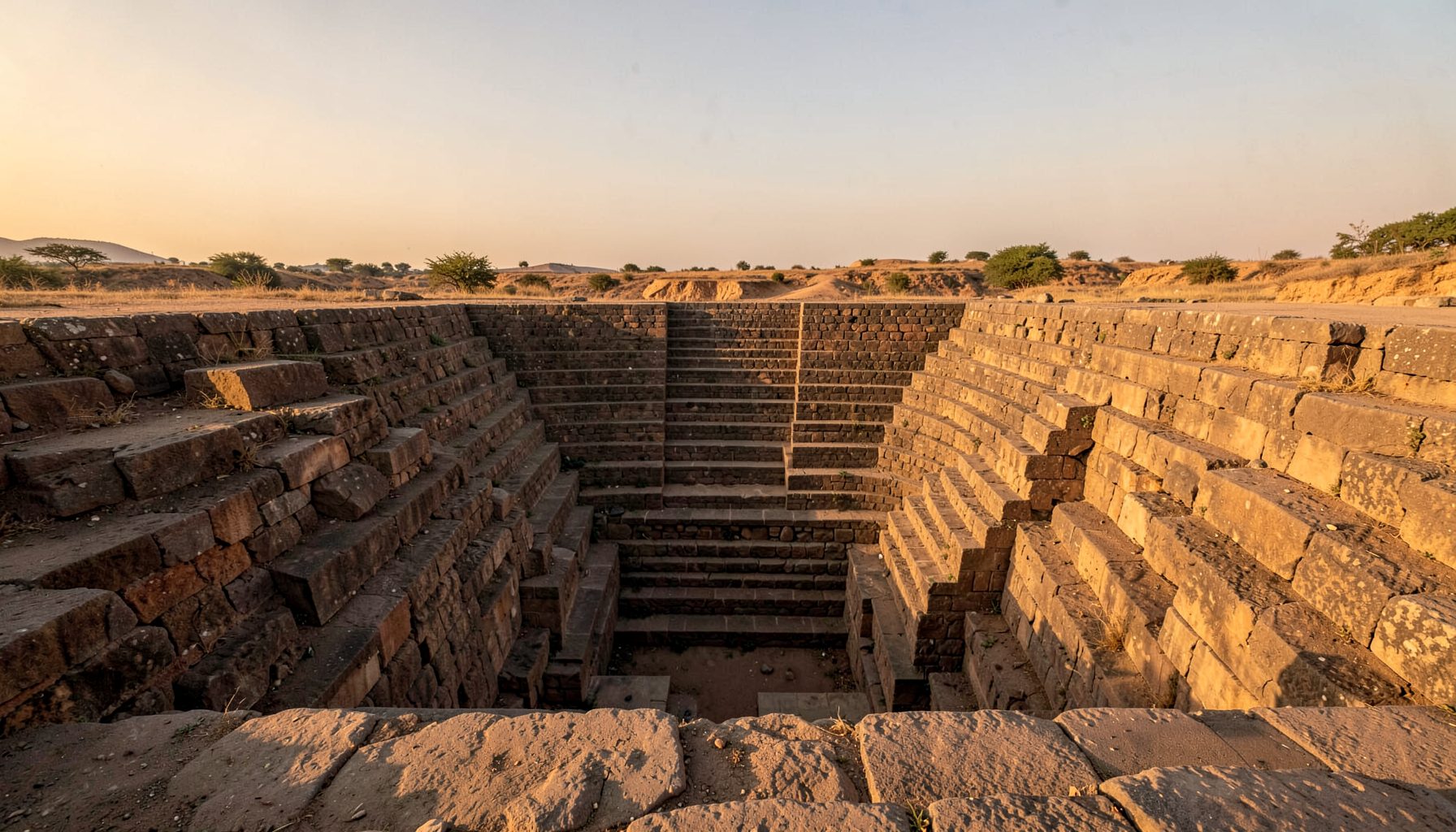
The stepwells of Bhuj: post-earthquake restoration efforts reveal how a historic water system can become a test of conservation judgement. On 26 January 2001, a magnitude 7.7 earthquake struck near Bhuj in Gujarat, damaging the city, nearby villages and a layered collection of monuments built to collect and share monsoon water. Restoring these structures required more than clearing debris: it required reading cracks, old masonry, water flow and community memory together.
Set in the dry landscape of Kutch, Bhuj’s stepwells were shaped by a climate where rainfall is seasonal, intense and unevenly distributed. Their stepped corridors, vaulted chambers and deep wells made water accessible while also cooling the surrounding settlement. The restoration effort has therefore combined structural repair with archaeological documentation, heritage education and renewed public use, producing a model relevant to historic water-conservation sites across western India.
Water Architecture for an Arid Region
The “stepwell” is an English umbrella term for several forms found across India, including the bawri, baoli, vav, kund and barav. Their shared purpose is water conservation, but local designs reflect different geology, groundwater conditions and building traditions. Kutch examples descend through carefully proportioned spaces, often using local stone and lime-based construction suited to the region’s heat and scarcity.
The Bhujodi area contains an important group of historic stepwells, while sites such as Navghan Kuvo and the Khavda stepwell are among those most frequently associated with the wider Bhuj landscape. Their architecture can include pillared landings, subterranean galleries and flights of stairs descending towards water. These features were not merely decorative: they organised movement, shade and collection within a settlement.
Comparable systems across the Kathiawar peninsula demonstrate how water architecture became part of civic and sacred life. Shared methods do not make every stepwell identical, however. The monuments around Bhuj must be understood within Kutch’s own materials, climate, water regimes and patterns of settlement.
The Earthquake and Its Structural Legacy
The 2001 earthquake damaged much more than the visible façades of Bhuj’s heritage buildings. At stepwells, seismic movement could fracture retaining walls, displace stair treads and deform the junctions between chambers and shafts. Roof or parapet collapse also carried stone into the wells, while loosened masonry created risks for anyone entering confined spaces.
Water management formed another part of the emergency. Debris, sediment and blocked passages could alter how rainwater entered a structure, sometimes directing pressure towards already weakened walls. A stepwell that had remained stable for centuries could therefore require drainage and structural intervention even where its main surfaces appeared largely intact.
Restoration began with recording rather than wholesale reconstruction. Archaeologists and engineers needed to distinguish earthquake damage from earlier repairs, identify surviving historic fabric and understand each monument’s original relationship with groundwater. Conservation has involved the Archaeological Survey of India, state heritage bodies, local authorities and community organisations, with responsibilities varying from site to site.
Stabilising the Fabric Without Rebuilding It
Careful conservation of a seismic-damaged stepwell begins with a measured record of its condition. Crack widths, displaced blocks, material loss and drainage routes can then be compared over time. This creates a defensible basis for deciding which elements should be stabilised, repaired or left visible as evidence of the earthquake.
The main priorities at Bhuj include:
- Recording cracks, settlement, blocked drains and displaced masonry before making permanent changes.
- Retaining sound historic stone wherever possible instead of replacing entire wall sections.
- Using compatible lime-based repairs rather than hard cement that could trap moisture.
- Installing discreet railings, stabilised edges and visitor limits in areas with structural risks.
- Monitoring drainage, groundwater and water quality so that repair work does not redirect moisture into the monument.
These principles allow a stepwell to remain recognisable as an evolving structure rather than a newly built imitation. Repair marks can be distinguished from original fabric, and reversible safety measures can protect visitors without erasing the qualities that make the site historically important.
Traditional masonry knowledge remains central to this process. Experienced local workers understand how stone responds to heat, salts and irregular loading, while conservation specialists contribute knowledge of archival research, engineering and documentation. Effective work joins those skills rather than treating local craft as supplementary to professional conservation.
Community Stewardship and Public Access
A stepwell is a water structure, but it also occupies a place in collective memory. Families may remember particular landings, wells, festivals or seasonal changes in water level. Those associations can reveal how the monument functioned socially, information that may be absent from architectural plans and excavation reports.
Community participation has several practical forms:
- Collecting oral histories in Kutchhi, Gujarati, Hindi and other languages used locally.
- Training local masons in lime preparation, stone repair and careful material reuse.
- Publishing bilingual site maps that explain access, safety and water history.
- Organising small guided walks led by residents rather than relying only on visiting specialists.
- Recording seasonal use, groundwater observations and changing visitor routes.
Public access must be balanced with preservation. Heavy foot traffic can wear stairs, while unrestricted entry into a chamber can worsen salt damage or create safety risks. Interpretation programmes work best when they explain why limits exist and help visitors recognise conservation as an active form of care.
This approach also connects restoration with education. Students can study geometry, climate adaptation and traditional engineering, while local organisations can use the site to discuss the history of water scarcity. A restored stepwell then becomes a classroom and a community resource rather than an isolated monument behind a barrier.
Conservation Lessons Extending into Maharashtra
Restoration in Bhuj offers lessons for Maharashtra, but the transfer must be sensitive to regional differences. Maharashtra’s stepwells can use basalt, sandstone, brick and lime plaster in combinations that differ from those found in Kutch. Groundwater behaviour, rainfall patterns and historic patronage also vary, meaning that a successful Bhuj repair detail cannot simply be repeated elsewhere.
That approach also connects with the Maharashtra campaign, where the same combination of photography, sketches and field research is helping identify both celebrated and neglected sites. Community reporting can reveal undocumented structures, damaged access routes and local names that formal records have missed.
A regional network also makes long-term monitoring more practical. When conservation records can be compared across districts, engineers gain a broader understanding of common failures and suitable materials. Photographic baselines, maintenance histories and community observations can reveal early movement before it becomes a major safety concern.
Field Records as an Engine of Preservation
Original photography is especially valuable because it records a monument’s condition before cleaning, repair or vegetation clearance changes its appearance. Architectural sketches clarify relationships that a photograph may flatten, while drone imagery can document roof plans, adjoining structures and the extent of collapse. None replaces ground-level observation, but together these records create a more complete account.
Digital access broadens the audience, yet credibility still depends on clear authorship and context. In broad online searches, heritage records can sit beside unrelated high-volatility gaming pages, making dated entries, named photographers and conservation terminology useful signs of a trustworthy archive.
Each restoration record should distinguish surviving original material from modern interventions and identify uncertainties honestly. Before-and-after images are strongest when accompanied by the date, direction of view, reason for the work and name of the responsible organisation. Exhibition captions can then tell a precise story without implying that a repaired element is older than it really is.
Following the Heritage Trail from Australia
Most Australian visitors to Bhuj travel through Delhi or Mumbai before connecting to Ahmedabad or Rajkot and continuing by road. Bhuj is not commonly a stand-alone Australian holiday destination, so it often appears alongside Gujarat, Rajasthan or other western Indian heritage routes. Australian heritage guides commonly use “stepwell” first and “baoli” second, while “Bhujodi stepwells” remains the most useful local phrase when requesting directions.
Similar public interpretation can be seen on walking routes through Adelaide, Fremantle and Ballarat, where industrial, civic and religious buildings are explained through signage, guides and community events. The comparison is useful because Australian cities also face the challenge of keeping historic structures relevant without losing their physical evidence or the stories attached to them.
The Australian preservation market usually works through a mixture of state agencies, local councils, philanthropic trusts, museums, volunteer groups and independent publishers rather than one national funding stream. Indian Stepwells can enter that ecosystem through exhibitions, commissioned photography, heritage events and exchanges between Australian researchers and Indian field teams. Such partnerships can give neglected Kutch monuments greater visibility while allowing Australian visitors to encounter conservation as an ongoing process, not simply the preservation of an attractive ruin.
Get in Touch
Have information about a stepwell that is not yet on our map? We would be glad to document it and give you full credit. Whether it is a Barav, Kund, Vihir, or any other form of stepwell, every contribution helps preserve India's water heritage.
Call or message us with details about the location, and we will follow up.
#9372496819
Send a Message
What People Say
"The Maharashtra Stepwells campaign has brought attention to structures that were nearly forgotten. The architectural documentation and drone photography are invaluable resources for researchers and students alike."
"Collaborating with the Indian Stepwells team gave our architecture students hands-on exposure to traditional water-harvesting structures. The presentations were insightful and inspiring."
"I shared details of a stepwell near my village that was not on any map. The team visited, documented it beautifully, and credited me. It felt wonderful to contribute."