 Explore Maharashtra
The Stepwells of Ahmedabad: A Walking Tour
Ahmedabad is best understood at walking pace. Behind busy roads, textile markets and modern cafés, its historic water architecture reveals a city shaped by heat, scarcity and careful civic planning. The stepwells of Ahmedabad, known locally as vavs and baolis, are more than impressive stone shafts: they are records of community life, engineering and devotion.
This route combines central Ahmedabad’s old pols with two remarkable stepwell sites on the city’s edge. It suits travellers who enjoy architectural detail, photography and a little improvisation. Distances can feel deceptive in the heat, so treat the walk as a sequence of short visits rather than a single uninterrupted hike.
For visitors arriving from Australia, the climate is an important part of the experience. Ahmedabad’s bright sun and dry heat can be more intense than a warm Melbourne or Perth day, while monsoon humidity changes the character of the streets. Start early, carry a refillable bottle, wear breathable clothing and allow time for shade, chai and slow observation.
The city also offers a useful connection with Australian water-conscious living. Many Australians are familiar with rainwater tanks, drought restrictions and the practical value of storing water at home. Ahmedabad’s subterranean reservoirs show how water conservation once operated at an urban, architectural scale, combining utility with ornament and public gathering.
Planning The Walking Route
Begin in the old city, where the pol neighbourhoods preserve timber façades, carved brackets, narrow lanes and small shrines. A short auto-rickshaw ride can connect the crowded centre with Dada Harir ni Vav, while Adalaj Vav is better treated as a separate excursion north of Ahmedabad. The route is therefore a walking tour in spirit, with brief vehicle transfers making the day manageable.
A practical schedule is to visit the old city early, continue to Dada Harir before the afternoon glare, and reserve Adalaj for a second morning if possible. Australian travellers used to clearly marked suburban footpaths may find the lanes unpredictable: motorcycles, scooters, vendors and pedestrians share the same space. Comfortable walking shoes are more useful than dress sandals, and a local guide can explain details that signs leave out.
Dada Harir Ni Vav
Dada Harir ni Vav, also called Bai Harir ni Vav, lies in Asarwa, a short distance from the historic centre. Commissioned in the late fifteenth century by Dhai Harir, a superintendent associated with the Gujarat Sultanate, it descends through several levels of finely carved sandstone. The structure is both monumental and intimate, with stairways, platforms and pillared galleries arranged around the well shaft.
The changing light is one of its strongest visual qualities. From the upper entrance, the geometric descent appears ordered and formal; lower down, the walls become cooler, quieter and more enclosing. Look for inscriptions, floral motifs and the way carved columns frame small fragments of sky. The site rewards sketches and measured photographs more than hurried snapshots.
Adalaj Vav Beyond The City
Adalaj Vav is among Gujarat’s most celebrated stepwells, built in 1498 under the patronage of Rudabai, the wife of the Vaghela ruler Rana Veer Singh. Its five levels combine Hindu and Islamic decorative language, reflecting the political and cultural complexity of the region. The octagonal shaft, balconies and carved pavilions create a carefully choreographed descent towards water.
Although it is outside the central walking grid, Adalaj belongs in any study of Ahmedabad’s water heritage. Reach it by taxi, auto-rickshaw or a booked car, and avoid the hottest middle hours. The site is popular with school groups, wedding photographers and domestic visitors, so an early arrival provides better opportunities to see the structure without blocking circulation.
For those interested in conservation across India, the Maharashtra campaign offers a useful comparison. Maharashtra’s bawdis, kunds and baravs often have different materials and regional forms, yet they share the same broad story: water infrastructure becomes heritage when communities continue to recognise its value.
Reading The Architecture
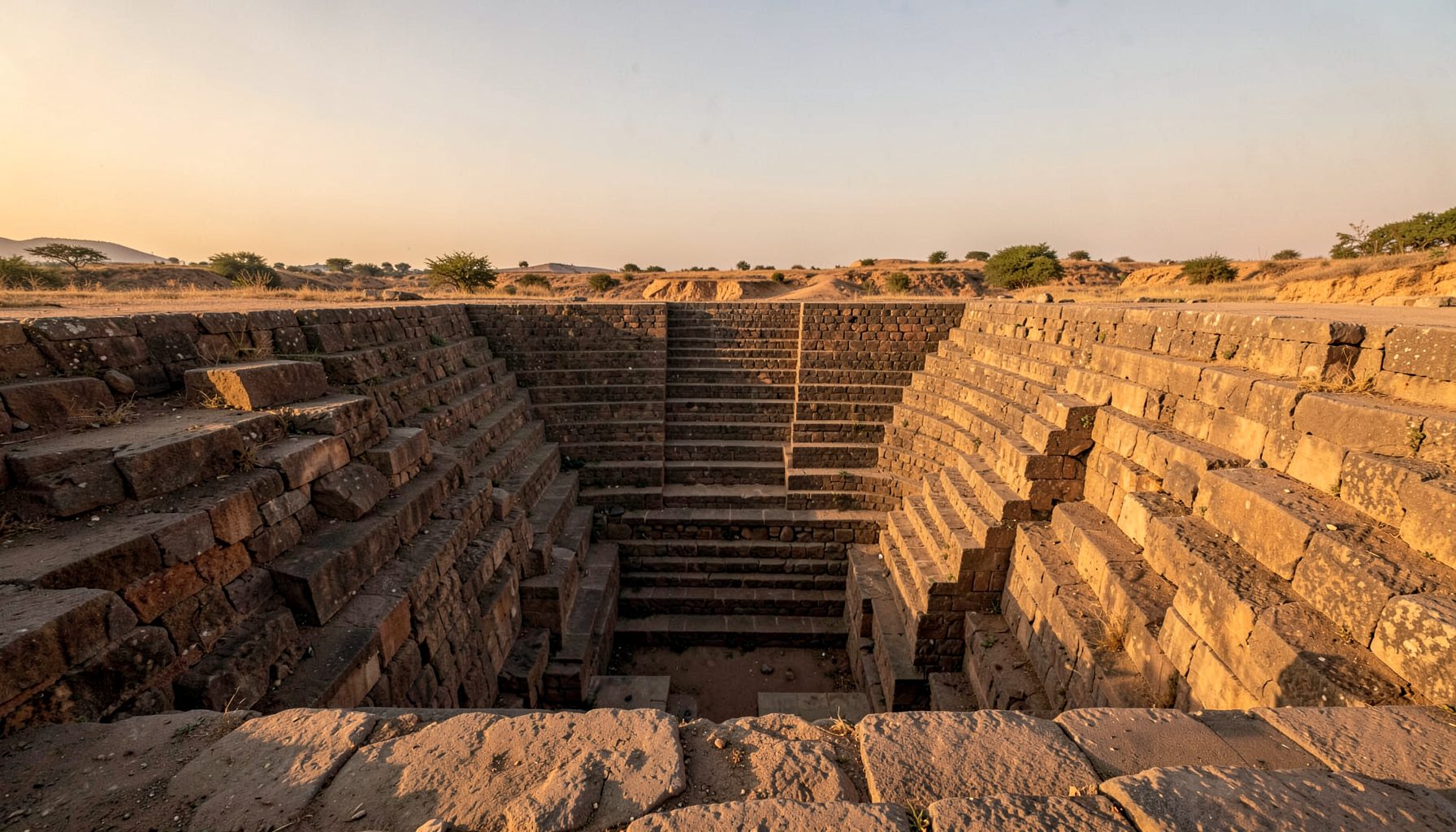
A stepwell is best read from the top down. The entrance establishes orientation, the descending flights manage movement, and the pavilions create resting places between levels. Deep construction reduced exposure to the sun and helped maintain cooler conditions near the water. Structural rhythm was therefore inseparable from climate adaptation.
Notice how the architects controlled views. A stairway may reveal only a narrow slice of the next gallery, encouraging a gradual discovery of depth. Pillars support shade while also producing a visual procession of repeated frames. Carvings of flowers, animals, deities and geometric patterns softened the technical purpose of the building without disguising its engineering logic.
Water, Memory And Symbolism
Stepwells were practical reservoirs, but they also carried social and spiritual meaning. Women often played a central role in collecting water, and the well could become a place for conversation, ritual, rest and exchange. Donations by royal women, merchants and administrators demonstrate that water infrastructure was tied to reputation, public generosity and the wellbeing of a settlement.
This broader symbolism can be compared with memorial traditions elsewhere. The symbolism of the oak tree shows how a functional or natural form can acquire layers of memory and identity. In Ahmedabad, the stepwell’s descending form, enduring stone and connection to communal survival similarly allow architecture to speak beyond its original use.
Details Worth Recording
A heritage photographer should work with restraint. Wide-angle images communicate the scale of a vav, while closer views reveal tool marks, weathering and the relationship between stone blocks. A small notebook is valuable for recording orientation, inscriptions, local names and signs of repair. Drone photography may require permission, particularly near dense neighbourhoods or protected monuments.
Useful details to look for include:
- Repeated column patterns that mark changes in level
- Water stains, mineral deposits and repaired masonry
- Carved figures partly concealed by shadow
- Views from the entrance towards the lowest visible chamber
- People using the surrounding space rather than the historic fabric
Avoid climbing on fragile edges, touching carvings unnecessarily or photographing people closely without consent. The best images often include scale without turning local visitors into props. For an independent documentation project, field notes and respectful observation are as important as a polished final photograph.
Conservation In A Living City
Ahmedabad’s stepwells face familiar pressures: rubbish, groundwater decline, vegetation, traffic vibration, inappropriate repairs and changing patterns of use. Conservation is not simply a matter of cleaning stone. It requires drainage management, structural monitoring, controlled visitor access and an understanding of how nearby residents relate to the monument.
The Raniji Ki Baori restoration demonstrates how careful work can recover architectural meaning while protecting historic fabric. Similar principles matter in Gujarat: remove damaging growth gradually, document every intervention and avoid replacing old stone with visually convenient but incompatible materials.
Visitors can support preservation through responsible spending and accurate sharing. Choose guides who value local history, buy from legitimate craftspeople and avoid geotagging vulnerable undocumented sites. If a neglected baoli appears during a village visit, record its location and condition from a safe distance rather than entering unstable chambers.
A Comfortable Day In Ahmedabad
Plan your route around the sun rather than around a checklist. An early start, a shaded lunch and a late-afternoon return to the old city will make the experience more enjoyable than forcing every site into one exhausting day. Australian travellers may recognise the logic from summer bushwalking: carry water, protect yourself from glare and take heat warnings seriously.
Keep these practical points in mind:
- Use a local SIM or offline maps before leaving the hotel
- Carry small notes for entrance fees, refreshments and short rides
- Wear a hat and closed shoes suitable for uneven stone
- Ask before photographing ceremonies, workers or private homes
- Leave room in the schedule for delays and unexpected street activity
Ahmedabad’s food, markets and neighbourhood life are part of the route rather than distractions from it. A Gujarati thali, a cup of masala chai or an evening walk near the Sabarmati can help place the stepwells within the living city that built and maintained them. Australian visitors accustomed to fixed tourism itineraries may find that the most memorable moments arrive between planned stops.
The walk also shows why documentation matters. Some famous vavs receive regular attention, while smaller kunds, wells and fragments remain absent from public records. Local knowledge can identify names, former water channels and seasonal uses that official descriptions overlook. Sharing this information responsibly helps build a fuller account of Ahmedabad’s historic water network.
A stepwell is never just an empty monument beneath the ground. It is an archive of climate knowledge, craftsmanship, patronage and everyday movement. Walking through Ahmedabad’s vavs makes those connections visible, one shaded stairway and carved column at a time.
Get in Touch
Have information about a stepwell that is not yet on our map? We would be glad to document it and give you full credit. Whether it is a Barav, Kund, Vihir, or any other form of stepwell, every contribution helps preserve India's water heritage.
Call or message us with details about the location, and we will follow up.
#9372496819
Send a Message
What People Say
"The Maharashtra Stepwells campaign has brought attention to structures that were nearly forgotten. The architectural documentation and drone photography are invaluable resources for researchers and students alike."
"Collaborating with the Indian Stepwells team gave our architecture students hands-on exposure to traditional water-harvesting structures. The presentations were insightful and inspiring."
"I shared details of a stepwell near my village that was not on any map. The team visited, documented it beautifully, and credited me. It felt wonderful to contribute."