 Explore Maharashtra
The stepwell of Modhera: a masterpiece in stone and water
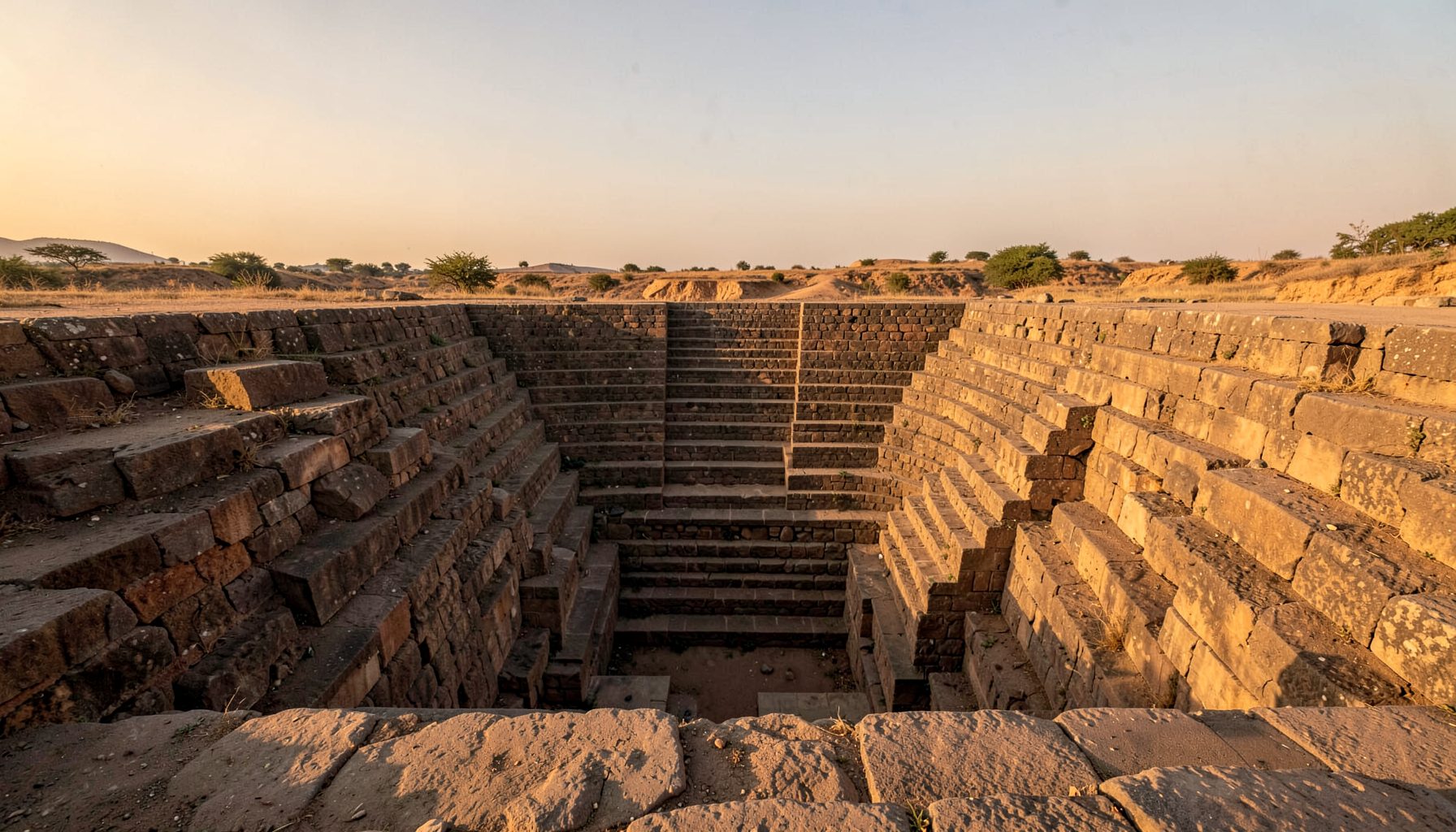
In northern Gujarat, the Sun Temple at Modhera is celebrated for its carved mandapas, solar symbolism and finely detailed sculptures. Yet its most immediate architectural experience begins before the shrine itself, at a vast stepped tank known as Suryakund or Ramakund. Descending towards the water, visitors move through a carefully composed landscape of geometry, shadow and sacred imagery.
Built during the reign of Solanki ruler Bhima I around the early eleventh century, the complex demonstrates how water, worship and royal design could operate as one architectural idea. The tank was not a practical reservoir separated from the temple; it formed the ceremonial forecourt and prepared the visitor for the sacred spaces beyond.
For Australians familiar with drought restrictions, rainwater tanks and water-sensitive urban design, Modhera offers a powerful historical perspective. It shows how water infrastructure can carry cultural meaning while responding to climate, topography and public life. The site is also a reminder that a water structure may deserve the same attention as the monument it serves.
A sacred approach shaped by water
Suryakund is a large rectangular stepped tank arranged on the eastern side of the temple. Its flights of stairs descend in precise patterns towards the former water basin, creating a strong visual axis leading to the Sun Temple. Small shrines occupy many of the terraces and corners, turning the edges of the tank into a sculptural procession.
The tank’s stepped geometry allowed people to reach different water levels as the season changed. It also created platforms for movement, pause and ritual. The repeated triangular forms produce an almost mathematical rhythm, but the effect is softened by carved deities, ornamental details and changing sunlight.
The relationship between tank and temple is central to the site’s meaning. A visitor approaching from the east would encounter the water court first, then continue towards the assembly hall and sanctum. The sequence makes physical movement part of the religious experience, a principle that can be studied through the field photography and architectural records collected by Indian Stepwells.
Geometry, shrines and solar symbolism
Suryakund is often described as a stepwell because of its descending flights and water-management function, although technically it is a stepped tank or ritual reservoir. This distinction matters when comparing Gujarat’s vavs and baolis with kunds across western and central India. Each type responds to water access differently, yet all can combine utility with ceremony and visual drama.
The tank is traditionally associated with 108 small shrines, a number with strong significance in Hindu religious traditions. These include images of deities such as Vishnu, Shiva and Shitala Mata, placed within niches around the stepped perimeter. The shrines transform the act of approaching water into a passage through a sacred landscape.
The wider temple complex is dedicated to Surya, the sun god, and its east-facing orientation reinforces the connection with light. Carved figures, celestial beings, dancers and scenes from daily life occupy the walls of the sabha mandapa and gudhamandapa. At sunrise, the stone surfaces reveal changing textures, making time and illumination part of the architecture.
Details worth observing on a field visit
Modhera rewards slow looking. The principal axis is easy to recognise, yet the smaller shrines, fractured mouldings and transitions between open and enclosed space can be missed during a quick visit. Australian travellers may find the experience closer to walking through an archaeological landscape than entering a conventional enclosed museum.
The following details help explain why the complex is regarded as a masterpiece:
- The repeated stair flights create a powerful pattern of solids, voids and diagonal shadows.
- The tank’s shrines connect the water court with a wider sacred geography.
- The assembly hall uses carved columns to frame movement, light and views.
- Solar imagery appears through the temple’s orientation and sculptural programme.
- The stonework records both elite patronage and the skills of specialised craftsmen.
Visitors should plan around Gujarat’s intense heat, particularly between late morning and mid-afternoon. A wide-brimmed hat, water bottle, sun protection and sturdy footwear are practical choices, much as they would be for a long heritage walk in Perth, Adelaide or regional New South Wales. The stone can become extremely hot, and the open tank offers little shade.
Water management before modern infrastructure
Stepwells and stepped tanks were part of a broad water culture that supported settlements, travellers, agriculture and religious institutions. Their design responded to seasonal rainfall, fluctuating groundwater and the need to make water accessible during dry periods. A detailed account of medieval water management places Modhera within this larger network rather than treating it as an isolated artistic achievement.
The Australian comparison is useful when handled carefully. Contemporary cities such as Melbourne and Sydney invest in stormwater harvesting, permeable surfaces and water-sensitive urban design, while communities in inland Queensland and Western Australia may depend on tanks, bores or carefully managed local supplies. Modhera belongs to a different climate, technology and religious world, yet it expresses a familiar principle: water systems become more resilient when their design is understood by the community that uses them.
Suryakund also shows that conservation cannot focus only on the temple’s sculptural walls. Drainage, groundwater, visitor pressure, vegetation and seasonal weather all affect the survival of the stepped tank. Recording the site through measured drawings, drone imagery and repeat photography can help researchers track changes that are difficult to see in a single visit.
Reading the complex through Australian eyes
For an Australian audience, Modhera can be approached through several familiar heritage questions. How should a monument be interpreted when its original water function has changed? How can public access be balanced with the protection of fragile stone? What responsibilities belong to government, conservation professionals, local residents, guides and visitors?
These questions also arise at Aboriginal cultural sites, historic water infrastructure and colonial-era landscapes across Australia, although the histories and custodianship frameworks are different. Any comparison should respect those differences, especially where Indigenous cultural authority and Country are concerned. Modhera’s lessons are strongest when they encourage careful observation rather than easy equivalence.
Photography is valuable here, provided it remains attentive to the place. Wide drone views reveal the tank’s geometry, while close images record tool marks, worn steps and damaged carvings. For an exhibition in Melbourne, Brisbane or Canberra, pairing these photographs with sketches and measured diagrams could communicate the relationship between engineering and ritual more effectively than isolated images of ornament.
A living heritage resource
The Sun Temple at Modhera is protected as a major monument, yet heritage survives through continuing interpretation. Local guides, researchers, schools, photographers and visitors all contribute to the way the site is understood. Responsible tourism supports conservation when it values accurate information, respects restricted areas and avoids treating sacred architecture as a decorative backdrop.
The complex also belongs to a wider conversation about documenting lesser-known water structures. Across India, many stepwells, baolis, bawdis and baravs remain absent from public records or are known only within nearby communities. Sharing local knowledge can reveal historic names, seasonal uses, oral histories and connections to older settlement patterns.
Useful principles for documenting a stepwell include:
- Record its location, approach route and relationship to nearby buildings.
- Photograph stairs, landings, water channels, shrines and structural damage.
- Ask residents about names, festivals, former uses and seasonal changes.
- Note access conditions without disturbing rituals or private property.
- Preserve original files and label images with dates and approximate viewpoints.
The stone tombs, wells and churchyards of other cultures can prompt similar questions about memory and place; an account of the tomb of the bards demonstrates how a modest historic setting can hold layers of cultural meaning. Modhera achieves this at monumental scale, but its significance likewise depends on the stories, practices and records attached to the physical structure.
The masterpiece is therefore more than a collection of carvings. It is a coordinated experience of descent, water, worship, sunlight and movement. Suryakund makes the temple’s approach unforgettable because it gives infrastructure a ceremonial language. In a time when water security is a pressing concern for communities from Canberra to Cairns, Modhera offers an enduring example of architecture that treats water as both a resource and a shared cultural responsibility.
Get in Touch
Have information about a stepwell that is not yet on our map? We would be glad to document it and give you full credit. Whether it is a Barav, Kund, Vihir, or any other form of stepwell, every contribution helps preserve India's water heritage.
Call or message us with details about the location, and we will follow up.
#9372496819
Send a Message
What People Say
"The Maharashtra Stepwells campaign has brought attention to structures that were nearly forgotten. The architectural documentation and drone photography are invaluable resources for researchers and students alike."
"Collaborating with the Indian Stepwells team gave our architecture students hands-on exposure to traditional water-harvesting structures. The presentations were insightful and inspiring."
"I shared details of a stepwell near my village that was not on any map. The team visited, documented it beautifully, and credited me. It felt wonderful to contribute."