 Explore Maharashtra
The Art of the Niche: Sculpted Beauty in Stepwell Walls
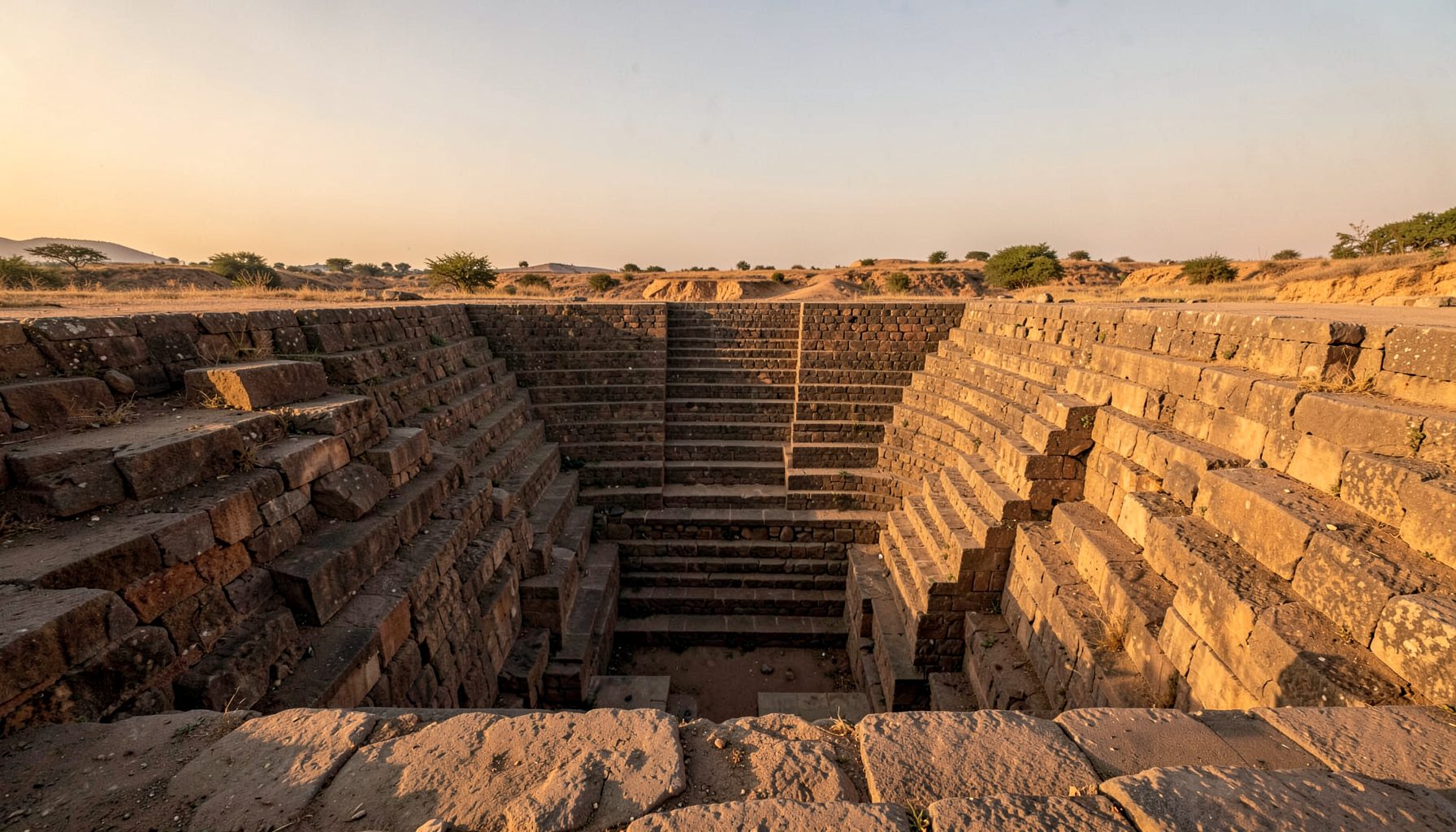
Across western and northern India, stepwells rise from arid plains as monuments where water, faith, and craftsmanship meet. Long before photography documented their carved walls, generations of stonemasons translated religious devotion, regional folklore, and geometric precision into niches cut directly into the descending levels of these structures. Today, those decorative recesses offer one of the richest visual archives of subcontinental heritage, and they continue to attract researchers, photographers, and travellers from as far as Sydney and Melbourne who seek to understand how water infrastructure became a canvas for art.
Australian readers familiar with the sandstone carvings around Sydney's heritage buildings, or with the restoration debates around Adelaide's Victorian facades, will recognise a familiar conversation about ornamentation and preservation. Stepwell niches invite a similar reflection, but on a far older and more sculptural scale. From the multi-storeyed pavilions of Adalaj to the silent chambers of Chand Baori, the carved details reward patient observation, and several Australian cultural institutions have begun incorporating Indian water architecture into their South Asian studies programmes.
Reading the carved surfaces of a stepwell
A niche in a stepwell is rarely a hollow afterthought. It is a deliberate architectural device that breaks the monotony of descending walls, provides a resting point for the eye, and creates a stage for figurative or floral ornament. Many stepwells feature hundreds of these recesses, each one carved to a slightly different depth so that daylight filtering down from the upper levels gradually reveals new layers of detail. The effect is closer to a slow-burning lantern than a static wall, and it is this quality that distinguishes stepwell ornament from temple friezes or palace reliefs.
Architectural historians attached to the University of Melbourne's Melbourne School of Design have compared these recessed compositions to the bracketed ledges of Federation-era verandas, where ornament also responds to light and shade. The comparison is useful because it reminds us that decorative architecture always speaks to climate as much as culture. In the heat of Rajasthan or Gujarat, niches created shadow pockets that cooled both the structure and the visitor pausing to draw water.
Iconography and what the figures represent
The motifs carved into these recessed spaces are extraordinarily varied. Some niches hold standing deities, others shelter river goddesses such as Ganga and Yamuna, and many frame narrative panels drawn from the Ramayana, the Mahabharata, or local legends. Floral arabesques, lotus medallions, and elephant processions appear alongside abstract geometric patterns, reflecting the same decorative vocabulary found across medieval Indian craft traditions. Each stepwell acts almost like a regional sampler, mixing pan-Indian iconography with locally revered figures.
Placement carries meaning. Niches on the upper levels tend to display solar or royal imagery, while those closer to the water table often carry fertility symbols, water deities, or guardian serpents. A niche placed at a turning in the staircase might show a musician or dancer, offering a visual pause at a moment when the visitor physically slowed. Brisbane-based South Asian art researchers have noted similar hierarchical arrangements in the Jain manuscripts held at the Queensland Art Gallery, where decorative borders echo the cosmological ordering seen in stepwell carvings.
For readers exploring the topic further, a useful starting point is the documentation project itself, where the project's background explains how communities gather local observations about undocumented stepwells. This grassroots approach mirrors the open-source mapping traditions popular in Australian heritage conservation, where citizen-led surveys complement government registers.
Techniques that brought the walls to life
The artisans who carved these walls worked primarily in sandstone, limestone, and basalt, depending on the regional geology. Mallets, chisels, and fine drills allowed them to undercut figures so that limbs and headdresses projected beyond the niche frame. This technique, sometimes called deep relief, gives many stepwell figures a three-dimensional presence even within a shallow recess. Traces of pigment, lime plaster, and even metallic foil have been found in some niches, suggesting that what we see today is often only the stone skeleton of a once brightly polychromed surface.
The labour behind a richly carved wall was collective. Master carvers led teams of apprentices, with each generation refining motifs inherited from earlier projects. The slight variations between identical motifs on the same wall are evidence of multiple hands at work, a feature that also appears in the carved sandstone of Perth's older civic buildings. Recognising this collaborative authorship helps visitors appreciate that a stepwell wall is less a single artwork and more an anthology of regional craft knowledge.
Regional voices in stone
Different parts of the country developed distinct decorative dialects. In the west, Gujarati and Rajasthani stepwells favour jali screens, lotus bosses, and elephant friezes. In Maharashtra, basalt allowed for sharper, more angular cuts, with niches often framing Maratha-style deities and warriors. Northern examples, particularly those around Delhi and Haryana, tend toward the ornate, almost lace-like carving associated with late Sultanate and early Mughal patronage. Each region absorbed influences from trade routes, court tastes, and local temple-building traditions.
Chand Baori in Abhaneri is one of the most studied examples, partly because its 3,500 steps preserve a remarkably consistent decorative vocabulary across thirteen storeys. Recent documentation work has used drone-based surveys to capture its scale and surface detail, and the aerial survey results revealed subtle patterning along its walls in ways that ground-level imagery had long obscured. The same survey techniques are now being trialled by Australian archaeologists mapping rock-art sites in the Kimberley, suggesting a shared methodological conversation between continents.
Materials, weathering, and the modern eye
Centuries of monsoon humidity, dry winds, and groundwater seepage have all taken their toll. Many niches have lost their sharper edges, and some have been damaged by later repairs using incompatible materials. Australian conservation specialists often point to the lessons of the Burra Charter, the country's widely adopted guide for heritage places, which emphasises minimal intervention and clear documentation of change. Applied to stepwell walls, the charter's principles encourage conservators to record original carving before any cleaning or stabilisation work is undertaken.
Modern viewing conditions differ sharply from those the carvers intended. Tourists now arrive with smartphones rather than brass lotas, and the play of light and shadow on the carved walls shifts as surrounding neighbourhoods grow taller. South Asian studies programmes at the Australian National University in Canberra have begun incorporating photogrammetry workshops, where students learn to build three-dimensional models of niches from ordinary photographs, a technique with obvious parallels to Australian efforts to preserve shipwreck timbers off the Victorian coast.
Patterns worth looking for when you visit a stepwell
A patient visitor can train their eye to read decorative niches the way a reader parses a paragraph, by spotting repeated motifs, deliberate breaks in rhythm, and small details that reward closer attention. The list below gathers some of the patterns that frequently appear in stepwell walls, though every monument offers its own regional twist.
- The change in motif scale between upper pavilions and lower water chambers
- Undercut carving that allows casts of light to fall onto adjacent figures
- Mixed iconography, such as a Hindu deity beside a Jain tirthankara
- Traces of pigment or plaster that show where colour once animated the stone
- Regional mason's marks hidden within floral borders
- A single off-rhythm niche that breaks an otherwise repeating pattern
Tools and approaches for closer study
Field study of carved walls can feel intimidating at first, but a small kit and a steady routine open up details that casual visitors miss entirely. For Australian researchers considering publishing their findings, starting a heritage blog is one of the simplest ways to share sketches, photographs, and field notes with a wider audience without the overheads of a formal academic press.
- A small mirror for examining undercut detail on carved ceilings
- A phone with a manual camera app for bracketed exposures in low light
- A field sketchbook for recording motifs before photography
- A torch with adjustable focus to throw raking light across reliefs
- A measuring tape for documenting niche dimensions and spacing
- A printed iconography guide for identifying regional deities and symbols
Get in Touch
Have information about a stepwell that is not yet on our map? We would be glad to document it and give you full credit. Whether it is a Barav, Kund, Vihir, or any other form of stepwell, every contribution helps preserve India's water heritage.
Call or message us with details about the location, and we will follow up.
#9372496819
Send a Message
What People Say
"The Maharashtra Stepwells campaign has brought attention to structures that were nearly forgotten. The architectural documentation and drone photography are invaluable resources for researchers and students alike."
"Collaborating with the Indian Stepwells team gave our architecture students hands-on exposure to traditional water-harvesting structures. The presentations were insightful and inspiring."
"I shared details of a stepwell near my village that was not on any map. The team visited, documented it beautifully, and credited me. It felt wonderful to contribute."