 Explore Maharashtra
The Architecture of Symmetry in Gujarat's Vavs
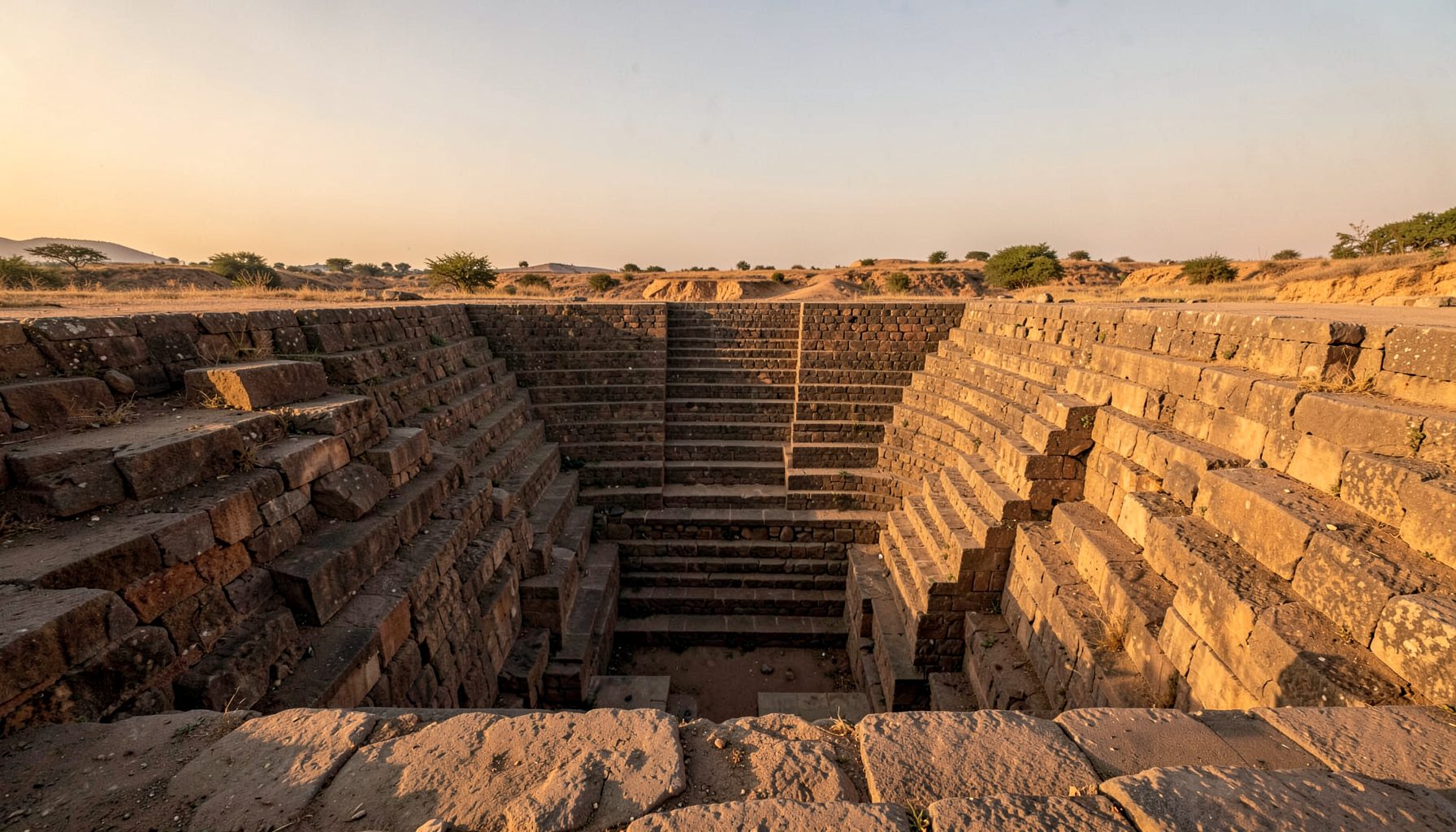
In the arid plains of Gujarat, master builders sank vavs into the earth, designing each around an invisible spine of symmetry that governs how light, water, and worshipper move through the structure. These stepwells were never improvised. Before carving began, the architect laid out a precise geometric idea — an octagon, a square within a square, or a mirror-image pair of staircases — and let every pillar, parapet, and pool obey it.
A vav differs from a baoli or a kund in important ways. While baolis across North India often follow a rectangular, more utilitarian plan, the Gujarati vav developed a distinct vertical and bilateral logic. Its pavilions descend in stepped tiers, each repeating the rhythm of the one above and below, so the eye reads the well not as a hole but as a folded poem carved in stone.
For Australian travellers tracing India's deep architectural traditions, a vav offers something most museums in Sydney or Melbourne can offer: a three-dimensional geometry that you walk into. The same instinct that draws visitors to the sandstone arcades of The Rocks or the inter-war civic buildings of Melbourne finds a deeper expression beneath the dust of Patan or Adalaj.
What makes symmetry worth studying is the way it fuses engineering with devotion. The central axis of a vav aligns with the cardinal directions, the path of the sun, and the village well from which families once drew water at dawn. The Indian Stepwells project has been mapping this relationship between ritual geometry and water access for several seasons.
Geometric foundations and axial plans
Gujarati vavs were built on a small family of geometric schemes, and the choice of plan dictated everything that followed. The most common was the octagonal plan, used in stepwells such as Adalaj and several smaller vavs near Ahmedabad. An octagon allowed builders to repeat identical pillar-and-arch units eight times around a central shaft, producing a hypnotic rotational symmetry.
A second scheme was the rectangular or square plan, often expanded into a cruciform with four projecting wings. Here symmetry took a bilateral form: walk down the eastern entry, and the western exit mirrors it almost perfectly. Dada Harir in Ahmedabad, completed in the late fifteenth century, combines both schemes, with a rectangular upper landing opening into an octagonal lower well.
A third, rarer form was the circular vav, where the entire descent spiralled around a single cylindrical void. Builders invented curved cornices with no precedent in temple architecture, yet the result was so orderly that visitors describe it as stepping inside a mandala.
The central axis and vertical layering
Almost every vav is organised around a single vertical line drawn from the surface wellhead down to the deepest water level. This axis is not a metaphor but a load-bearing reality: the deepest pillars and heaviest beams sit directly over the water source, and the lighter pavilions float outwards from that core.
Layering follows this axis in clear bands. At the top, an open courtyard frames the sky. One storey down, columned galleries surround the well shaft, often screened by perforated stone jaalis that filter the brutal Gujarat sun. Deeper still, the temperature drops and the columns thicken.
Each storey is essentially a horizontal ring, a near-perfect copy of the one above. The eye learns the rhythm quickly, and after the second landing the visitor can predict where the next pillar will stand.
Mandapas and pavilions as symmetrical anchors
The pavilions inside a vav are called mandapas, and they function as anchor points of the symmetrical plan. A mandapa is a columned hall, often open on all four sides, marking a resting level, a turning point, or a place for ritual. Because a mandapa is symmetrical in itself, repeating its pillar grid in both directions, it reinforces the broader geometry of the well.
In many vavs, mandapas appear at every storey, each rotated slightly so that the visitor's view of the well shaft shifts as they descend. Builders also used paired pavilions to emphasise the entrance axis. At Rani ki Vav in Patan, the entry sequence passes through three nested pavilions before reaching the well proper, each one framing the next like matched picture frames in a corridor.
Carved details and mirrored ornament
The most visible expression of symmetry in a Gujarati vav is the carving itself. Sculptors on one wall could be matched, almost stone for stone, against sculptors on the opposite wall. In the best-preserved examples, a Vishnu image on the east wall has a matching consort figure on the west, and a dancing apsara on the north reappears, in reverse posture, on the south.
This mirrored ornament extends beyond iconography. Foliate scrollwork, miniature temple motifs, and decorative friezes follow the same mirror logic. Even the wear patterns on the stone, after eight centuries of barefoot pilgrims and monsoon humidity, tend to develop symmetrically.
Australian visitors familiar with the bilateral composition of Federation-era terraces in Sydney's inner west, or with the mirror-image floor plans of Victorian public buildings in Adelaide, often find that the carved surfaces of a vav resonate with the same design instincts. For researchers used to working within frameworks such as the Environment Protection and Biodiversity Conservation Act, the listing of Rani ki Vav as a UNESCO World Heritage Site offers a familiar point of comparison: heritage protection as both a legal tool and a cultural conversation.
Light, shadow, and reflective pools
Symmetry in a vav is not only a property of stone but of light. At certain hours, the perforated jaali screens cast shadows that fall in geometric grids across the floors and pillars below, and the play repeats, inverted, on the opposite side.
When water is present at the bottom of the well, the vertical axis acquires a second, reflected half. The surface of the pool becomes a mirror plane, and the entire architecture is doubled. Visitors who arrive at midday see one composition; visitors who arrive when sunlight enters horizontally see another, with the carved columns appearing to float in the reflected image.
Photographers chasing these moments often work with a specific set of field techniques:
- Arriving in the first hour after sunrise, when shafts of light enter at a steep angle
- Using a polarising filter to deepen the water reflection and reduce glare on the sandstone
- Composing with the central axis running vertically through the frame
- Returning in the monsoon, when lowered water levels reveal carved walls not visible in dry months
The patience required to read these structures also defines a good photographic survey, and methods outlined in a related photographic journey through Pune's lesser-known stepwells apply in equal measure to the vavs of Gujarat.
Comparing Adalaj, Rani ki Vav, and Dada Harir
Although every vav shares a symmetrical grammar, the three most celebrated examples use that grammar differently. Adalaj, north of Ahmedabad, is a four-storey octagonal well whose pavilions rotate gently as they descend, producing a corkscrew rhythm that pulls the eye downward in a slow spiral.
Rani ki Vav in Patan, a UNESCO World Heritage Site, is the deepest and most extravagantly carved, with seven storeys of pavilions arranged around a rectangular spine that bends slightly near the base. Its symmetry is dense and rewards repeat visits.
Dada Harir, in the older quarters of Ahmedabad, is the most compact and most rigorous in its mirror symmetry. Its upper galleries are a textbook exercise in bilateral ornament: every figure, every vine, every decorative border has a twin on the opposite wall.
Reading symmetry in the field
For visitors who want to read symmetry actively, a simple approach helps. Stand at the entrance and identify the central axis — often marked by a slightly larger pillar or a line of skylights above. Walk that line to the water, noting how each landing repeats the geometry of the one above. Then return to the surface and walk the cross axis.
Several symmetrical elements reward close attention during a field visit:
- The placement of the main mandapa, which often sits exactly on the central axis
- The orientation of carved deities, which typically face inward toward the well shaft
- The pattern of jaali screens, whose perforations usually form a repeating geometric lattice
- The shadow grid cast by the upper pavilions at midday, marking the rotational symmetry
Contributing to the broader documentation of these structures is straightforward, and field researchers who encounter lesser-known vavs are welcome to share their findings. For Australians planning heritage trips, the long-weekend rhythm of travel from Brisbane or Perth, combined with India's cooler dry season, makes a focused study tour of three or four vavs in ten days entirely realistic.
Symmetry in a vav is rarely accidental. It is the grammar that allowed builders to carve a hole in the earth and turn it into a temple, a reservoir, a cool gathering hall, and a piece of geometry — all in one structure.
Get in Touch
Have information about a stepwell that is not yet on our map? We would be glad to document it and give you full credit. Whether it is a Barav, Kund, Vihir, or any other form of stepwell, every contribution helps preserve India's water heritage.
Call or message us with details about the location, and we will follow up.
#9372496819
Send a Message
What People Say
"The Maharashtra Stepwells campaign has brought attention to structures that were nearly forgotten. The architectural documentation and drone photography are invaluable resources for researchers and students alike."
"Collaborating with the Indian Stepwells team gave our architecture students hands-on exposure to traditional water-harvesting structures. The presentations were insightful and inspiring."
"I shared details of a stepwell near my village that was not on any map. The team visited, documented it beautifully, and credited me. It felt wonderful to contribute."