 Explore Maharashtra
Stepwells of the Konkan Coast Hidden Beneath the Palms
Along the slender strip of western India where the Sahyadri foothills tip into the Arabian Sea, the Konkan coast stretches from Mumbai's southern edges through the palm-thick districts of Ratnagiri and Sindhudurg, and into the estuarine maze of Goa. Travellers arriving at Goa airport recognise the coast by its coconut groves, cashew plantations, and curving beaches. Hidden within this landscape, however, lies a quieter water heritage that even many Maharashtrans have never seen: a chain of stepwells known locally as vavs, baravs, and kunds. Their construction responds to one of the wettest climates in the subcontinent, where the monsoon delivers more rain in four months than parts of the inland Deccan receive in a year.
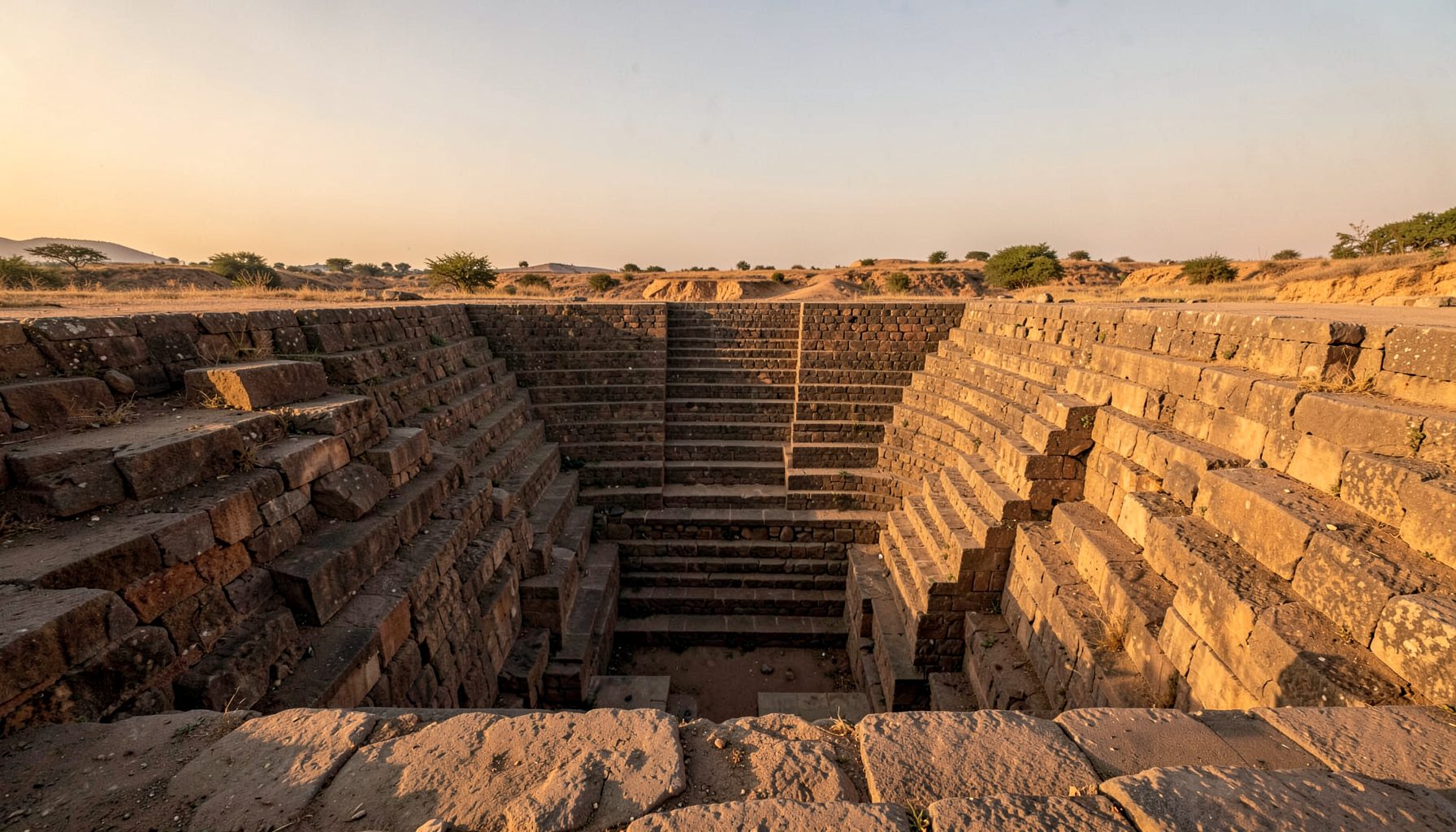
The Konkan's stepwells are smaller than the monumental vavs of Gujarat and less ornate than the sandstone chambers of Rajasthan, yet they answer to a regional logic all their own. Built from the porous laterite that lines the coast, lined sometimes with basalt shipped down the ghats, and tucked beneath dense clusters of coconut and betel nut palms, they served coastal villages that drew drinking water, ritual ablution water, and irrigation flows from the same network of wells. Their setting, half buried in shade and often a short walk from a tidal creek, has kept them off most tourist maps. Photographers documenting them for Indian Stepwells often note that the first challenge is not finding them in old gazetteers, but simply locating them beneath the palms after a monsoon has thickened the undergrowth.
For readers based in Australia, the resonance is closer than it might first appear. Indian communities from Maharashtra and Goa have shaped cultural life in Sydney's Harris Park, in Melbourne's western suburbs, and in pockets of Brisbane and Perth, where Diwali and Ganesh Chaturthi festivals now fill public streets. Australian heritage legislation, including the Environment Protection and Biodiversity Conservation Act 1999 together with state registers such as Heritage Victoria and the NSW State Heritage Register, frames how local communities protect places of memory. That same impulse, safeguarding shared infrastructure against weather, neglect, and rapid development, drives the work being done along the Konkan shoreline.
Architecture Shaped by Salt Air and Stone
Konkan stepwells are quintessentially coastal structures. The principal building material is laterite, a reddish stone quarried inland that hardens on exposure to air. Wells cut into laterite require careful lining because the stone itself is permeable, so builders traditionally faced the well shafts with dressed basalt set in lime mortar and sealed the inner walls with a fine lime-and-jaggery plaster that resisted the brackish moisture drawn up from nearby tidal flats.
Where the bedrock dipped, masons carved multi-storied galleries descending to the water table. Where the surface was flatter, they built stepped pavilions around an open shaft, much like the simpler kunds found across peninsular India. A distinctive Konkan feature is the integration of a small shrine or niche directly above the well mouth, so a pilgrim descending the steps passed beneath the gaze of a tutelary deity before drawing water.
Many of these structures are now overgrown, and field teams returning to a site after three or four monsoons typically find the original flight of steps buried under silt and coconut fronds. The challenge has shaped a documentation ethic at Indian Stepwells that pairs original photography with measured architectural sketches and drone imagery taken from above the canopy.
Water in a Coast of Abundance and Scarcity
The Konkan coast is one of the heaviest rainfall belts in the world. Coastal Maharashtrian stations such as Harnai, the seaward slopes of Mahabaleshwar, and Amboli record averages exceeding 3000 millimetres in a good monsoon. Yet because the terrain falls so steeply to the sea, the water rushes off rather than soaking in, and villages historically faced summer scarcity even while winter and spring brought flooding.
Stepwells along the coast answered this paradox. They captured surface runoff during the rains, filtered it through laterite and basalt, and held it in cool darkness through the dry months. Their depth, sometimes fifteen metres or more, was calibrated to keep the water below the salt wedge that crept inland through tidal creeks. A well sited correctly, as one researcher from Sindhudurg put it, drank the freshwater floating on top of the salt.
Australian readers familiar with the Murray–Darling basin will recognise a parallel. South-eastern Australia faces similar tensions, with heavy summer storms and bushfire-driven erosion alternating with prolonged dry spells. The reuse of traditional knowledge to manage water across seasons has become a quiet point of contact between Maharashtrian fieldworkers and Australian researchers studying Indigenous water management in western New South Wales.
Ritual, Folklore, and Daily Use
The role of stepwells in coastal Maharashtra goes far beyond utility. Several of the documented baravs are tied to specific legends, including a sati memorial, a cursed merchant, and a saint said to have drawn the first bucket, and these stories are passed down by families in surrounding wadis. Festivals such as Kartiki Ekadashi, when pilgrims traditionally descend a sacred well after fasting, still draw small crowds to some of the better-preserved vavs.
The cultural weight of these sites is documented in the wider literature on Indian water structures, including studies of folk traditions and rituals, which trace how wells became anchors for weddings, name-giving rites, and post-harvest gatherings. In the Konkan, many of these rituals survive precisely because the wells are small and local rather than monumental.
Daily routines also shaped the architecture. Women drew water at dawn before the steps heated up, schoolchildren splashed through the shallows in the early afternoon, and herders watered cattle on the way home from grazing. The wells functioned as communal living rooms. Documentation now often includes oral testimony recorded from elders, capturing the texture of those routines before they fade.
Fieldwork, Drones, and the Difficulty of Reaching What is Hidden
Mapping the Konkan's hidden wells requires an unusual mix of skills. Researchers begin with nineteenth-century British survey records and Marathi-language village chronicles, then triangulate against modern satellite imagery. Once a candidate well is identified, the harder work begins: a walk through coconut groves, across monsoon-fed rivulets, and frequently into private land where permission must be sought from the owning family.
Drone photography has become essential because the canopy conceals structures that were once visible from nearby roads. Aerial images frequently reveal the geometric outline of a forgotten kund hidden in the centre of what appears to be an unbroken palm grove. Architectural sketches then record the precise joinery of the steps, the curve of the well shaft, and the position of any shrine or drainage channel.
Fieldwork in this terrain is not for those expecting tidy sites. Some wells are home to colonies of bats; others shelter snakes during the cooler months. Researchers also negotiate with local communities, who sometimes regard a stepwell as a private ancestral place rather than a public monument. The work is patient, slow, and deeply collaborative — a process described on the about page of the Indian Stepwells project.
Heritage in a Time of Rapid Change
Coastal Maharashtra is changing quickly. New highway construction, real-estate pressure from second-home buyers, and the conversion of agricultural land into mango orchards have all affected historic wells in the last decade. Several documented vavs have been damaged by road-widening; others have been partly filled to make way for parking or small shrines.
Preservation efforts are gaining momentum through partnerships between heritage photographers, local historians, and village panchayats. The model mirrors approaches used in Australia, where the National Trust of Australia and state-level bodies in Victoria, Queensland, and South Australia support community-led heritage documentation. Australian readers interested in international heritage methods can look at comparative work, such as the cataloguing of iron cross markers, which shows how a different community has documented modest roadside monuments with rigour and care.
Funding remains a persistent challenge. Heritage grants rarely reach remote coastal panchayats, and project leads sometimes rely on creative support models, including small community prize pools whose online gambling payouts are redirected into field documentation. While the approach is unusual, it speaks to the resourcefulness required to keep small heritage projects alive in regions overlooked by major institutions.
Distinctive features of Konkan stepwells
- Laterite and basalt construction suited to humid coastal air
- Shrine niches built directly above the well mouth
- Stepped pavilions shaded by dense coconut and betel nut palms
- Depth calibrated to keep freshwater above the saline wedge
- Continuous daily use by women, children, and herders through the dry months
Pressures facing the Konkan water heritage
- Highway expansion cutting through historic village cores
- Conversion of groves into mango orchards and real-estate plots
- Monsoon-driven siltation burying original step flights
- Loss of oral memory as elders pass without recorded testimony
- Limited state heritage funding reaching remote coastal panchayats
Get in Touch
Have information about a stepwell that is not yet on our map? We would be glad to document it and give you full credit. Whether it is a Barav, Kund, Vihir, or any other form of stepwell, every contribution helps preserve India's water heritage.
Call or message us with details about the location, and we will follow up.
#9372496819
Send a Message
What People Say
"The Maharashtra Stepwells campaign has brought attention to structures that were nearly forgotten. The architectural documentation and drone photography are invaluable resources for researchers and students alike."
"Collaborating with the Indian Stepwells team gave our architecture students hands-on exposure to traditional water-harvesting structures. The presentations were insightful and inspiring."
"I shared details of a stepwell near my village that was not on any map. The team visited, documented it beautifully, and credited me. It felt wonderful to contribute."