 Explore Maharashtra
Stepwells In Literature And The Stories Water Leaves Behind
Stepwells are often described as works of architecture, yet their meanings extend into poetry, religious writing, inscriptions, court histories and travellers’ accounts. A flight of stairs descending towards water could represent generosity, ritual purity, civic responsibility or the fragile relationship between settlement and climate.
Ancient Indian texts rarely provide a simple catalogue of stepwells in the modern sense. Instead, they discuss wells, tanks, ponds and acts of water donation within wider ideas of dharma, merit and public duty. Later inscriptions and regional records make the physical structures easier to identify, while folklore gives them names, personalities and warnings.
For readers in Australia, these sources offer a useful way to think about water heritage. A baoli in Rajasthan or a barav in Maharashtra may seem distant from a dry creek near Adelaide, a tank in regional New South Wales or the water stories of the Western Australian bush, yet each reflects a society adapting to limited and seasonal water.
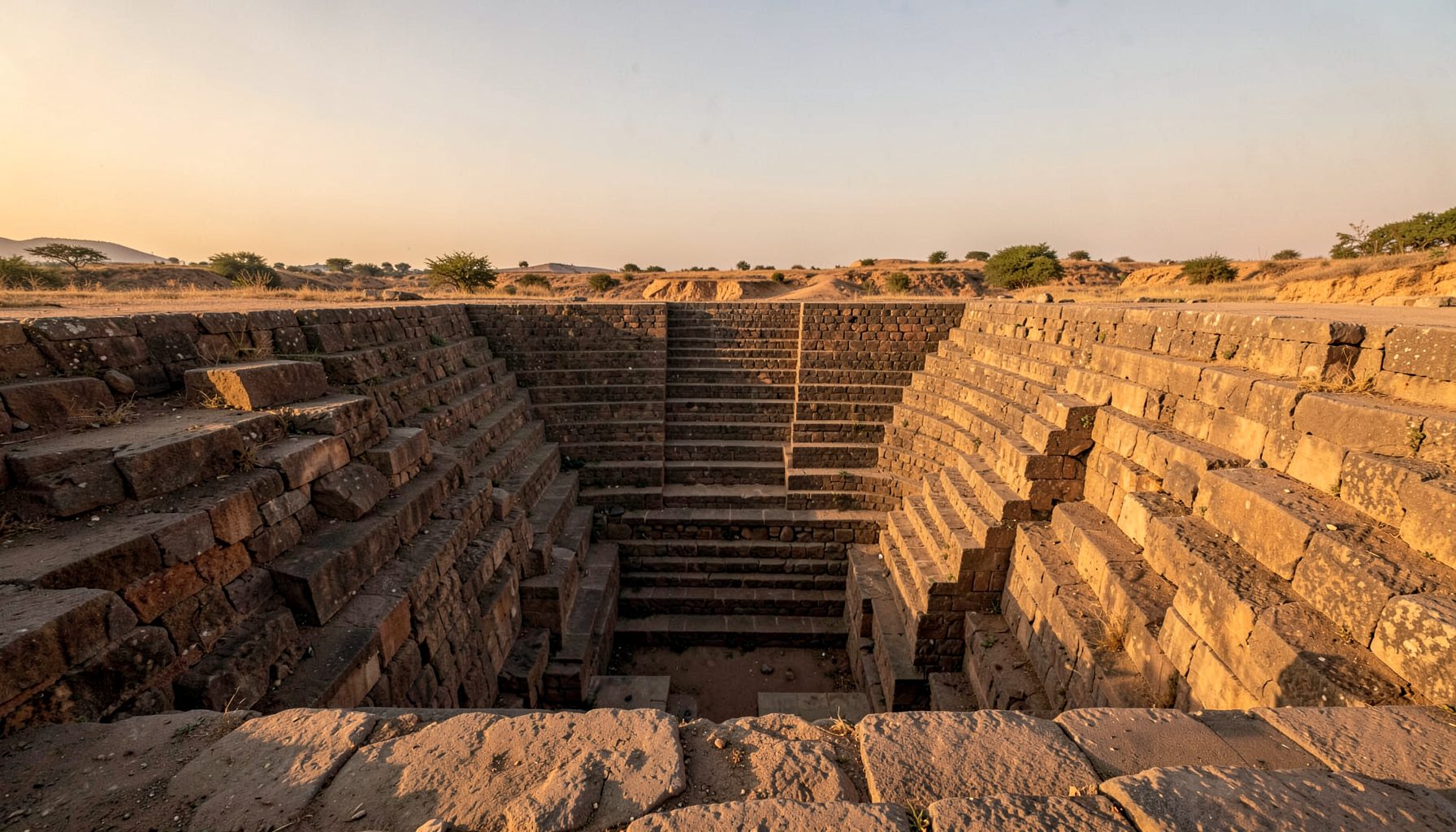
The Indian stepwell archive brings together photography, field notes, architectural sketches and aerial views that help connect written references with surviving places. Literature supplies clues, while careful documentation shows how stone, shadow, access and community use shaped the lived experience of each monument.
Water Giving In Ancient Indian Thought
In Sanskrit religious and legal literature, constructing a well, pond or reservoir is frequently treated as a meritorious act. Texts associated with the Puranic tradition describe the spiritual benefits of creating public water sources, especially when they serve travellers, villagers, animals and agricultural communities. These passages establish an ethical setting in which water architecture becomes an offering to society.
The language does not always distinguish between a stepwell, an open well and a tank. That distinction matters to modern researchers, because a poetic reference to descending for water may describe several types of structure. Still, the repeated association between water construction and charitable virtue helps explain why wealthy patrons commissioned elaborate subterranean spaces.
A stepwell could therefore function as a public gift with a long afterlife. Its usefulness was practical, while its literary and religious significance extended into memory, ritual and reputation.
Epics, Puranas And The Subterranean Imagination
The great epics and later religious narratives often use water as a setting for encounters, vows, purification and transformation. They may mention wells or reservoirs without describing the architectural sequence familiar from a developed vav or baoli. These references are valuable less as building plans than as evidence of the cultural importance attached to water places.
Texts such as the Matsya Purana and other treatises connected with sacred architecture discuss the making of water bodies, temple compounds and public works. Their instructions reflect ideals of proportion, auspicious placement and communal benefit. They should not be read as direct blueprints for every surviving monument, since local builders adapted forms to geology, rainfall, available stone and regional taste.
In Maharashtra, the word barav appears in local contexts for stepped wells and related water structures. Literary and inscriptional evidence becomes especially useful when paired with field observation, allowing researchers to compare inherited terminology with the physical remains around villages, forts and older settlement routes.
Inscriptions Speak More Precisely
Stone inscriptions often provide the clearest historical testimony. They can record a patron’s name, a ruler’s reign, the reason for construction, the date of repair or the religious institution responsible for maintenance. Many also reveal that water architecture was tied to women of royal and mercantile families, whose patronage is sometimes reduced in general histories.
An inscription transforms a monument from an anonymous object into a social document. It may identify a queen, minister, merchant or local administrator and describe the stepwell as a charitable foundation. Even when a text is damaged, a surviving name or fragment can guide archival research and help distinguish a structure from a later reconstruction.
For Australian audiences familiar with heritage registers, the comparison is useful. A plaque at a historic water reserve in Victoria or a listing managed through a state heritage system may preserve a site’s official story, while oral histories and local records add the details that formal descriptions miss.
Travellers Descend Into The Record
Travelogues offer another kind of evidence. Foreign visitors wrote about roads, cities, markets, temples and water facilities because these features affected movement and daily survival. Their descriptions can be hurried, selective or shaped by unfamiliar cultural assumptions, yet they often capture atmosphere: cool air below ground, crowded landings, sculpted columns and the relief of finding water after a long journey.
Persian, Arabic and European observers did not always use the same categories as local builders. A traveller might describe a deep well, a reservoir or a pavilion without recognising the technical distinctions between a baoli, vav, kund or barav. Their accounts are most reliable when read alongside inscriptions, maps, drawings and archaeology.
The value of a small visual detail can be seen in records as different as a medieval travel account and this discussion of a crusader effigy. A single carved figure, doorway or stair can anchor a broader interpretation of place, even when the observer did not understand every local meaning.
From Colonial Surveys To Digital Archives
Colonial surveyors, photographers and gazetteer writers created another layer of documentation. Their measurements and images sometimes preserve evidence of structures that have since collapsed or been covered by silt. Their terminology, however, can flatten regional distinctions and present living monuments as picturesque ruins rather than community infrastructure.
Modern digital documentation can correct some of that distance. Drone imagery reveals plans and relationships that are difficult to understand from the lowest landing, while field photography records blocked entrances, reused masonry, vegetation and nearby development. The web now places scholarly records beside commercial material, including a modern gambling page, which makes careful labelling and source evaluation essential for heritage readers.
For schools, museums and independent researchers in Australia, this mixed environment is familiar. A search for “stepwell” may produce academic papers, tourism listings, social media posts and unverified captions. Reading the source, checking the image date and separating observation from interpretation are basic but important research habits.
Reading Maharashtra Through Place And Language
Maharashtra’s stepwells are often less internationally recognised than the grand vavs of Gujarat or the famous baolis of Delhi and Rajasthan. That relative quiet is precisely why local documentation matters. A modest barav beside a temple, village road or agricultural field may retain construction details, seasonal uses and stories that never entered major travel literature.
Regional vocabulary carries information. Words such as barav, kund and vihir may point towards different forms or local habits of description, though meanings can overlap. Oral testimony may explain where women gathered, which communities maintained the water, or why a structure was abandoned after a borewell, dam or piped supply arrived.
Photography should therefore include more than the central stairway. The surrounding settlement, approach path, drainage, shade trees, shrine, inscription and present water level all help recreate the monument’s role. This approach suits Australia’s own heritage culture, where a council reserve, old stock route or abandoned mining site can only be understood through its surrounding landscape.
Restoration, Memory And Responsible Tourism
Restoration can preserve a structure while changing the way it is read. Cleaning steps, stabilising walls and removing invasive growth may reveal architectural details, but interventions should retain evidence of age and use. New paving, bright lighting or decorative additions can make a site easier to visit while obscuring its historical character.
The Raniji ki Baori in Bundi illustrates how conservation can reconnect a major monument with public attention; its restoration story is useful when considering the relationship between repair, interpretation and tourism. Such projects also raise practical questions about drainage, visitor pressure, safety and the balance between ceremony and preservation.
Australian visitors may recognise similar tensions at heritage-listed places in Sydney, Melbourne or the Blue Mountains. A site must be accessible enough for school groups and travellers, yet protected from careless touching, litter, climbing and photography that ignores local customs. Good interpretation allows visitors to see a stepwell as a living cultural landscape rather than a backdrop.
Field Notes For Reading A Stepwell
Written sources become most powerful when tested against the monument itself. A careful visit can reveal whether a description of darkness, coolness, water depth or crowding still makes sense. It can also expose the limits of an old account, especially where restoration, urban growth or groundwater change has altered the site.
Researchers working from Australia can begin with published surveys and image archives before contacting local historians, conservation groups or residents. The National Trust movement, university heritage programs and regional museums provide useful models for recording places that fall outside major tourist circuits.
A practical field approach includes these actions:
- Record local names and variant spellings before relying on a translated term.
- Photograph the entrance, stair flights, landings, columns, inscriptions and wider setting.
- Compare historical descriptions with current water levels, vegetation and access routes.
- Ask permission before recording people, rituals or privately held documents.
- Note repairs and additions separately from original masonry.
- Share verified discoveries with researchers and local communities.
Literature gives stepwells a long memory, but the present landscape remains part of that story. Every documented barav, baoli, vav or kund adds evidence about water management, patronage, belief and adaptation. Read alongside field photography and community knowledge, ancient texts and travelogues become more than historical references: they become invitations to recognise how architecture preserves the values of people who built for generations they would never meet.
Get in Touch
Have information about a stepwell that is not yet on our map? We would be glad to document it and give you full credit. Whether it is a Barav, Kund, Vihir, or any other form of stepwell, every contribution helps preserve India's water heritage.
Call or message us with details about the location, and we will follow up.
#9372496819
Send a Message
What People Say
"The Maharashtra Stepwells campaign has brought attention to structures that were nearly forgotten. The architectural documentation and drone photography are invaluable resources for researchers and students alike."
"Collaborating with the Indian Stepwells team gave our architecture students hands-on exposure to traditional water-harvesting structures. The presentations were insightful and inspiring."
"I shared details of a stepwell near my village that was not on any map. The team visited, documented it beautifully, and credited me. It felt wonderful to contribute."