 Explore Maharashtra
Stepwells as inspiration for contemporary public art
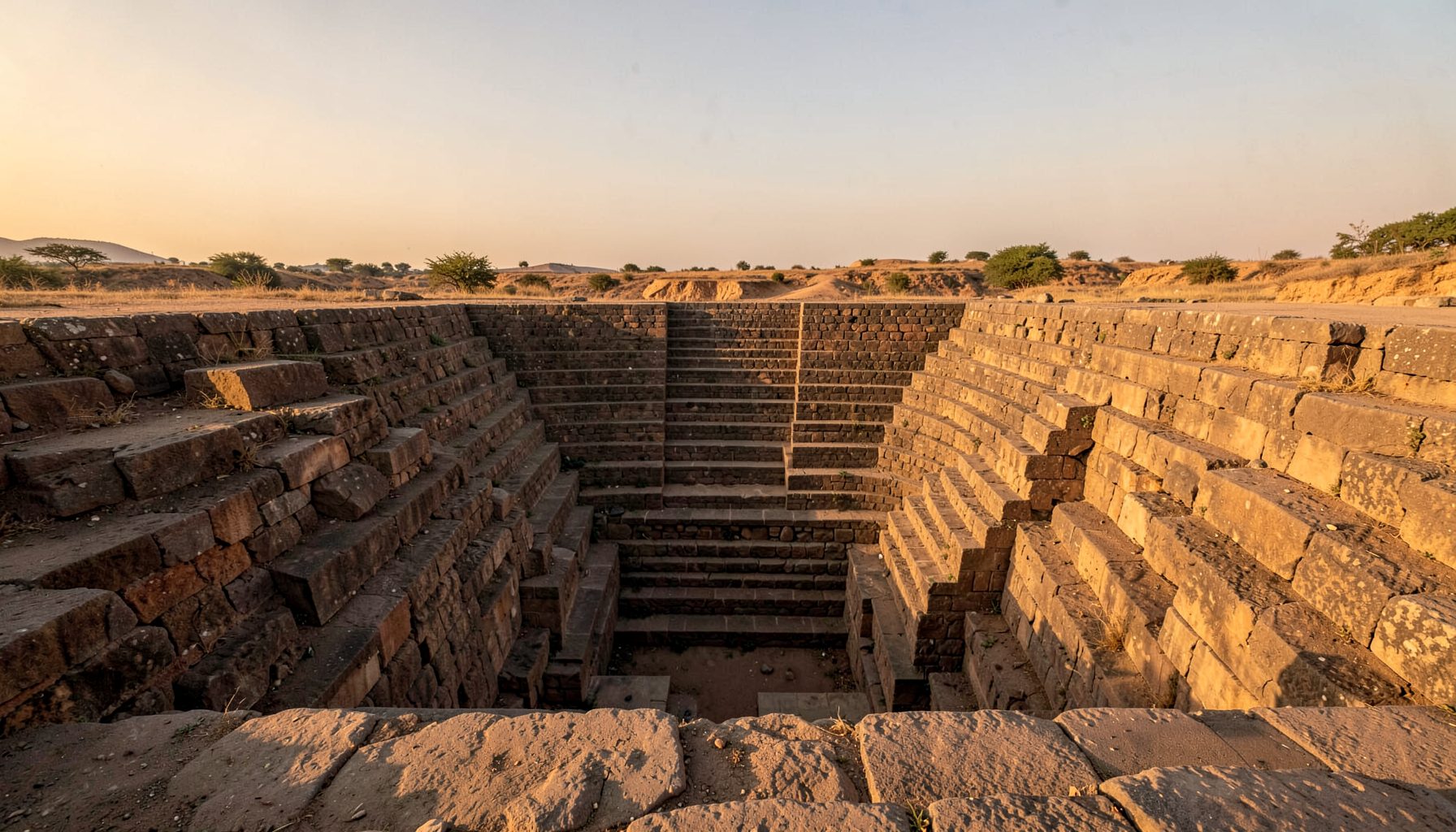
Across India, stepwells transform the practical work of collecting water into an experience of movement, shade, proportion and memory. A visitor descends through carved edges, repeating landings and changing light before reaching the water below. These structures are bawdis, baolis, vavs, kunds and baravs, yet each one responds to its landscape, climate and community.
For contemporary artists, the stepwell offers more than an attractive geometric motif. It provides a way to think about public space as a place for gathering, pause and shared responsibility. Its architecture can inspire sculptural installations, sound works, projections, temporary performances and participatory projects without copying historic ornament.
This approach has particular value in Australia, where public art increasingly engages with heat, drought, stormwater, urban growth and local identity. A project informed by stepwells can connect Indian architectural knowledge with Australian conditions while treating heritage as a living source of ideas rather than a museum display.
Learning from descent, shade and sequence
The most powerful feature of a stepwell is often the journey downwards. A staircase creates a measured transition from the noisy surface of a settlement to a cooler, quieter and more intimate environment. Each landing changes the view, making architecture unfold through the body rather than being understood from a single viewpoint.
A public artwork might translate this sequence into a sunken courtyard, a stepped seating area or a sloping field of stone and timber. The work does not need to reach groundwater. It could lead people towards a shaded gathering point, a garden planted with drought-tolerant species or a low platform where recorded stories become audible. In Melbourne, such an intervention could complement the laneway culture of the inner city by creating a slower space beside a busy pedestrian route.
Light is equally important. Historic vavs and baolis use deep walls, overhangs and changing orientations to soften the harsh sun. In an Australian installation, perforated screens, tensile canopies or carefully placed walls could create moving patterns of shade across the day. Designers should treat shade as an environmental service, not simply a visual effect, especially in playgrounds, town squares and transport precincts exposed to summer heat.
Turning water heritage into public experience
Stepwells can help artists make water visible in places where modern infrastructure usually remains hidden. A rain garden, retention basin or sculptural channel can reveal how rainfall travels through a site. In Adelaide, where dry conditions and water-sensitive urban design are familiar parts of civic planning, an artwork could collect roof runoff and show its movement through stone channels, planted terraces and storage chambers.
Such a project would need to be honest about scale. A shallow installation cannot reproduce the social and hydrological role of a historic stepwell, and decorative water features may consume resources without offering environmental benefit. The strongest works could operate as functioning infrastructure, capturing stormwater, cooling a courtyard, supporting native planting or marking seasonal changes through changing water levels.
Artists and architects should also consider local First Nations knowledge and custodianship. An Indian reference must not be placed over an Australian site as though all water traditions are interchangeable. Consultation with Traditional Owners, local ecologists and community groups can establish which stories belong in a particular place. The result may be a layered work in which Indian stepwell principles sit beside, rather than replace, local knowledge of water, Country and seasonal cycles.
Geometry, repetition and the social life of space
The stepped geometry of a stepwell is visually striking because repetition creates rhythm. Rows of pillars, landings and brackets produce a pattern that can be reinterpreted through contemporary materials. Recycled brick, rammed earth, salvaged timber, steel mesh and locally sourced stone could form a modular artwork that changes as people walk around it.
Geometry should serve use as well as appearance. A stepped structure can become seating for a community concert, a platform for a school performance or an informal meeting place during a weekend market. Sydney’s public spaces often host temporary food stalls, cultural festivals and outdoor exhibitions, so a flexible installation could support several activities without becoming an obstacle between events.
Interactive design can deepen this social role. Sensors might trigger water sounds when people cross a landing, while projections could reveal archival photographs or animated diagrams of rainfall. An installation may also borrow the clear decisions and feedback associated with strategic play, turning visitors into participants who choose routes, activate layers of sound or collectively influence the artwork’s light.
Research, photography and the value of detail
Contemporary public art becomes more meaningful when it begins with close observation. Photographs, measured drawings, drone imagery and field notes can reveal how a stepwell responds to terrain, sunlight, access and use. The Pune stepwell journey demonstrates how photographic research can draw attention to structures that are easy to overlook within a rapidly changing city.
For an Australian project, the same method might involve documenting drains, creek crossings, old tanks, reservoirs and disused industrial water systems before proposing a design. Local residents may remember swimming holes, flood patterns or former public fountains that do not appear in official records. Their testimony can prevent an artwork from becoming a generic image of “Indian architecture” and connect it to the actual history of its site.
Documentation can also become part of the finished work. A wall of field photographs, a projected map or a series of engraved measurements could show how research shaped the design. This is especially useful when an installation is temporary. Once removed, its archive can remain available through a council website, school resource or exhibition, allowing the project to continue educating people beyond its physical lifespan.
Designing for Australian regulations and everyday use
Public art inspired by stepwells must satisfy practical requirements before it can serve the public. In Australia, responsibilities are divided across federal, state and territory frameworks, local planning schemes and council approvals. A project affecting a heritage-listed place may require assessment under state heritage legislation, while a work on public land may need development consent, engineering certification and an approved maintenance plan.
Access is a central design issue. Deep stairs and narrow edges may evoke a historic structure, but a contemporary public facility should provide compliant paths, handrails, safe surfaces and alternatives for people using wheelchairs, prams or mobility aids. The Disability Discrimination Act 1992 and accessibility standards such as AS 1428 are relevant considerations, alongside local council requirements. Inclusive design can be integrated creatively through ramps that follow the descending geometry, broad landings and tactile surfaces.
Everyday habits also matter. Australians often use public spaces with dogs, bicycles, takeaway food, sports equipment and children, so edges must be robust and easily supervised. Materials need to withstand intense sun, sudden storms, graffiti removal and periods of drought. A work that depends on constant water circulation may be unsuitable, whereas a dry basin that becomes a rain garden during wet weather may fit both local conditions and public expectations.
Building projects with communities and continuity
A stepwell-inspired artwork should be developed with the people who will encounter it. Workshops can invite residents to map local water memories, make small geometric models or record the sounds of rain, pumps and public gatherings. Schools may study Indian water architecture alongside Australian catchments, while community groups can help decide whether the work should prioritise performance, ecological education or quiet reflection.
Local cultural organisations and Indian-Australian communities can contribute knowledge without being treated as decorative consultants. Their involvement may shape language, storytelling, material choices and opening events. Artists can also learn from heritage documentation projects and field documentation methods when building a disciplined archive of images, interviews and site observations, provided the sources are clearly identified and used responsibly.
Long-term care should be planned from the beginning. Councils and commissioning bodies need agreements covering cleaning, planting, lighting, water systems, repairs and future interpretation. A successful artwork may become a landmark, but it should remain adaptable as a neighbourhood changes. By combining careful research, environmental performance, accessible design and community authorship, stepwell-inspired public art can turn water heritage into a durable civic experience rather than a short-lived visual reference.
Get in Touch
Have information about a stepwell that is not yet on our map? We would be glad to document it and give you full credit. Whether it is a Barav, Kund, Vihir, or any other form of stepwell, every contribution helps preserve India's water heritage.
Call or message us with details about the location, and we will follow up.
#9372496819
Send a Message
What People Say
"The Maharashtra Stepwells campaign has brought attention to structures that were nearly forgotten. The architectural documentation and drone photography are invaluable resources for researchers and students alike."
"Collaborating with the Indian Stepwells team gave our architecture students hands-on exposure to traditional water-harvesting structures. The presentations were insightful and inspiring."
"I shared details of a stepwell near my village that was not on any map. The team visited, documented it beautifully, and credited me. It felt wonderful to contribute."