 Explore Maharashtra
Baolis as living meeting places across centuries
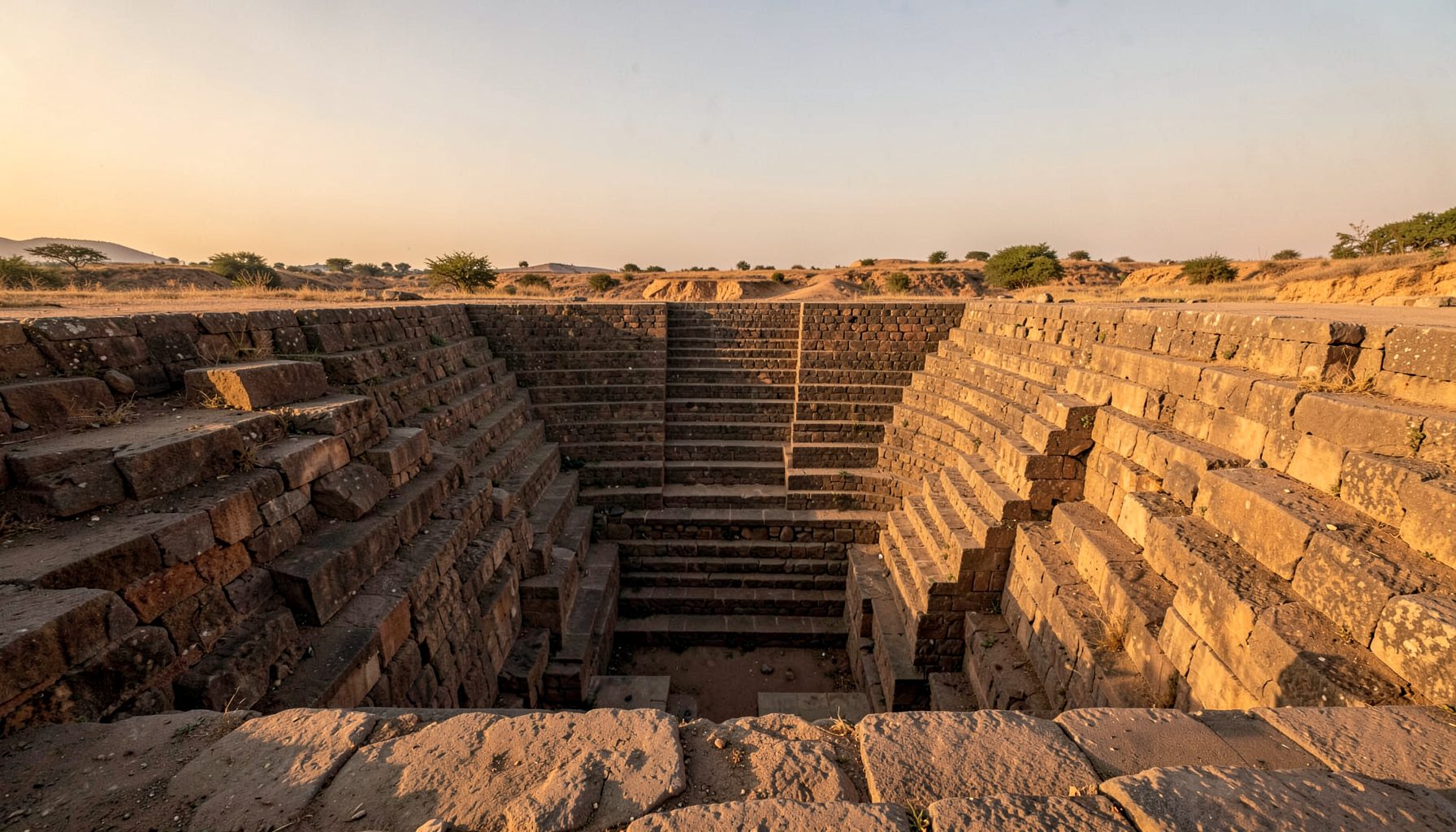
For more than a thousand years, the stone-cut stepwells of the Indian subcontinent did far more than store monsoon water. In Rajasthan, Gujarat, Delhi, and the Deccan plateau, these inverted pyramids of carved sandstone and basalt drew villagers, traders, pilgrims, and royal courts into the same shaded enclosure. A baoli, vav, or kund was the closest thing many regions had to a town square — a place where the rhythm of the year was negotiated in conversation.
This article traces the social history of these gathering places: how communities carved their rituals, friendships, and disputes into the architecture itself, and what survives when the crowds thin out. Along the way, it considers what heritage sites in places like Melbourne or Perth might learn from a tradition that fused utility and sociability so completely.
Communal origins of the baoli
The earliest reference to a stepwell appears in the writings of the Buddhist emperor Ashoka in the third century BCE, but the architectural form we recognise today flourished between the eighth and sixteenth centuries. Patrons commissioned vavs not merely to secure drinking water through the dry months, but to earn spiritual merit by providing a public good. The cost of excavation was shared among guilds, merchant families, and village councils, so the wellhead became a kind of ledger carved in stone.
Because construction required cooperation, the finished baoli was already a community artefact before its first bucket was drawn. Inscriptions on the walls of Adalaj ni Vav near Ahmedabad list contributions from carpenters, oil-pressers, and travelling traders who never lived in the village permanently. The same stone records marriages, debts, and pilgrimages. Reading the structure from top to bottom, you read the social hierarchy of the place that built it.
Daily rhythms at the water's edge
In the working hours of a pre-colonial Indian town, a baoli operated like a clock set to many rhythms. Before dawn, women descended with brass lotas to fill drinking vessels, pausing on landings to exchange news of illnesses, marriages, and harvests. Mid-morning brought washerfolk beating cloth on lower platforms, while herdsmen watered cattle on the upper terraces. By late afternoon, the steps cooled enough for travellers to rest, sometimes overnight, in pillared galleries that lined many stepwells.
These routines were governed by rules so embedded in daily life that they rarely needed to be written down. Some wells reserved certain landings for particular castes or professions; others opened every step to all visitors, a radical gesture in a stratified society. Travellers from distant regions could read the etiquette of a new baoli within minutes, much as a visitor to a Melbourne laneway café learns to read the queue at Pellegrini's without a signboard.
Who used the baoli, and when
- Dawn: women drawing drinking water and exchanging household news
- Mid-morning: washerfolk on lower landings, cattle on upper terraces
- Afternoon: travellers resting in shaded galleries
- Evening: communal bathing and cooling before nightfall
Festivals, fairs and pilgrimage routes
A baoli that saw only daily traffic was useful; a baoli that hosted a mela was powerful. Many stepwells sat on pilgrimage circuits linking temples, dargahs, and mountain shrines. During the festival of Teej, women dressed in green descended into the vavs of Bundi to honour the monsoon, while at Rani ki Vav in Patan, a Navratri gathering filled every gallery with devotional music. Such fairs could swell a village's population tenfold for a week, and merchants planned their routes around them.
The economic spillover was substantial. Stalls clustered near the wellhead to sell bangles, sugarcane, and roasted gram. Storytellers and puppeteers set up beside the entrance, their voices carrying down into the cool stone. A field researcher in Delhi traced how the loss of a single festival gathering rippled through the surrounding bazaars for generations — a pattern that recurs wherever civic infrastructure slips from public memory. That investigator's Delhi field report describes market traders who still remember their grandmothers' pilgrimages, even though the well they rested beside is now bricked shut.
Women, children and the social fabric
Stepwells gave women one of their few authorised spaces outside the home. While wells elsewhere required bending over a parapet in public view, the multi-storied baoli allowed women to descend out of sight, share the cool interior with friends, and supervise children learning to swim in the deeper tanks. Several wells, including Raniji ki Vav, contain shrines to Vishnu or the mother goddesses on lower landings that were effectively women-only zones during certain hours.
Children, meanwhile, treated the stepped geometry as a playground. The very depth that protected women's privacy also turned each landing into a separate social terrace — a stratification so literal that it has no real parallel in modern urban design. Educators in Sydney working on cross-cultural architecture modules sometimes show photographs of stepwells to students as an antidote to the flat, single-level public squares of European origin. The comparison unsettles assumptions about what a "public" building can be.
Colonial disruptions and shifting gathering spaces
British administrators, suspicious of unsupervised gatherings, often filled in or fenced off stepwells in the nineteenth century. Sanitary reports blamed the wells for cholera, though municipal pipelines arrived far later. By the 1940s, thousands of baolis across northern India had lost their central role, and the generations raised with standpipes had little reason to descend the old stone steps.
The social fabric frayed with the architecture. Festivals migrated to open maidans; gossip moved to bus stops and television sets; the carved galleries that once hosted wedding processions stood empty except for bats. Where communities resisted the change — as in parts of rural Gujarat and the Maratha heartland — the baoli continued to function as a gathering place through the twentieth century, sustained by women who still preferred the taste of well water and the company it brought.
Heritage tourism and modern revival
Today, a small but growing heritage movement is reconnecting stepwells with the communities that built them. The current Maharashtra documentation campaign is mapping dozens of forgotten kunds in the Deccan, often with the help of villagers who still name the carvings their great-grandparents pointed out. Photographers and sketch artists are producing records local councils can use to argue for restoration over demolition.
Tourism plays a double role. Visitors from Delhi, Bengaluru, and abroad bring revenue that funds cleaning and lighting, yet they also press the fragile sites with footfall they were never designed for. Operators in heritage-sensitive cities have begun borrowing techniques from places such as Kyoto and Edinburgh — timed-entry tickets, modest entry fees, locally trained guides — to keep the social function of the well alive. Australian audiences encounter this debate at the State Library of Victoria or the Art Gallery of New South Wales during exhibitions on South Asian architecture; curators in Brisbane commission companion programmes that ask how a colonial-era public building can recover its communal life.
Pressures facing restored stepwells
- Encroachment from new residential construction on surrounding land
- Sewage discharge from neighbourhoods that have expanded uphill
- Loss of the festival calendar that once justified upkeep
- Over-tourism that displaces the local users a baoli was built for
What distant communities can learn
The history of the baoli offers an unusual mirror for places far from the Indian subcontinent. In Perth, community organisations rehabilitating Aboriginal waterholes along the Swan Coastal Plain have pointed to stepwells as a parallel — a sacred and social infrastructure combining drinking water, storytelling, and ceremony. In regional Victoria, conversations about reviving public baths echo older arguments about why a city builds a place for strangers to meet.
The lesson is rarely about the architecture alone. Stepwells taught generations to treat water as a reason to gather, not a chore. Where that idea survives — in a Melbourne debate about who left the tap running, in a Sydney council plan to revive neighbourhood ponds, in a Perth festival marking the spring flush — the spirit of the old baoli quietly persists. The stones of Rajasthan may sit far away, but the social pattern they embody is portable, and still urgently needed.
Get in Touch
Have information about a stepwell that is not yet on our map? We would be glad to document it and give you full credit. Whether it is a Barav, Kund, Vihir, or any other form of stepwell, every contribution helps preserve India's water heritage.
Call or message us with details about the location, and we will follow up.
#9372496819
Send a Message
What People Say
"The Maharashtra Stepwells campaign has brought attention to structures that were nearly forgotten. The architectural documentation and drone photography are invaluable resources for researchers and students alike."
"Collaborating with the Indian Stepwells team gave our architecture students hands-on exposure to traditional water-harvesting structures. The presentations were insightful and inspiring."
"I shared details of a stepwell near my village that was not on any map. The team visited, documented it beautifully, and credited me. It felt wonderful to contribute."