 Explore Maharashtra
Stepwells and the Water Table in Ancient India
Stepwells are often admired for their carved pillars, descending stairs and dramatic geometry, yet their most important achievement was practical. These structures helped communities reach groundwater, store seasonal runoff and manage access to water when monsoon rains had disappeared from the surface. Their architecture was shaped by the behaviour of the water table.
Across India, bawdis, baolis, vavs, kunds and baravs formed part of wider systems of wells, tanks, catchments and channels. They were places to collect water, rest in the shade, conduct rituals, meet neighbours and support travellers. Their design reveals a close reading of geology, rainfall and seasonal change.
For Australians living with drought, groundwater pressure and increasingly variable rainfall, this heritage has a strong contemporary relevance. A stepwell is not a ready-made solution to modern water scarcity, but it offers a thoughtful example of how infrastructure can work with a landscape rather than treating water as an unlimited supply.
Reading The Seasonal Water Cycle
Most stepwells were built in regions where rainfall arrived in a short, intense wet season and then declined sharply. Rainwater filtered through soil and fractured rock, replenishing underground aquifers. As the dry months continued, the water table fell, and people descended further into the structure to reach it.
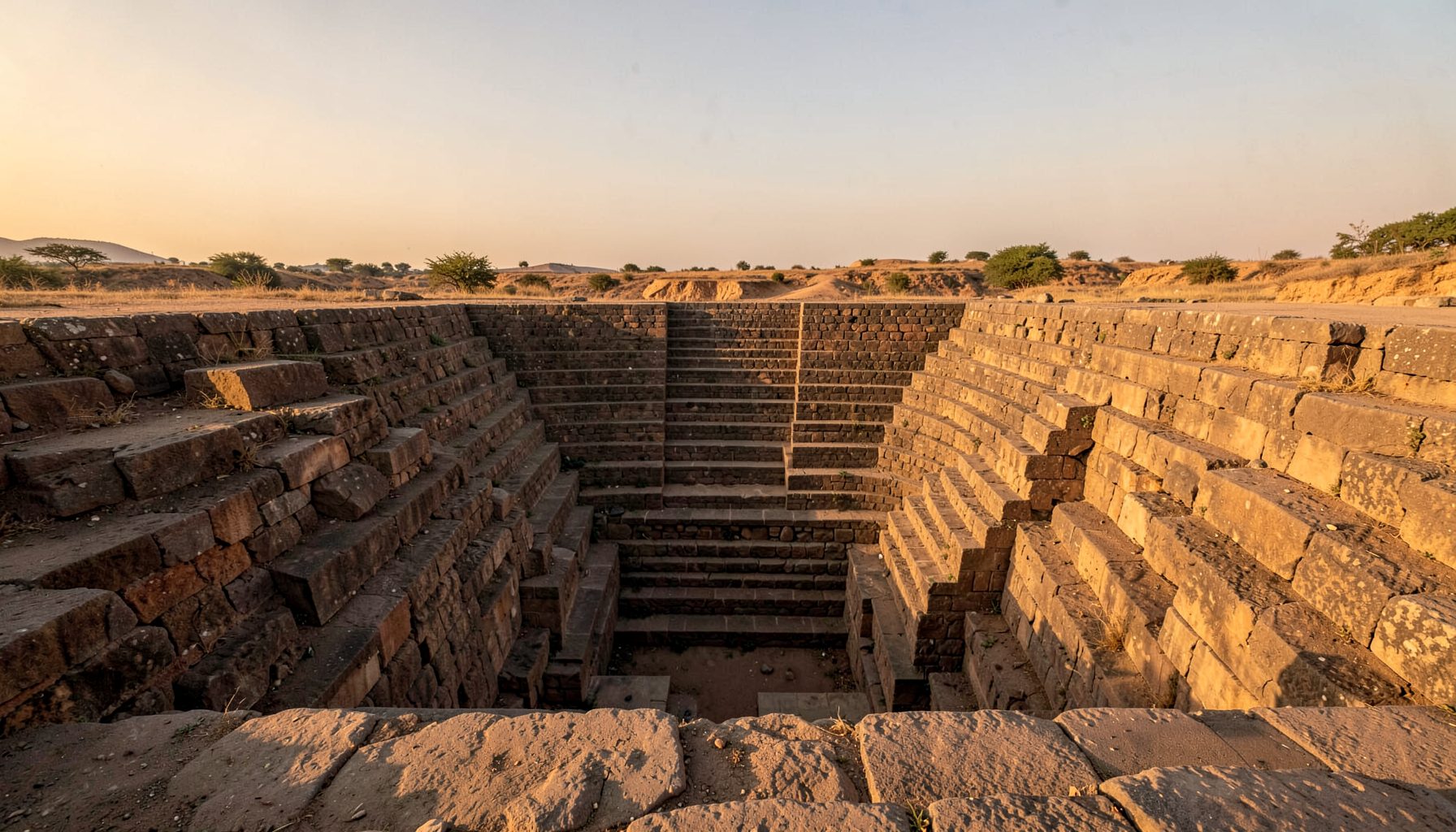
The stairs were therefore more than an access route. They allowed a community to follow changing water levels. In a deep vav, the lowest landings might remain usable when shallow wells had dried. Broad platforms gave people somewhere to pause, carry vessels and shelter from heat, while retaining walls helped protect the water from erosion and contamination.
This seasonal logic has parallels in Australia, where a wet summer storm can produce heavy runoff but contribute little to long-term groundwater recharge if the soil is compacted or the catchment is degraded. In places such as regional New South Wales or South Australia, the difference between rainfall received and water stored underground can be substantial.
Architecture As Water Infrastructure
The shape of a stepwell responded to local ground conditions and construction materials. Some were straight shafts with flights of steps, while others developed into long, monumental corridors with pavilions, galleries and shaded chambers. Stone linings stabilised the sides and reduced the risk of collapse, while carefully graded surfaces directed rainwater towards the reservoir.
Many structures also captured water from their surrounding catchments. Runoff could enter through channels, inlets or open edges, allowing the basin to recharge during the monsoon. The design had to balance collection with cleanliness, since silt, animals and human activity could affect the quality of stored water.
Architectural details carry evidence of this practical intelligence. A useful architectural glossary helps distinguish elements such as flights of stairs, landings, galleries, pavilions and retaining walls. These features were not decorative additions placed around a water hole; they formed a working system that joined engineering, climate and social life.
Groundwater, Geology And Recharge
A stepwell could only succeed when its location matched the underground landscape. Builders needed to understand where groundwater accumulated, how quickly it moved and whether the surrounding stone could support excavation. Valleys, river margins and low-lying areas were often favourable, but the precise choice depended on local geology and drainage.
The relationship between surface water and groundwater is especially important. A tank or pond may hold water temporarily, while a stepwell provides access to water stored below ground. When rainfall infiltrates rather than running away, it can replenish the aquifer. The stepwell then becomes a visible access point to a much larger hidden reserve.
Modern Australian water management often separates stormwater, irrigation, groundwater and urban drainage into different categories. Historic Indian systems suggest a more connected view. Catchments, soil, vegetation, storage and access can be considered together, with the goal of slowing water down and giving it time to enter the ground.
Community Rules And Shared Access
Water infrastructure depends on social arrangements as much as physical design. Stepwells were commonly supported by rulers, merchants, landowners, religious institutions or local communities, but their ongoing usefulness required maintenance and agreed patterns of access. Cleaning, repairing steps and managing surrounding land were collective responsibilities.
The structures also served people who did not own farmland or private wells. Travellers, traders, women collecting household water and residents from nearby settlements could gather there. In hot regions, the cooler lower levels created valuable public space, making the stepwell part of daily civic life rather than a remote utility.
There is a useful lesson here for Australian towns, where water restrictions can become a source of frustration when people feel that decisions are imposed without local participation. Community consultation, accessible public information and visible shared benefits can make conservation measures more trusted. A bore, wetland or rain garden works better when people understand who cares for it and why it matters.
Lessons For A Drying Climate
Australia’s water challenges vary widely. Perth relies heavily on groundwater and desalination, inland communities face long dry periods, and cities such as Melbourne manage reservoirs under pressure from shifting rainfall patterns. In the Murray–Darling Basin, groundwater extraction and river health are closely linked, while remote communities may face expensive infrastructure and limited technical support.
Historic stepwells do not offer a simple blueprint for these conditions. Their scale, materials and social context differ from modern urban systems, and many are no longer safe or hydraulically functional. Their value lies in the principles they reveal: harvest water close to where it falls, protect recharge zones, design for seasonal fluctuation and make conservation visible.
Australian designers already use related ideas through water-sensitive urban design. Permeable paving, constructed wetlands, detention basins, swales and household rainwater tanks can reduce rapid runoff and support infiltration. A contemporary public space inspired by a stepwell might combine shaded seating, stormwater storage and groundwater education without pretending to recreate a historic monument.
Documentation Before Restoration
Many stepwells are threatened by rubbish, invasive vegetation, encroaching construction, altered drainage and falling groundwater levels. A restoration project that repairs stonework but ignores the catchment may preserve the appearance while destroying the function. Documentation must therefore record both the structure and its environmental setting.
Photography, measured drawings, drone imagery, oral histories and seasonal observations can reveal how a site has changed. Researchers can map inlets, outlets, nearby wells, soil conditions and signs of recharge. Comparing images taken before and after the monsoon may show whether water enters naturally or whether the basin has become disconnected from its original system.
The independent Indian Stepwells project demonstrates how field photography and architectural recording can make overlooked heritage more visible. Such work is valuable in Australia too, where local knowledge about old bores, farm dams, spring lines and Aboriginal water places may not appear in formal records. Documentation should respect cultural authority and involve communities from the beginning.
Heritage, Astronomy And Place
Stepwells belong to a broader history of people designing structures around natural cycles. Their orientation, shade, water levels and ceremonial uses connected architecture to monsoon rhythms and the movement of the sun. They remind us that environmental knowledge can be embedded in buildings, paths and public customs rather than stored only in technical reports.
This wider relationship between construction and seasonal change can be seen in other ancient places. The Newgrange solar alignment shows how a structure could be designed around a precise annual solar event. A stepwell’s purpose was different, but both examples demonstrate careful observation translated into durable architecture.
For Australians, place-based design can include local rainfall, evaporation, flood behaviour, groundwater, heat and cultural knowledge. It can also encourage a more patient understanding of water. Rather than viewing every storm as a nuisance to be drained away, communities can ask where it might be slowed, filtered and stored for the season ahead.
Practical Principles For Water-Conscious Heritage
A useful starting point is to treat every stepwell as both a cultural site and a water system. Its carvings, stairs and pavilions deserve care, but so do the upstream catchment, recharge area and community relationships that made the structure effective. Preservation is strongest when these parts are considered together.
The following principles can guide research, interpretation and contemporary design:
- Map the entire catchment, including slopes, drains, soil, vegetation and nearby water bodies.
- Record water levels across wet and dry seasons rather than relying on a single site visit.
- Protect recharge zones from paving, dumping, intensive extraction and uncontrolled construction.
- Combine heritage conservation with hydrological assessment before repairing or adapting a structure.
- Involve local residents, landholders and cultural custodians in documenting histories and use.
- Use public interpretation to explain groundwater, seasonal rainfall and responsible water access.
- Adapt relevant ideas through Australian materials and conditions instead of copying historic forms.
Stepwells show that groundwater management can be practical, beautiful and socially meaningful at the same time. Their descending paths make an invisible resource legible: every step reflects the changing distance between people and water. For communities facing hotter summers and uncertain rainfall, that physical reminder remains one of their most powerful lessons.
Get in Touch
Have information about a stepwell that is not yet on our map? We would be glad to document it and give you full credit. Whether it is a Barav, Kund, Vihir, or any other form of stepwell, every contribution helps preserve India's water heritage.
Call or message us with details about the location, and we will follow up.
#9372496819
Send a Message
What People Say
"The Maharashtra Stepwells campaign has brought attention to structures that were nearly forgotten. The architectural documentation and drone photography are invaluable resources for researchers and students alike."
"Collaborating with the Indian Stepwells team gave our architecture students hands-on exposure to traditional water-harvesting structures. The presentations were insightful and inspiring."
"I shared details of a stepwell near my village that was not on any map. The team visited, documented it beautifully, and credited me. It felt wonderful to contribute."