 Explore Maharashtra
Water, status and exclusion in India’s stepwells
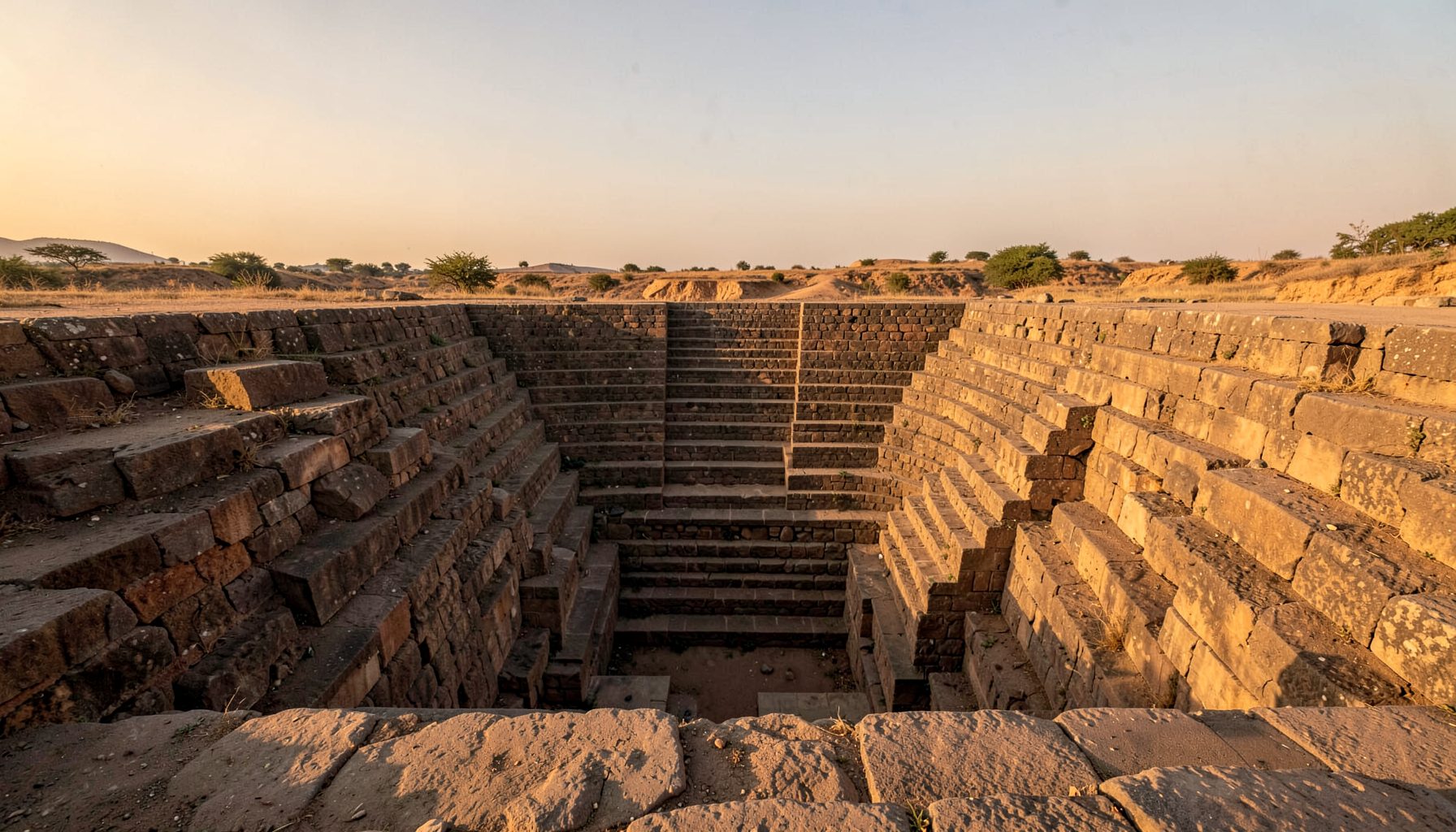
Across much of arid and semi-arid India, a stepwell turned groundwater into a shared civic resource. In Maharashtra, in western India, these structures are often called bawdis; elsewhere they may be baolis, vavs, kunds or baravs. The basic form—a deep well reached by descending stairs—allowed people to collect water, bathe, meet and move through shaded levels. Such places joined engineering to public life. Their architecture reveals responses to heat and drought, but it can also preserve the social order that determined who entered, where they stood and how much water they drew.
The relationship between stepwells and the caste system was central rather than incidental. Some settlements provided separate tanks for different castes; elsewhere, access was controlled through gates, screened passages or customary rules. These arrangements varied by place and century, so no single plan can stand for all of India. The Indian Stepwells archive offers photography, sketches and field research that make it possible to examine these differences while keeping local testimony and material evidence in view.
Water as an architectural expression of hierarchy
Water carried ritual as well as practical value. Kings, nobles, merchants and temples endowed wells, and the cleanliness, seclusion or prestige attached to a basin could reinforce their standing. A tank reserved for a privileged group made hierarchy visible in stone. Distance, elevation and carving became proxies for status, while inscriptions naming donors turned charitable works into declarations of rank.
Caste rules also affected who fetched water, cleaned tanks and maintained them. In many historical arrangements, Dalit residents performed labour others avoided while being directed toward less prestigious sources. Ideas of ritual purity and pollution made contact with some water sources and with people assigned to clean them fraught. “Untouchability” was never uniform, however. A custom recorded in one town cannot be transferred automatically to another, and an access difference may reflect gender, religion, wealth or municipal regulation as well as caste.
These distinctions were lived through routines. Men might approach a well for ritual bathing, while women and girls collected household water under conditions of privacy. A space reserved for women could provide safety from scrutiny yet still occupy a subordinate place in the social order. Studying stepwells therefore requires attention to intersecting inequalities rather than one simple line of exclusion.
Separate tanks and regulated access
Not every stepwell contained parallel basins for different castes. Some served one neighbourhood, some were divided by gender, and some changed use over time. Researchers therefore seek several kinds of evidence before calling a structure segregated. At documented sites, arrangements could include:
Physical clues recorded at such sites include:
- paired or adjacent wells serving different groups in one precinct
- gates, screens or separated landings redirecting users
- inscriptions identifying donors, occupations or permitted users
- worn paving and informal routes showing where crowds moved
Social relationships reflected in these arrangements include:
- elite patrons receiving cleaner water and secluded settings
- women and girls using areas set aside for collection and bathing
- Dalit residents assigned lower-status tanks or peripheral entrances
- water carriers carrying exclusion into their daily labour
These features do not always name the excluded. Archaeology can reveal a division without proving its legal basis; oral histories may explain a custom that plans cannot. The crucial distinction is between a temporary practical arrangement and a durable system that fixed rank. Separate access could preserve custom, but it also made inequality easier to enforce because the building reminded each visitor of their place.
Women, labour and the everyday journey for water
Fetching water organised the day of countless households. Women and girls travelled with vessels, waited in queues and negotiated uneven streets, while caste expectations often added unpaid or low-paid labour. A women-only tank might offer protection from male attention and a place to bathe; it did not necessarily signal equality. Privacy and confinement could occupy the same architecture.
These relationships become clearer when a stepwell is read as a route rather than a sculpture. An Ahmedabad walking tour places surviving wells within dense residential quarters, close to the lives that sustained them. At Dada Harir, traditional accounts distinguish access to upper and lower levels, with the upper basin associated with elite men and lower levels used by women, children and people of lower caste. The carved stairs, landings and relative shade form a social map as well as an aesthetic one.
Australian cities offer a limited comparison, not an equation. Melbourne residents became accustomed to strict drought restrictions and carrying refillable bottles, while Sydney’s historic tank catchments remain prominent in the city’s water infrastructure. These customs show how a community governs a common resource. They also show why legal categories matter: Australian sex-separated amenities and class inequalities do not map neatly onto caste, and comparison must begin with history rather than appearance.
Reading access without flattening the past
Colonial surveys and modern restorations often concentrated on engineering, craftsmanship and the fame of a patron. They might record a ruler’s name while passing over women who fetched water, servants who cleaned steps or Dalit communities that used a peripheral entrance. Labels also change over time. A well called by its founder in one period may later be known by a neighbourhood, occupation or religious use.
Public memory involves comparable choices. At the Cobh famine memorial, graves and interpretive material preserve the reality of mass death while showing how communities remember people and journeys. It is not an analogy for caste hierarchy. Its value is methodological: careful reading asks whose names appear, whose labour is invisible and which conflicts the commemorative story leaves out.
In Melbourne and Sydney, plaques, migration festivals and neighbourhood histories also negotiate public memory. Queen Victoria Market provides a useful everyday setting: traders’ stories, workers’ routines and community events occupy the same spaces where official heritage interpretation often appears on buildings. The contrast between a commissioned monument and an oral account can reveal which histories receive authority, especially where migrant communities know that official records rarely described them.
Preservation, law and the responsibility to document
Conservation requires choices about water, vegetation, structural loads and continuing use. A neglected dry well, a functioning community tank and a restored monument demand different treatments. Cleaning may protect masonry but erase worn steps, deposits or traces of repeated journeys. Documentation can record those details alongside the visible architecture, preserving evidence that a polished photograph alone would miss.
Indian law adds another layer. Many nationally important monuments fall under the Archaeological Survey of India and the Ancient Monuments and Archaeological Sites and Remains Act 1958, while state laws, trusts and municipalities govern other sites and public use. Protection can retain masonry without resolving groundwater ownership, customary access or the interests of surrounding residents.
Australian heritage practice has no single equivalent system. The Commonwealth’s National Heritage Act 2003 covers places on the National Heritage List, while state heritage acts and local overlays govern many others. Aboriginal cultural heritage may also engage the Aboriginal and Torres Strait Islander Heritage Protection Act 1984 and state provisions; the Burra Charter guides custodianship and community participation. Legal category matters because a drain, reservoir, tank or place of Aboriginal cultural significance may be valued for different reasons. Recognition can require a documented process without settling access.
Detailed records connect visual evidence with testimony about names, labour and customary use. Community reports of undocumented wells can preserve knowledge that aerial photography cannot reveal. By combining the two, a stepwell becomes what it always was: a water system, a meeting place and a statement about power. The central issue is not whether the structure looks harmonious, but whose experience that harmony was built upon.
Get in Touch
Have information about a stepwell that is not yet on our map? We would be glad to document it and give you full credit. Whether it is a Barav, Kund, Vihir, or any other form of stepwell, every contribution helps preserve India's water heritage.
Call or message us with details about the location, and we will follow up.
#9372496819
Send a Message
What People Say
"The Maharashtra Stepwells campaign has brought attention to structures that were nearly forgotten. The architectural documentation and drone photography are invaluable resources for researchers and students alike."
"Collaborating with the Indian Stepwells team gave our architecture students hands-on exposure to traditional water-harvesting structures. The presentations were insightful and inspiring."
"I shared details of a stepwell near my village that was not on any map. The team visited, documented it beautifully, and credited me. It felt wonderful to contribute."