 Explore Maharashtra
Stepwell earthquake resilience after the 2001 Bhuj quake
Stepwells are monuments to water, but their significance lies in the meeting of architecture, climate and community life. Bawdis, baolis, vavs, kunds and baravs stored seasonal water through shared steps and shaded landings. Their value includes engineering knowledge, everyday use and memories of collective care.
The Bhuj earthquake showed that these places can be both infrastructure and vulnerable heritage. Resilience depends on safe access, water quality, emergency distribution and local knowledge as much as on surviving walls. The event offers lessons, not a licence to copy traditional forms without analysis.
Why the Bhuj earthquake matters
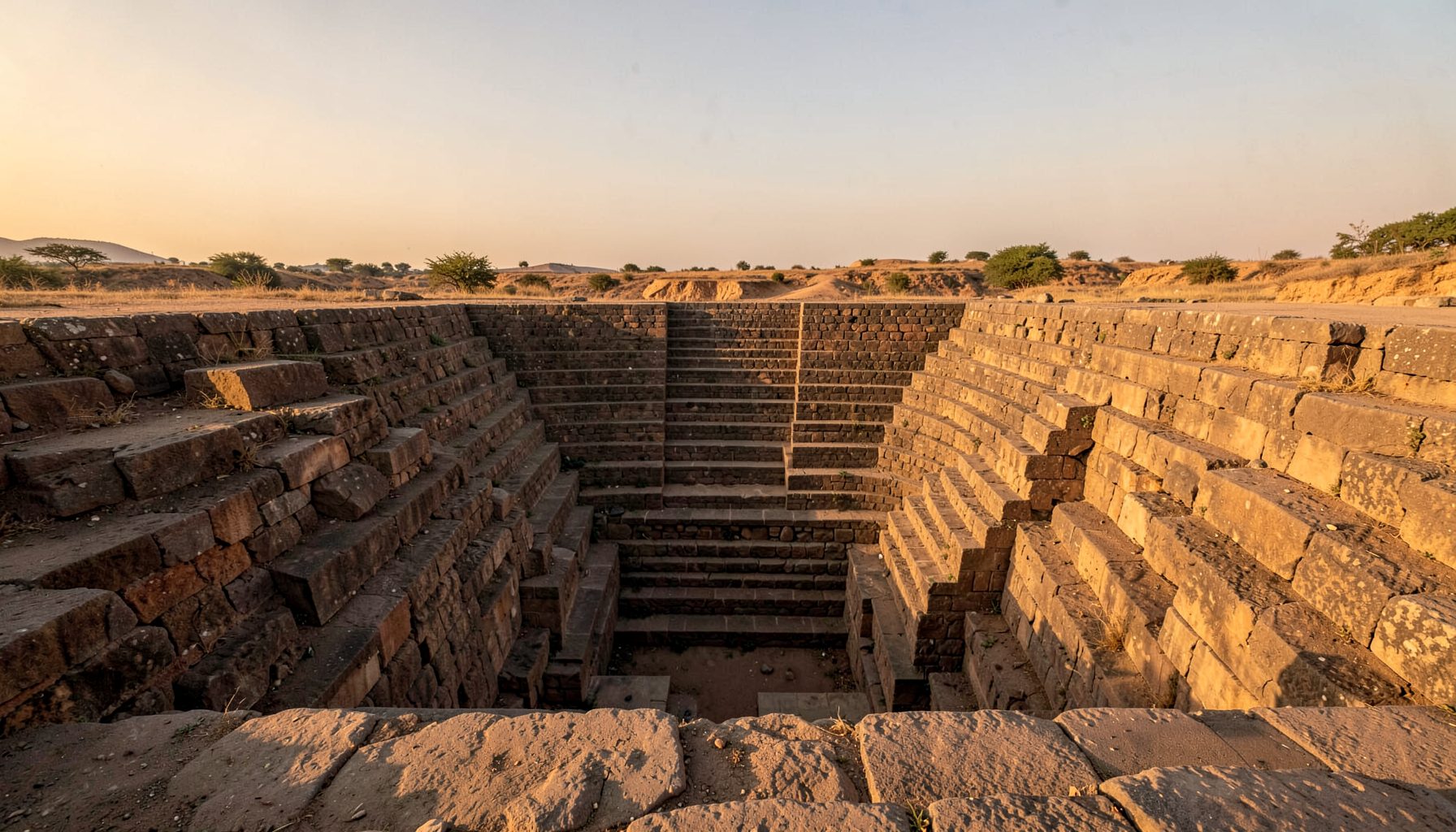
On 26 January 2001, a magnitude 7.7 earthquake struck Kutch in Gujarat. It killed about 20,000 people, damaged roughly one million homes and disrupted housing, hospitals, roads and water supply. Damage to Navghan Kuvo in Bhuj showed how vulnerable a deep stepwell’s masonry access, retaining walls and carved elements could be. Such a site could not serve as a public water source if its stairs or chambers were unsafe.
Recovery required triage: distinguish harmless cracking from threatening movement, identify safe routes and stabilise places before reopening. Local masons understood the existing stone, mortar and drainage logic, while engineers added seismic assessment and reinforcement. Combining both forms of knowledge repaired specific failures while retaining authentic material.
The photographs, sketches and field observations collected by Indian Stepwells support this approach. They place structures within regional patterns and help researchers identify features that are original, repaired or seismically altered. A crack fixed after 2001 records the earthquake’s effect; it does not prove that the feature is ancient.
What stepwell masonry can and cannot do
Much of a stepwell’s mass sits low, excavation reduces the span over the tank, and thick walls carry gravity loads mainly in compression. Its descending geometry concentrates forces near the base. These features help, provided joints and foundations are sound.
Traditional masonry has little tensile capacity. Lateral acceleration can open cracks, separate stones or rotate retaining walls. Brackets, narrow passages, parapets and ornate edges may detach, while steep steps become dangerous. Sloshing water adds pressure, and changed groundwater or settlement can disturb alluvial foundations. Performance depends on bond, mortar, geometry, drainage and past repairs, not age alone.
Maintenance is part of resilience. Clearing silt, repairing drains, controlling vegetation and using compatible mortar can stop minor defects becoming leverage points. Monitoring should combine dated photographs, crack gauges and level markers. Stable water levels also limit hydraulic pressure during ordinary repairs.
Water security in the first days after shaking
Fresh water was an immediate need in Bhuj, where roads, pipes and supply depots were disrupted. A safe stepwell could provide a decentralised source without a long pipeline or fuel-dependent pump station. Emergency planning should map water bodies, depth, access, ownership, seasonal yield and lifting equipment before disaster.
Access must be checked before use. Seismic movement may have shifted stairs or blocked a passage. A qualified structural inspection should precede public access, with a safe route established from the surface. Rope-and-vessel lifting offers a manual fallback when electricity fails, but pumps cannot substitute for structural safety.
Water quality is equally critical. A cracked lining, polluted run-off, sewage intrusion or disturbed sediment can make a sound site unsafe to drink. Testing, filtration and clear labelling should accompany distribution. Without public-health controls, a stepwell may spread illness rather than strengthen recovery.
Rebuilding through local knowledge
The Bhuj recovery showed why conservation skills belong in emergency planning. Traditional stone cutting, lime preparation, joint finishing and drainage repair affect how walls shed water and accommodate movement. Training local craftspeople alongside engineers creates a durable workforce and produces site-specific repairs rather than generic details imposed on every monument.
Documentation comes before intervention. Drawings, photographs, drone views, material samples and oral histories create a record before pieces move. The same principle appears in research on Achill Island’s lost graveyard, where archival evidence and community memory reconstruct a cultural landscape that physical loss alone could not explain. Here too, documentation links place, fabric and memory.
Residents may know which landing floods first, where shade is used and when water remains sweet. Such knowledge can guide barriers, access upgrades and emergency collection points. Consultation should continue after reopening because use reveals changing levels, crowding and maintenance needs that a single inspection may miss.
Australian realities for ageing masonry
Australia has no exact stepwell tradition, but it has parallels. Melbourne’s Victorian terraces, Adelaide’s masonry buildings and Sydney’s sandstone heritage all require careful work around older structures. Underground tanks and retaining walls are closer functional analogues. Although shaking risk is lower than Kutch’s, the 1989 Newcastle earthquake and active faults show that severe shaking remains possible.
Everyday habits provide a bridge. In Adelaide, Melbourne and regional areas, many residents inspect rainwater tanks, screens, gutters and pumps routinely. During drought, stored water becomes a household reserve. Heritage sites need the same discipline: know capacity, keep the intake clear, test the water and maintain access before an emergency.
The local market shapes what is practicable. Hardware chains such as Bunnings and Mitre 10 stock sealants, wall ties, reinforcement bars and monitoring tools, while conservation contractors and engineers provide specialist services. Insurers value documented condition and maintenance, but a retail product is not a seismic design. Materials for moving masonry need engineering selection, tested installation and a permanent record.
Regulation sets the boundary. The National Construction Code governs relevant new work and alterations, while state heritage law and council planning schemes control changes to listed places. In Melbourne, Heritage Victoria or council consent may be required; in Sydney, NSW Heritage and local approvals can apply. Owners need one pathway meeting safety, conservation and documentation requirements.
A practical field and conservation checklist
For site managers and engineers, the priorities are practical:
- Appoint a structural engineer with seismic and heritage experience to assess cracks, retaining walls, arches, stairs and nearby ground movement.
- Record every defect with photographs, measurements, dates and level references, then compare the baseline after future rainfall or shaking.
- Verify water quality and keep the intake, drainage routes and shaded access operational under normal and emergency conditions.
- Establish safe exclusion zones and a manual water-lifting method before opening a structure to the public after an event.
- Specify compatible repairs, record installed materials and schedule inspections after strong shaking, flooding or changes in groundwater.
For communities and researchers, complementary priorities capture knowledge that formal reports often miss:
- Geotag and date photographs, then share them with the relevant heritage authority, local council or site custodian.
- Record oral histories about water levels, seasonal use, past repairs, flood paths and the location of earlier structures.
- Compare maps, excavation records and old photographs to identify buried landings, blocked drains and later changes in access.
- Document craft techniques and materials, including local stone, lime, mortar and joinery, before repair methods are standardised.
- Report damaged or undocumented sites using clear location notes and photographs so that urgent triage can follow archival research.
The wider challenge is to protect a stepwell while it remains part of a living city. The account of Mumbai stepwell survival shows how conservation can coexist with intense urban change. The same balance between access, density and conservation will shape seismic adaptation, especially where roads, towers and groundwater changes alter the forces acting on an old structure.
From emergency response to shared stewardship
Resilience is sustained by routine attention. Baseline surveys, agreed shutdown thresholds, clean drainage and rehearsed water-distribution plans turn a one-off inspection into a system that can operate during a crisis. Monitoring should also account for long-term climate pressure, since intense rainfall, drought and changing water levels affect masonry differently from sudden shaking.
Communities are essential to that system because they notice small changes in water, access and workmanship. Researchers and local communities can share field discoveries so that field reports can be compared with measured evidence and added to the wider record. The aim is a body of knowledge that engineers, craftspeople, councils and residents can use together.
A stepwell survives when its engineering, water function and community history reinforce one another. The Bhuj lesson is clear: preserve the fabric, protect access and keep local knowledge active, so severe shaking remains an interruption rather than the end of the site’s life.
Get in Touch
Have information about a stepwell that is not yet on our map? We would be glad to document it and give you full credit. Whether it is a Barav, Kund, Vihir, or any other form of stepwell, every contribution helps preserve India's water heritage.
Call or message us with details about the location, and we will follow up.
#9372496819
Send a Message
What People Say
"The Maharashtra Stepwells campaign has brought attention to structures that were nearly forgotten. The architectural documentation and drone photography are invaluable resources for researchers and students alike."
"Collaborating with the Indian Stepwells team gave our architecture students hands-on exposure to traditional water-harvesting structures. The presentations were insightful and inspiring."
"I shared details of a stepwell near my village that was not on any map. The team visited, documented it beautifully, and credited me. It felt wonderful to contribute."