 Explore Maharashtra
Stepwells and caste: the builders, the patrons, and the users
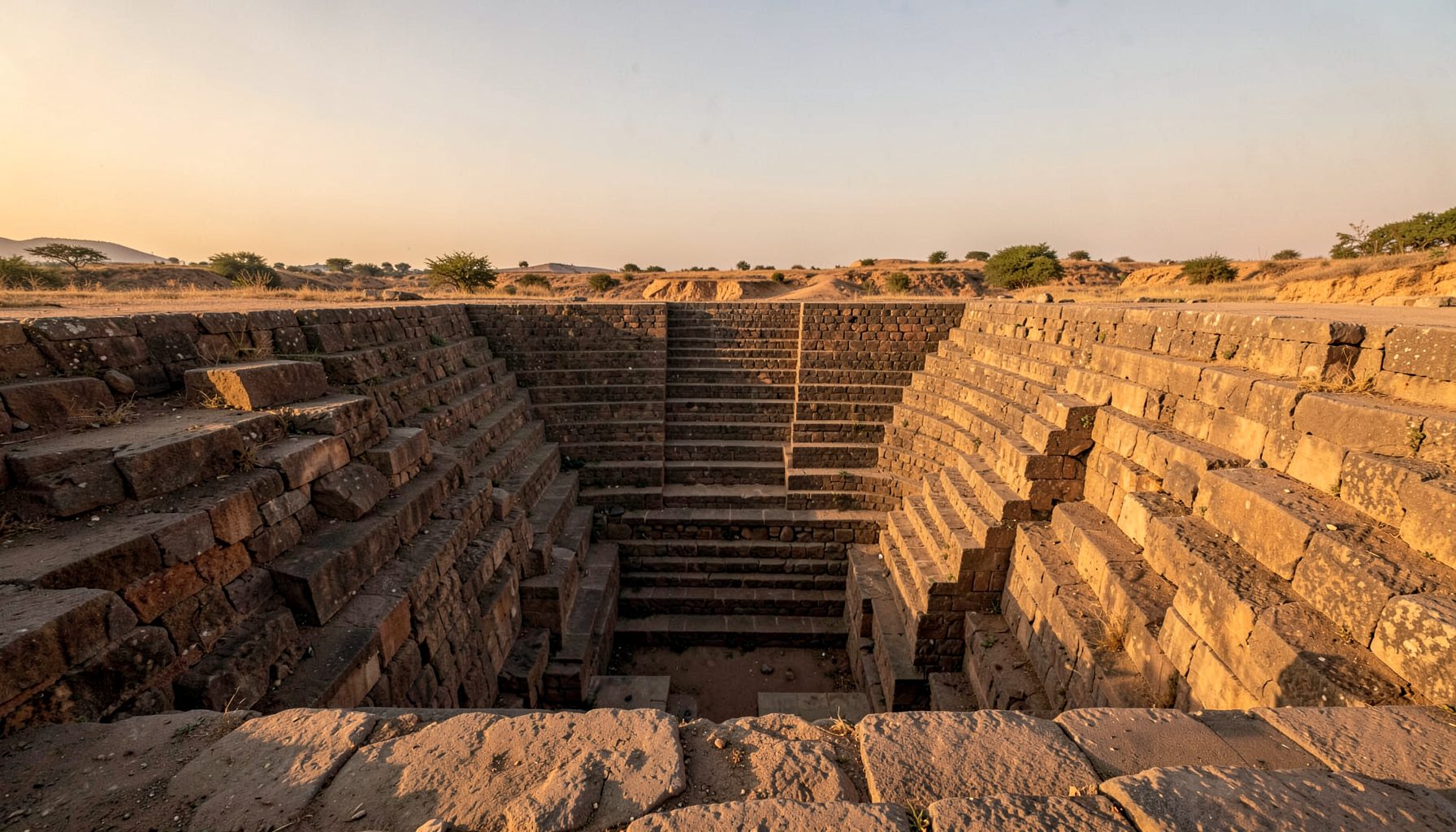
Stepwells are often photographed as quiet stone geometries, sunlit corridors dropping into cool water, columns dissolving into shadow. The pictures rarely show the human architecture behind them: who paid for the excavation, who swung the chisel, and who was allowed to draw water and who was turned away. Across western India, the vavs, baolis, and baradis served communities organised by jati, occupation, and ritual rank. Untangling who built and who used them means reading the wells alongside the social order that gave them meaning.
For audiences used to the dry interior of Australia, the logic of underground water takes a moment to grasp. In Melbourne during the Millennium Drought, households watched their tank levels and obeyed restrictions on garden watering, while in Sydney a desalination plant was brought into service to keep taps running through the worst years. Indian stepwells answered a different problem on a much longer timescale: harvesting monsoon rain in arid districts where the surface went months without a drinkable drop. The technologies developed independently, yet both speak to a society's relationship with scarcity and who gets to control it.
What the wells reveal is rarely a single story. Patron, architect, sculptor, labourer, pilgrim, water-bearer, washerwoman, child, and Brahmin priest all appear in the record if you know where to look. Stepwells were civic, religious, and commercial spaces at the same time, and caste operated as a sorting principle within each of those roles.
Patronage and labour in the vavs of Gujarat and Rajasthan
Most surviving stepwells were commissioned by wealthy individuals: queens, ministers, wealthy merchants, or local rulers. The Rani ki vav in Patan, for instance, was built by Queen Udayamati in the late eleventh century in memory of her husband. Similar endowments funded the Adalaj stepwell and many of the great vavs along the trade routes of Gujarat and Rajasthan. Patronage records, often carved into the parapets or surrounding walls, name the donor and sometimes the family lineage, but rarely the names of the workers.
The actual construction was carried out by skilled artisans whose trades were hereditary. Stonecutters, masons, and sculptors belonged to specific communities with long traditions of temple and cistern building. The Suthar, Kachhia, and Musahar communities, among others, were routinely engaged for well excavation and structural work. A master craftsman might be named in an inscription; the dozens of assistants who dressed the stone, hauled material, and polished the columns rarely were. Reading stepwells honestly means acknowledging this asymmetry of credit.
In many villages the people who built the wells were among the groups whose access to the water was most restricted. The work was skilled and respected in its own right, yet the social position of those who laboured on the wells often placed them outside the high-caste patrons whose names appear on the stone. The wells were, in this sense, monuments to both generosity and inequality at once.
Access rules and the social geography of water
Caste regulated the well in spatial terms that are still legible in the architecture itself. Larger stepwells typically have multiple levels and landings, and traditional accounts describe how each level was used by particular groups. Upper platforms and pavilions were associated with Brahmin priests, royal guests, and wealthy patrons. Middle landings served the general community, while lower platforms close to the water were used by washerfolk, water carriers, and those who worked directly with the well.
Separate wells and water sources were prescribed for communities considered outside the four-varna system. In many villages, Dalit households relied on smaller tanks, ponds, or separate hand-dug shafts because they were barred from the main stepwell. This exclusion was codified in custom rather than always in formal law, yet custom carried the weight of social sanction. In parts of Gujarat and Rajasthan, marginalised castes still remember within living memory which wells they were forbidden to enter.
The Australian comparison is instructive rather than equivalent. Aboriginal communities in places like Bourke or Alice Springs have long fought for water access on their own Country, and the Water Act 2007 reshaped how the Murray–Darling Basin shares water between irrigators, towns, and the environment. Both contexts show that water rights and water architecture have rarely been neutral.
Women, ritual purity, and daily use of the well
Stepwells are often described in tourist literature as places where women gathered to escape domestic heat, and there is truth in this image, but it needs careful framing. Women did use stepwells intensively, especially in regions where female seclusion made the lower, shaded landings one of the few acceptable public spaces. For women of higher-caste households, the stepwell could function as a semi-public arena, a place to meet other women, to oversee servants, to perform rituals of bathing and prayer.
For women from service castes, the stepwell was often a workplace. Bhistis and other water-drawing communities carried water in skins and pots to upper-caste households, a labour that reinforced the same hierarchy the architecture encoded. Lower landings, shaded and close to the source, were where these women waited, filled vessels, and hauled water back up the steps. The architectural space mirrored the social space, since those closest to the water were often those with the least ritual standing.
Purity rules shaped nearly every interaction. Spilled water from a higher-caste person's vessel could pollute a lower landing, and menstrual taboos meant women of certain groups were excluded entirely during specific periods. The well's cool stone was a quiet enforcer of social order, even when no one was watching.
Stepwells as community infrastructure, not monuments
Modern heritage tourism tends to frame stepwells as architectural wonders, comparable to cathedrals or palaces. The communities that originally used them tended to frame them as infrastructure: a place to wash, to water cattle, to draw drinking water after the rains failed. The shift in framing has consequences for how the wells are conserved today. When a structure is treated purely as a monument, its daily functions are forgotten, and the people who still use the area around it may feel disconnected from its preservation.
The Indian Stepwells project keeps both readings alive. Field recording in districts like Satara includes not only the carved column and the parrot-faced bracket but the current uses of the surrounding precinct: who passes through, who has rebuilt a crumbling step, which village committee maintains the approach. Some of these field notes from Satara have been written up in a recent field blog post that captures both the ruin and the life around it.
This dual approach has parallels in Australia. The National Trust in Victoria maintains working homesteads, courthouses, and gardens because buildings only remain meaningful when the surrounding community still uses them in some form. A stepwell fenced off from the village, treated as a static heritage object, loses the social life that gave it purpose.
Reading inscriptions for clues about the builders
Inscriptions on the parapets, pillars, and surrounding shrines of stepwells are some of the best evidence we have for caste and labour relations. Sanskrit and Old Gujarati dedications name patrons, list the month and year of construction, and sometimes record the guild or community of artisans involved. A skilled reader can spot references to specific occupational communities, religious endowments, and pilgrim routes that connect one well to a wider network.
Not every clue is textual. Iconography can hint at the communities served by the well: a carved Naga couple over the main tank often signals Hindu devotion, a nearby dargah or mosque suggests Muslim patronage or use, and a tiny shrine to a regional deity indicates which village community claimed the well as theirs. Even the choice of stone, the depth of excavation, and the number of landings reflect the resources and social organisation of the patrons and users.
Modern documentation methods add another layer. Drone photography captures the wider catchment and approach roads, architectural sketches record construction phases, and oral histories collected from elderly residents reach back into the late nineteenth and early twentieth centuries. Together these sources reconstruct a fuller picture than any single inscription could provide.
Reading the social layers of a stepwell
- Look at the landing levels, since upper pavilions often belonged to patrons and priests while lower landings served water carriers and washerfolk.
- Check for separate tanks or smaller hand-dug shafts near the main well, which may indicate access restrictions by caste.
- Read dedicatory inscriptions for patron names, dates, and guild references, then cross-reference local historical accounts.
- Notice nearby shrines, mosques, or dargahs that signal the religious communities using the well.
- Talk to local residents about which groups used which level, because oral memory holds much that the stone does not record.
How Australian visitors encounter these layered histories
Indian stepwells attract a growing number of travellers from Australia, many of them flying into Delhi or Mumbai before continuing to smaller towns in Gujarat and Rajasthan. Heritage-focused operators now run small-group tours that include Adalaj, Abhaneri, and the Raniji ki baori stepwell in Bundi. Australian visitors accustomed to reading Aboriginal rock art or pastoral homesteads often find the scale and ornamentation of stepwells startling, but the underlying social questions feel familiar.
Australia has its own history of excluding particular communities from public water sources, from the displacement of Aboriginal peoples from river frontages to urban infrastructure choices of the twentieth century. The Heritage Council of South Australia, the NSW Heritage Office, and the federal Heritage Council of Australia all maintain registers that try to capture the social value of places, not just their architectural merit. The language of "outstanding social value to a community" used in the Environment Protection and Biodiversity Conservation Act 1999 is one that Indian heritage practitioners are also adapting.
For Australian visitors, the most respectful approach is to learn something of the wells' social history before arriving, and to support documentation projects that record community knowledge. The current Maharashtra documentation campaign by Indian Stepwells welcomes community contributions and field reports, and is an example of the kind of slow, careful work the wells deserve.
Heritage protection today and why documentation matters
Many stepwells remain unprotected. They sit on private land, within active villages, or under departments whose priorities lie elsewhere. Encroachments, dumping, groundwater depletion, and stone quarrying around historic sites all threaten the surviving structures. State archaeology departments, where they exist, are often under-resourced, and panchayat-level awareness is patchy at best.
The role of independent documentation projects has grown as a result. Photographic archives, architectural surveys, and oral histories can be shared with local authorities, included in heritage listings, and used to argue for protection. The ongoing effort in Maharashtra combines on-the-ground recording with online publication, and independent documentation does not replace state protection but builds the evidence base that protection requires.
For audiences following these projects from Australia, financial support, technical collaboration, and respectful travel all help. The wells were built by particular communities, used by particular communities, and will only survive if those communities remain central to the conversation about their future.
Ways Australian readers can support stepwell documentation
- Sponsor a field survey through the Indian Stepwells project, with costs itemised by district and travel.
- Contribute photographic or oral history material if your family has ties to a stepwell region, especially in Maharashtra or Gujarat.
- Support listings with the Australian Heritage Council's overseas place categories for sites of cultural significance to Australian communities.
- Share documentation with local panchayats and state archaeology departments through the project's reporting channels.
- Visit responsibly by hiring local guides, respecting access rules, and asking permission before photographing rituals or residents.
Get in Touch
Have information about a stepwell that is not yet on our map? We would be glad to document it and give you full credit. Whether it is a Barav, Kund, Vihir, or any other form of stepwell, every contribution helps preserve India's water heritage.
Call or message us with details about the location, and we will follow up.
#9372496819
Send a Message
What People Say
"The Maharashtra Stepwells campaign has brought attention to structures that were nearly forgotten. The architectural documentation and drone photography are invaluable resources for researchers and students alike."
"Collaborating with the Indian Stepwells team gave our architecture students hands-on exposure to traditional water-harvesting structures. The presentations were insightful and inspiring."
"I shared details of a stepwell near my village that was not on any map. The team visited, documented it beautifully, and credited me. It felt wonderful to contribute."