 Explore Maharashtra
The voice beside a forgotten baoli
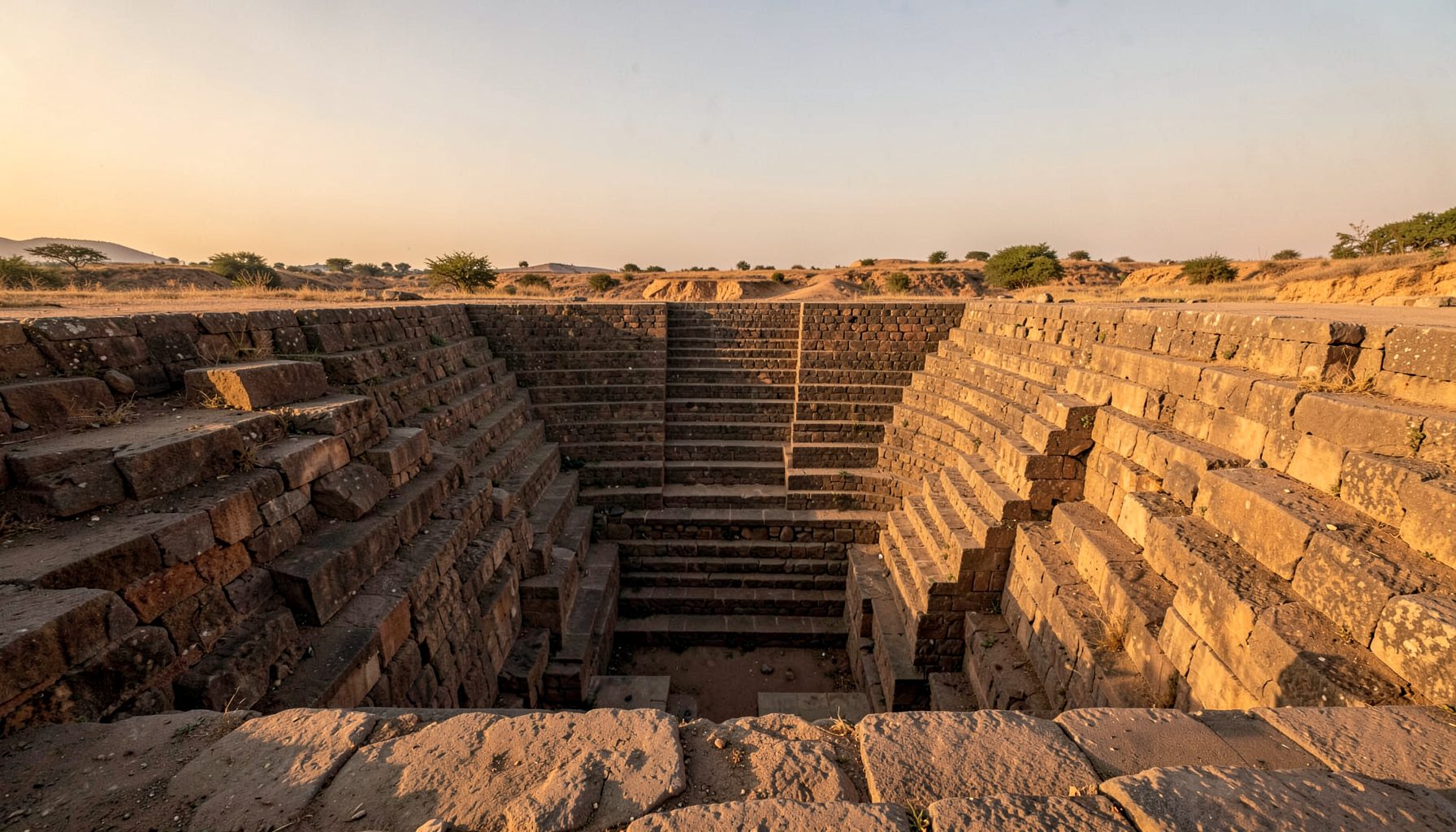
Before sunrise, a baoli can look less like a monument than a dark opening in the earth. Dust gathers along its steps, thorny shrubs press against the parapet, and the last traces of painted plaster fade into the stone. Yet someone usually knows the structure intimately: who cleaned it, where the water once rose, which family held the keys, and why local people stopped visiting.
A conversation with such a person changes the way we read a stepwell. The baoli is no longer an isolated piece of architecture waiting for restoration. It becomes a record of drought, migration, caste, trade, ritual, engineering and everyday labour. Its history survives in practical memories that may never appear on a plaque.
For Indian Stepwells, these encounters are central to heritage documentation. Original photography, measured sketches, drone views and local testimony can work together, especially in Maharashtra and other regions where bawdis, baolis, vavs, kunds and baravs remain outside the better-known tourist routes.
Meeting the guardian at the edge of the village
The guardian we will call Shankar first approaches the baoli with a ring of old keys and a length of coir rope. He is not an appointed caretaker in the formal sense. No department pays him a regular wage, and no sign identifies him as the person responsible. He simply inherited the duty from his father, who inherited it from an uncle.
“People come when they need a story,” he says, looking across the broken steps. “But when the rubbish comes, nobody says it belongs to them.”
His relationship with the site is practical rather than romantic. He clears plastic after religious festivals, warns children away from unstable masonry and occasionally sweeps the upper platform before a wedding procession passes nearby. The work is carried out quietly, often without recognition, yet it preserves the possibility of future study.
The baoli lies beyond a cluster of homes and a small shrine. An older resident remembers women carrying brass pots down to the lower landing. Another recalls buffalo being led to a side channel. Shankar separates what he has witnessed from what was told to him, but he treats both forms of knowledge carefully.
Reading stone through memory
The interview reveals details that photographs alone cannot provide. A blocked opening on the eastern wall once connected the stepwell to a seasonal runoff route. A shallow groove along the coping stone held a wooden cover during the monsoon. The fourth flight of steps was avoided because the stone became slippery and a child drowned there decades ago.
These observations help explain why a seemingly plain baoli was built with particular alignments and changes in level. Water architecture was designed around fluctuating supply, not a single permanent pool. Each landing offered a place to rest, draw water, conduct repairs or wait for a crowded passage to clear.
The relationship between sky, structure and ceremony also deserves attention. Ancient sites across the world show how communities connected built spaces with seasonal light and celestial cycles; the Newgrange solar alignment offers a useful comparison without suggesting that every sacred structure had the same purpose. At the baoli, the important alignments may be less dramatic: morning shade, the direction of monsoon flow or the position of a shrine above the waterline.
Shankar points to a narrow ledge and says this was where women placed their pots. The ledge is too low to feature in a formal architectural description, yet it explains how the structure worked at human scale. Heritage is often held in such small, repeated actions.
When water was a public responsibility
The guardian remembers the baoli as a place of negotiation. During dry months, households took turns drawing water. The order was understood locally, and arguments were settled by elders who knew which families had helped repair the steps. Water access was never merely technical; it shaped relationships, obligations and status.
As borewells and piped supply expanded, the baoli lost its daily purpose. The change brought convenience, yet it also removed the routine that kept the structure visible. Once people no longer descended for water, weeds grew across the treads and repairs became somebody else’s problem.
This pattern will feel familiar to many Australians. In regional New South Wales and Queensland, drought has made people attentive to dams, tanks, groundwater and water restrictions, yet modern infrastructure can still hide the older systems that supported settlement. A forgotten baoli offers a different lesson: water conservation is also about maintaining shared knowledge and shared responsibility.
Shankar is careful not to describe the past as perfect. Some families were allowed closer access than others, and women carried much of the physical burden. Recording local testimony means preserving uncomfortable social history alongside engineering skill and community care.
Why a baoli disappears from public memory
A structure can be physically present and culturally absent. The baoli may sit beside a road used every day, but passing drivers see a collapsed wall rather than a water system. Official records may give the site a vague name, an incorrect location or no entry at all. Without consistent documentation, each generation loses another layer of context.
There are also practical barriers. Unstable steps, snakes, rubbish, private boundaries and unclear ownership make fieldwork difficult. A local guardian may welcome visitors but lack authority to approve excavation, cleaning or repairs. Well-intended action can damage surviving plaster, disturb archaeological deposits or create conflict with nearby residents.
This is why documentation should begin with listening. The Indian Stepwells background explains a broader approach built around photography, architectural sketches, field research and public awareness. A measured drawing can record dimensions; a conversation can explain why one entrance is blocked and another remains in use.
The interview also demonstrates the importance of naming uncertainty. If Shankar says a ruler built the baoli, that claim should be recorded as oral tradition until supported by inscriptions, archival material or comparative architectural evidence. Respect for local knowledge does not require accepting every detail as proven fact.
A wider regional water story
Baolis belong to a large family of water structures shaped by local geology, rainfall and political history. In Maharashtra they may be called baravs; elsewhere, terms such as bawdi, baoli, vav or kund describe related forms with distinct regional features. Their differences matter, but so do the connections between them.
The architectural history of central India offers useful context. Research into Paramara-era stepwells shows how patronage, temple culture and regional building traditions influenced the design of water structures. Such comparisons help researchers recognise patterns without forcing every neglected baoli into a single historical category.
For Australian audiences, this wider view can be especially valuable. People familiar with Aboriginal water knowledge, stock routes, farm dams and town water towers understand that infrastructure carries social meaning. A community museum in Ballarat, a local historical society in Adelaide or a heritage walk in Fremantle may use different language, yet each depends on connecting objects and places with lived experience.
The Australian heritage market also favours clear storytelling. Visitors often respond to a short, well-grounded account more readily than to a dense technical label. A baoli exhibition in Melbourne or Sydney could pair large-format photographs with a guardian’s voice, a drainage sketch, a stone sample and an explanation of how seasonal water levels shaped movement through the structure.
From interview to responsible preservation
A local guardian’s testimony should become part of a carefully managed record. Photograph the site from public access points, note the date and weather, map visible features, and record different versions of the story rather than smoothing them into one polished narrative. Permission matters, especially when photographing people, shrines, homes or private land.
Digital publication can bring attention, but exposure must be balanced against risk. Exact coordinates may attract vandalism, souvenir hunters or unsafe visitor numbers. In some cases, a broad location is more responsible until local custodians, researchers and authorities agree on access arrangements.
Australian readers can support this work through schools, cultural organisations, photography groups and regional exhibitions. A local council grant, a National Trust programme or a community museum partnership may provide a useful model, even when the baoli itself is thousands of kilometres away. The aim is not to turn a fragile water structure into a backdrop for tourism, but to make its history legible while protecting its future.
The most important question Shankar leaves us with is simple: who will remember the site when he is gone? Documentation cannot replace a living relationship with place, but it can help communities recognise the value of that relationship before the steps, stories and water channels disappear.
Practical ways to support forgotten stepwells
- Record local names, alternative spellings and oral histories alongside photographs and measurements.
- Ask permission before entering, filming, publishing portraits or sharing precise site locations.
- Document drainage channels, wells, shrines, platforms and repair marks rather than photographing only the most dramatic view.
- Compare community accounts with inscriptions, maps, archival sources and architectural evidence.
- Avoid cleaning, repainting or rebuilding masonry without advice from qualified conservation professionals.
- Create accessible displays through schools, libraries, museums, heritage walks and photography exhibitions.
- Share information about undocumented baolis with responsible researchers who can verify and preserve it.
Get in Touch
Have information about a stepwell that is not yet on our map? We would be glad to document it and give you full credit. Whether it is a Barav, Kund, Vihir, or any other form of stepwell, every contribution helps preserve India's water heritage.
Call or message us with details about the location, and we will follow up.
#9372496819
Send a Message
What People Say
"The Maharashtra Stepwells campaign has brought attention to structures that were nearly forgotten. The architectural documentation and drone photography are invaluable resources for researchers and students alike."
"Collaborating with the Indian Stepwells team gave our architecture students hands-on exposure to traditional water-harvesting structures. The presentations were insightful and inspiring."
"I shared details of a stepwell near my village that was not on any map. The team visited, documented it beautifully, and credited me. It felt wonderful to contribute."