 Explore Maharashtra
Climate change and the slow erosion of India's stepwell heritage
For more than a millennium, the stepwells of India served as living infrastructure, drawing groundwater to the surface through tiered stone shafts that doubled as gathering places, rest stops, and sanctuaries from the desert sun. Their survival has always depended on a balance between seasonal rain, aquifers, and the communities who maintained them. That balance is now tilting, and the structures that embody it are paying the price.
Australia sits on the other side of the Indian Ocean, but the country shares a deeply intertwined relationship with India, from the Indian-Australian communities in Sydney and Melbourne to bilateral research partnerships on water security. The pressures reshaping India's water landscapes therefore have a direct relevance to anyone watching climate adaptation in arid regions, including the southern parts of Australia where drought management is a perennial concern.
The water crisis hidden beneath the stones
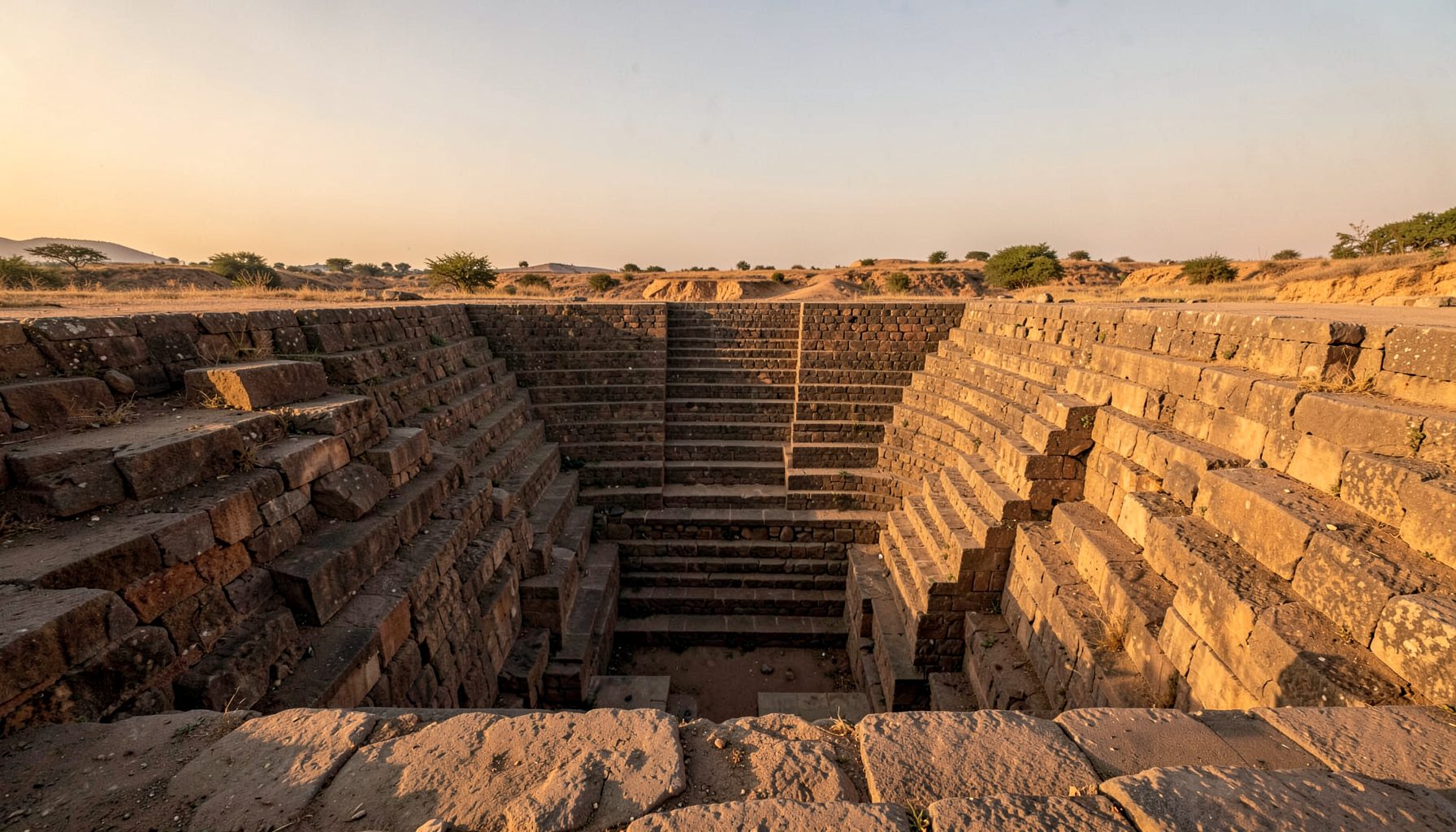
Stepwells were engineered for a climate that delivered reliable, if erratic, summer monsoons followed by long dry spells. They were not designed to cope with what is now unfolding. Across western India, groundwater tables are dropping at rates that vary between half a metre and several metres per year in overexploited districts, and vavs in Gujarat are showing the consequences in their brickwork. Pillars that once stood in shallow reflective water are now surrounded by cracked earth, and the humidity that once preserved their lime plaster has been replaced by thermal stress that fractures the same surfaces.
The climate variability that has always been part of the Indian subcontinent's character has intensified. Hotter summers, longer heatwaves, and shifts in the timing of the southwest monsoon all combine to alter the hydrology that the wells depend on. Researchers from the Indian Institute of Technology Bombay and collaborators in Adelaide have begun modelling how recharge patterns are changing, and the early results suggest that even vavs a hundred kilometres from the coast are seeing altered water cycles. Anyone familiar with the Murray-Darling basin discussions in Canberra will recognise the patterns, even if the specific landscape is very different.
Heat, salt, and the chemistry of decay
The damage from a changing climate rarely arrives in a single dramatic event. It accumulates through small chemical shifts. Stepwells built with lime mortar, sandstone, and basalt rely on stable humidity and a relatively narrow range of temperatures. When those conditions drift, salts within the stone begin to migrate. During the dry season they crystallise near the surface, and during rare wet spells they dissolve and re-crystallise deeper in the wall, slowly prising the structure apart.
This kind of decay is invisible from a distance, but it is being documented in the field. The architectural detailing of stepwells, particularly the architecture of symmetry found in the vavs of Gujarat, has been studied for its mathematical precision, yet that same precision becomes a liability when stone expands unevenly. Mirror-image carvings that once aligned to a fraction of a millimetre now show stress fractures running through them. Some of the most photographed galleries in Adalaj and Rani ki Vav are beginning to display exactly this pattern.
The heat itself is a problem. Surface temperatures in uncovered stepwell courtyards in Rajasthan have been recorded above 55 degrees Celsius during recent heatwaves, conditions that would have been unusual a generation ago. Stone that expands and contracts daily loses its binder more quickly, and the hand-carved figurative panels at the deepest levels are now vulnerable to spalling that conservation teams in Pune and Jaipur are struggling to keep up with.
When the rains come too hard, or not at all
Australia's experience with sudden swings between drought and flood, in towns from Lismore to Broken Hill, has shaped public conversations about infrastructure resilience, and Indian-Australian readers across Sydney and Melbourne follow these parallel climate stories closely. The site itself reaches that audience through a mix of heritage and lifestyle content, including a multihand blackjack guide tailored to Australian players, which keeps readers engaged with the wider documentation work. India faces a similar, more concentrated version of the same problem. The monsoon's arrival is less predictable, and when it does arrive, the rainfall is often compressed into fewer, more violent events. Stepwells that once absorbed a gentle two-month soaking now endure brief deluges that test their drainage systems.
Floodwater carries silt, agricultural chemicals, and urban runoff into the wells, staining walls and overwhelming silt traps that have not been maintained for decades. In some cases, sudden inundation has undermined the soft earth behind retaining walls, causing partial collapses in structures that had stood for five hundred years. Conversely, years of weak monsoon mean that wells do not refill, and the microbial communities that once kept water clean begin to die off, leaving stagnant pools that breed mosquitoes and accelerate biological fouling of the stonework.
Communities, custodians, and vanishing knowledge
The greatest heritage risk from climate change may not be physical. The vavs of Gujarat and the baolis of Maharashtra were maintained by communities who understood them, knew when to clear sediment, which plants signalled aquifer health, and how to perform rituals that kept them integrated into the social calendar. As younger generations migrate to cities such as Pune and Hyderabad, or, on a parallel track, Brisbane and Perth, that knowledge erodes faster than the stonework does.
Documentation projects are racing to capture what they can. Heritage photographers working with local informants have built up visual records, drone surveys, and oral histories across more than four hundred sites, but many remain unrecorded. The slow pace of academic publishing is not keeping up with the pace of loss, and informal channels between researchers, conservation architects, and village elders are becoming the most effective way to share findings. Even Australian universities, including the University of Western Australia, have signed memoranda with Indian institutions to support joint fieldwork in this area. There is also value in connecting with Irish heritage networks who have faced parallel questions about vernacular water structures and climate-driven decay.
Funding, tourism, and the road ahead
There is no single fix, but there are workable pieces. Heritage tourism, when managed carefully, can fund the conservation that climate adaptation requires. Indian heritage tours are already popular with travellers from Melbourne and Sydney who combine them with visits to Rajasthan and Gujarat, and a small share of that revenue is beginning to reach the sites themselves through structured entry fees and community-run guesthouses. The wider Australian market for cultural tourism is mature, and Indian operators are well placed to build on existing patterns.
Funding for site-level conservation is more complicated. Some government grants are available, and international heritage bodies have begun to recognise the climate vulnerability of subterranean water structures. Private sector interest is also growing, though partnerships between conservation trusts and gaming sponsors remain unusual. Examples from elsewhere, including casino bonus structures used to support niche causes, show how transparent revenue-sharing could guide ethical heritage funding in India.
Practical steps that can be taken now
The most immediate actions are at site level and are within reach of small teams:
- Installing low-cost humidity and temperature monitors in priority sites so conservators have real data to work with
- Training local masons in lime-mortar repair techniques specific to stepwell contexts
- Mapping flood pathways around each structure and reinforcing drainage inlets before each monsoon
- Producing open-access visual records that can be used by diaspora communities, including the large Indian-Australian population in western Sydney, for advocacy and education
Policy levers for longer-term change
Broader change depends on decisions made at state and national level:
- Recognising stepwells as climate-vulnerable heritage in state-level inventories, opening access to adaptation funding
- Linking stepwell conservation to watershed management plans rather than treating each site in isolation
- Supporting community-led custodianship through small annual grants tied to maintenance reports
- Building international research exchanges that bring Indian expertise into Australian arid-zone studies and vice versa
The task is not to freeze these places in time. Stepwells have always adapted to their environment. What climate change now demands is a more deliberate, faster, and better-funded adaptation than the slow accretion of community knowledge can provide on its own. The stone, the water, and the people who care for them are all still here, and the window for coordinated action, while narrowing, is not yet closed.
Get in Touch
Have information about a stepwell that is not yet on our map? We would be glad to document it and give you full credit. Whether it is a Barav, Kund, Vihir, or any other form of stepwell, every contribution helps preserve India's water heritage.
Call or message us with details about the location, and we will follow up.
#9372496819
Send a Message
What People Say
"The Maharashtra Stepwells campaign has brought attention to structures that were nearly forgotten. The architectural documentation and drone photography are invaluable resources for researchers and students alike."
"Collaborating with the Indian Stepwells team gave our architecture students hands-on exposure to traditional water-harvesting structures. The presentations were insightful and inspiring."
"I shared details of a stepwell near my village that was not on any map. The team visited, documented it beautifully, and credited me. It felt wonderful to contribute."