 Explore Maharashtra
Documenting the stepwells of the Western Ghats: A trekker's guide
The Sahyadri, Maharashtra’s section of the Western Ghats, rewards walkers with forest paths, basalt ridges and sudden monsoon runoff. Historic stepwells translate that water history into architecture: stepped tanks descend towards springs, wells and infiltration chambers. Some stand beside trekking routes, while others occupy old villages, forts or pilgrimage corridors below the range. The best journeys pair a genuine walk with a nearby baoli or bawdi rather than treating every stepwell as a remote summit.
A productive field day starts in cool, even light, when carved steps and stone joints are easiest to read. Photograph each structure from the entrance, then work downward with a wide view, a detail and a scale reference. Keep a sketchbook for profiles, inscriptions and restoration marks that a camera may flatten. Note coordinates, access conditions, water level, nearby buildings and modern alterations. A careful field record helps far more than a large pile of similar images.
Australian bushwalkers already understand the value of a plan and an alert check. Sydney’s Blue Mountains routes can close because of fire danger, while Maharashtra trails can close because of intense rain, landslides or swollen streams. Carry an offline map, download local forecasts and identify a retreat point. The comparison is practical rather than cosmetic: both landscapes demand restraint when conditions change.
Documenting sacred places also requires local manners. Ask before photographing worshippers, step around offerings, remove footwear where requested, and keep drones away from people, shrines and crowded lanes. A local market near the trailhead can provide water, seasonal fruit and useful conversation with residents. Record what you hear without turning local knowledge into a spectacle; heritage belongs first to the community that sustains it.
Planning around rain and access
Rain creates access, but it can erase a safe route. The southwest monsoon generally arrives in June and peaks through July and August; flash floods, slippery basalt and falling rock make descents dangerous. October to February offers firmer paths, though March and April bring heat and water stress. Start at first light, photograph in the cool hours, and treat any pool with moving or rising water as a barrier. A clear sky above the valley is not evidence that the gully below is safe.
Build each outing around the nearest trailhead in Pune, Mumbai or a village base, not a heroic cross-range traverse. Public transport can reach the Karla and Pashan corridors, while a local bus, auto-rickshaw or pre-booked taxi may cover the final stretch. Check district weather warnings on the day, carry the route in offline maps and tell a driver or lodge when you expect to return. During a monsoon pause, this selection of true-crime docuseries can fill an indoor evening, although no screen can substitute for a real safety assessment.
Reading the waterworks
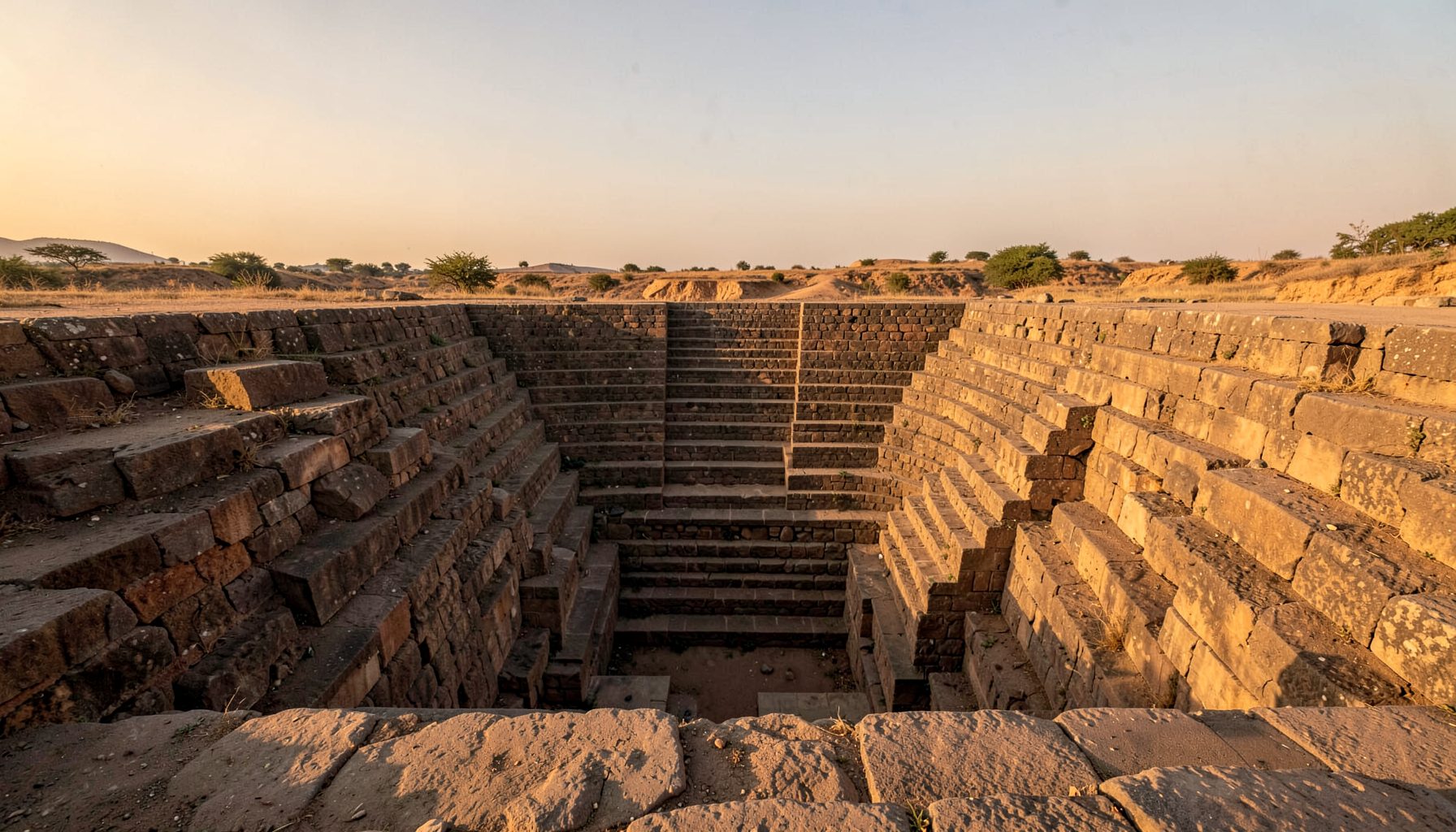
Begin by learning the local vocabulary. A bawdi is often a broad, open stepped well, while a baoli may be a deeper reservoir with stairs descending around a shaft. Vavs and baravs are regional names for comparable structures, and kunds often describe tanks connected with temples or settlements. Labels vary between districts, so a useful field note records both the local term and a plain description of the waterworks rather than assuming every stone tank has the same purpose.
Builders worked with a practical water system and a symbolic landscape at once. They intercepted percolating water, guided it through stone conduits and created cooler levels below the street. Carved niches, brackets, guardian figures and small shrines transformed infrastructure into a place for ritual and daily use. Sketch the section from entrance to waterline, note which parts remain functional and watch how the structure meets roads, homes and vegetation. That wider context often explains a feature more clearly than decorative detail alone.
For a comparative starting point, the account of the Paramara influence shows how motifs and construction ideas can travel between regions while acquiring local forms. Look for the same pattern in the Sahyadri: a functional core paired with religious sculpture, carved brackets, niches and guardian figures. Ask what each image marks—water, safety, fertility or authority—and record the evidence rather than assigning a meaning from appearance alone.
Walking to Karla
Karla provides one of the clearest combinations of forest walking, archaeology and water architecture. Begin in Bhivpuri village and follow the old road toward the Karla cave complex, allowing time for the rock-cut chambers before visiting the bawdi nearby. The walk is relatively short, but the stone surfaces can remain slick long after the surrounding track appears dry. Early morning offers softer light on the steps and fewer vehicles on the narrow access road.
The bawdi rewards a slower survey. Work from the upper entrance toward the central shaft, recording side passages, sculpted landings and the small Nandi shrine at the lower level. Side light can reveal carving that overhead photographs conceal, while a tripod and scale bar establish the size of columns and steps. Before committing to a steep descent, inspect the railing, broken treads and water depth; the discipline behind playing the odds is checking conditions rather than trusting appearance.
Following the stepwell trail into Pune
Pune offers the easiest stepping-stone for a Sahyadri stepwell itinerary. Pashan bawdi lies below the Sus Road slopes and works well with a morning walk through wet-season greenery; from there, continue towards the Mula–Mutha river corridor and other old-city water structures. Along the old Mumbai–Pune road, Malavalli baoli near the Tamhini Ghat turn provides a longer day combining forest, old highway and stone waterworks. These are short walks beside substantial landscapes, not isolated trekking destinations.
If time is limited, make Pashan the main visit, using a bus or auto-rickshaw to reach the edge of the site and leaving enough time for changing light. At the Mumbai end of the regional itinerary, Wadala baoli and its Gomukh shrine provide a useful city extension. Both sites are embedded in busy neighbourhoods, so work from public paths, respect private entrances and let residents pass. Note traffic, vendors and redevelopment without treating everyday activity as clutter to be edited out of the story.
Recording living heritage
Many stepwells have functioned as more than ruins: they have served as water sources, temple approaches and gathering places. At active shrines, cover shoulders and knees, remove shoes where signs or attendants indicate, ask before taking portraits and keep voices low in the chamber. Avoid flash around worship and never enter water for a photograph. Water may carry ritual significance or pollution, so treat it as off-limits unless a custodian explicitly grants access.
Drone imagery can reveal a site’s plan, but launch only after checking permissions, airspace and local sensitivities; crowded religious precincts are often inappropriate. Give copies of useful photographs to local custodians and record the photographer, date and direction of each view. Photographers and residents with reliable photographs, sketches, oral histories or newly discovered structures can share field information with Indian Stepwells, whose current Maharashtra emphasis offers a clear home for responsible follow-up.
Packing for Maharashtra from Australia
Packing should respect the monsoon rather than borrow a standard Australian bush kit. Melbourne’s famously changeable weather is a useful reminder to layer, though Pune’s wet-season humidity calls for breathable clothing and reliable leak protection. Carry more water than expected, electrolyte sachets, a light rain shell, warm layer, sun hat, repellent, gaiters and a compact first-aid kit. Add a headlamp, power bank, offline map and personal locator beacon for remote sections; charged phones alone are not an emergency plan.
The Australian custom of leaving a written route plan with someone at home translates well to Maharashtra’s trails and village roads. At a local market such as Melbourne’s Queen Victoria Market, stock compact high-energy foods and check labels for nuts, a serious allergen on shared trails. In Maharashtra, replenish at a neighbourhood bazaar with seasonal fruit, roasted chickpeas and sealed water. Leave room in the daypack for those purchases, keep the dry bag closed before monsoon rain and pack out every wrapper. The strongest field record joins accurate observations to patient relationships: water level, carved evidence, present-day use and the names local people give to the place.
Get in Touch
Have information about a stepwell that is not yet on our map? We would be glad to document it and give you full credit. Whether it is a Barav, Kund, Vihir, or any other form of stepwell, every contribution helps preserve India's water heritage.
Call or message us with details about the location, and we will follow up.
#9372496819
Send a Message
What People Say
"The Maharashtra Stepwells campaign has brought attention to structures that were nearly forgotten. The architectural documentation and drone photography are invaluable resources for researchers and students alike."
"Collaborating with the Indian Stepwells team gave our architecture students hands-on exposure to traditional water-harvesting structures. The presentations were insightful and inspiring."
"I shared details of a stepwell near my village that was not on any map. The team visited, documented it beautifully, and credited me. It felt wonderful to contribute."