 Explore Maharashtra
Rajon ki Baoli and the Craft of Brick
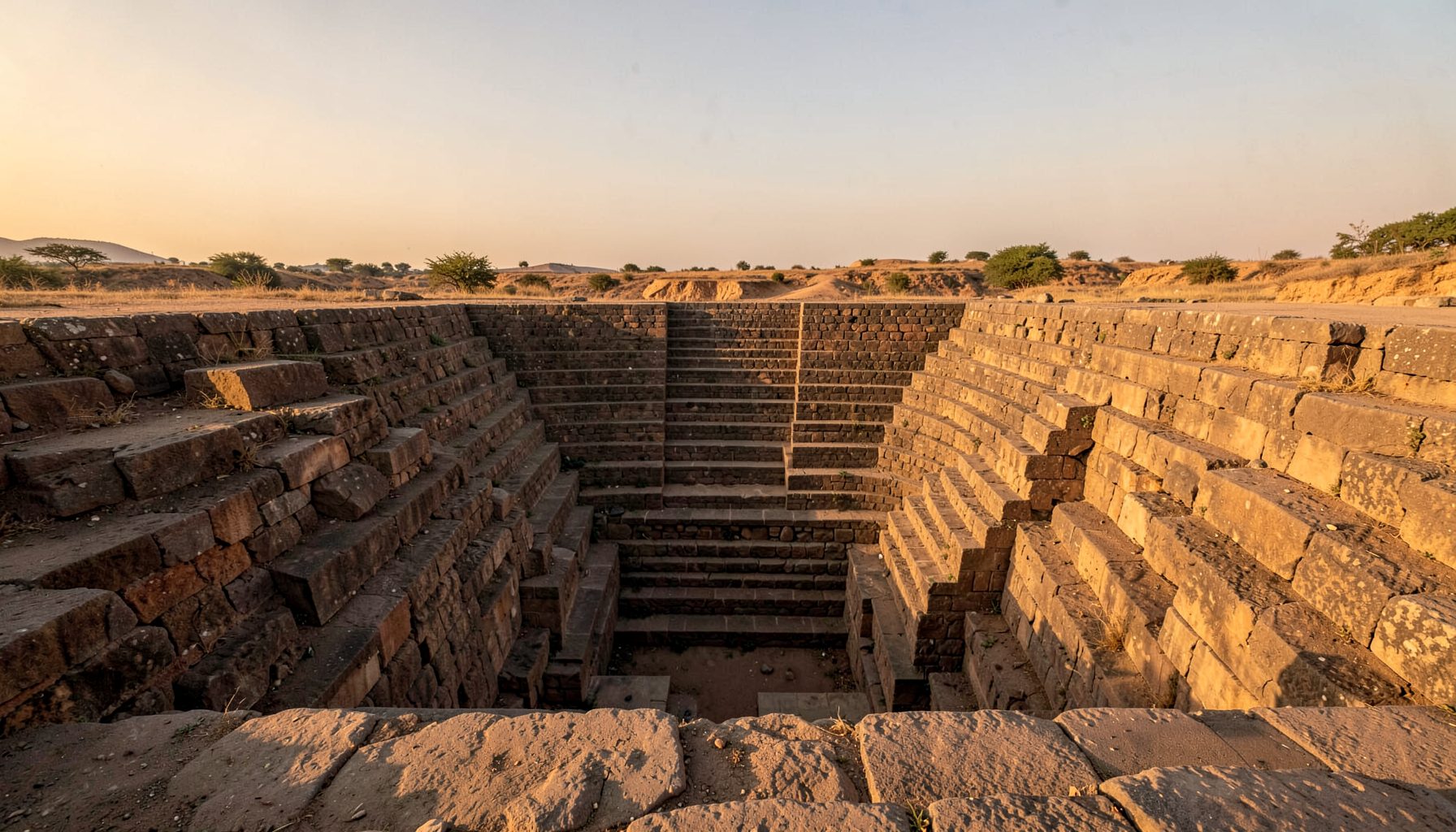
Rajon ki Baoli stands in Rajon village, about 25 kilometres from Pune in Maharashtra. Usually dated to the 18th century and also known locally as Shahi Baoli, it descends through brick arches and flights of steps toward a reservoir. Its importance lies in material as much as form: where many western Indian stepwells are cut or built in stone, this one is constructed almost entirely from fired brick.
That distinction makes Rajon an invaluable case for understanding how builders shaped earth, water and social life in the Deccan. Brick offered repeatable units, curved forms and crisp edges, but it changed how the structure could be ornamented, weathered and maintained. Its fabric tells a story of climate, craft and community rather than merely preserving a vanished age.
A rare stepwell near Pune
The stepwell belongs to a broad family of structures descended from ordinary wells. A baoli in Maharashtra, a bawdi in Rajasthan, a vav in Gujarat and a kund in northern India are regional names for places where water, shade and civic life could meet. Differences in geology and custom produced many local forms, so Rajon should not be treated as a copy of any single distant site.
Rajon lies in the countryside southeast of Pune, where old travel routes, farms and settlements shaped access to water. The approach through a village landscape matters: the baoli was not an isolated scenic object, but part of a lived network of wells, shrines, fields and paths.
The unusual choice of brick gives this example an unusually legible identity. Rather than presenting one universal model, Rajon exposes how local builders selected material, geometry and patronage according to their own circumstances. That specificity is precisely why close documentation is valuable.
How brick shapes the descent
From its arched entrance, the baoli falls in stages toward the water chamber, commonly recorded as roughly 40 feet, or 12 metres, deep. Descending flights create shade and reveal the reservoir gradually, turning the approach into an architectural sequence. Openings and recessed surfaces admit daylight while guiding views and movement toward the lower level.
Fired brick was laid in lime mortar, producing fine joints and a regular rhythm of courses. Its modular size allowed builders to form arches, vaults and deep recesses without the massive blocks required for comparable stone construction. Curved brickwork also catches light differently throughout the day, making the descent feel more textured than the broad, hard planes often associated with stone stepwells.
Brick imposed particular constraints. It is porous, responds quickly to seasonal moisture and can suffer from salt movement, eroded mortar and biological growth. Fine workmanship has not prevented weathering, yet the surviving fabric preserves an advanced understanding of load, drainage and enclosure. Rajon demonstrates that the choice of material was a technical decision with profound visual and environmental consequences.
Water, gathering and daily use
As a waterwork, Rajon belonged to a system of seasonal replenishment and careful storage. Monsoon rain and groundwater could feed the reservoir, while its depth provided a reserve through drier periods. The architecture made that reserve accessible from the surface, allowing users to descend gradually instead of handling a well through buckets and ropes alone.
The steps also made the structure social. People could draw water, wash, rest in shade, water animals and meet neighbours there. Such uses turn a water source into civic space. A photograph of an empty reservoir can conceal this history, making it important to document former activities alongside present physical conditions.
Conservation now involves a delicate balance. Water levels depend on rainfall, groundwater and maintenance, while damp soil, salts and plant roots threaten brick and mortar. At the same time, public access requires stable steps and safe surfaces. Keeping a historic baoli functional without sealing its masonry with impermeable cement is a central challenge for those responsible for its future.
History with open questions
Popular accounts connect Rajon with the Nizam era and use titles such as Shahi Baoli, while local traditions associate it with families, shrines and former travel routes. These clues need not conflict, but they are not the same as a documented chronology. Dates, patronage and later alterations should be compared with measured drawings, heritage records and testimony from residents rather than presented as settled fact.
Stories of concealed routes also attract the imagination. The separate Bhangir tunnel mystery shows why photographs, plans and local testimony need to be read together rather than treated as interchangeable proof. Rajon should be documented with the same care: a possible feature should not become a confirmed tunnel, nor should a local memory be dismissed merely because it lacks a technical plan.
A living archive of shared knowledge
Stepwell research becomes richer when architecture is connected to language and memory. Regional words such as baoli, bawdi, vav, kund and barav carry information about climate, building methods and everyday use. Recording how residents name a structure, describe its water or remember a vanished flight can reveal details that a formal survey misses.
Cultural memory works in a similar way. The public attention surrounding O’Carolan’s final resting place offers a parallel: a place gains cultural force when its physical fabric and stories are preserved together. For Rajon, village memory may explain changes in the water supply, old approaches or structures surrounding the baoli that are otherwise difficult to date.
Photography, measured sketches and carefully planned aerial imagery can each answer different questions. A ground-level photograph records texture and scale; a drawing records geometry; an aerial image clarifies the relationship between the reservoir, village and surrounding landscape. Their value increases when captions separate direct observation from interpretation and identify dates, weather conditions and uncertain features.
Why the example matters in Australia
Australian viewers often encounter fired brick in a different context, particularly around Melbourne’s surviving nineteenth-century warehouses. Rajon offers a useful comparison between local brick architecture and a South Asian water structure built for a monsoon climate. Adelaide provides another point of familiarity: residents there understand the civic importance of storing water through dry summers, although Adelaide’s Mediterranean climate differs from Maharashtra’s monsoon pattern.
In family and community conversation, many people in western Sydney and Melbourne’s eastern suburbs use terms such as baoli, bawdi and vav alongside English words like well and tank. Australian heritage guides commonly advertise a “heritage walk”, while local Indian organisations may offer talks that connect architecture with family migration and cultural memory. Fremantle’s multicultural Indian Ocean port identity also creates a natural setting for conversations about water, movement and shared heritage.
The Australian heritage market usually combines council and state grants, donations, memberships, print sales, workshops, exhibitions and specialist tours. Independent projects such as Indian Stepwells operate within that mixed funding environment, where documentary photography and exhibitions can reach audiences without turning a sensitive site into a conventional attraction. Drone imagery must also comply with Civil Aviation Safety Authority rules and any landowner or local authority conditions. In Australian professional language, “conservation” often includes repair, maintenance and managed change, while “restoration” implies a return to a defined historic state.
A field guide for careful visitors
A visit to Rajon becomes more rewarding when observation is separated from assumption. Attention to the route, masonry, water system and surrounding village reveals why this brick stepwell deserves detailed study.
Features to examine in the brickwork
- Start with the entrance sequence, where the arched portal frames a controlled descent into the structure.
- Compare stretcher and header bricks to see how the masons bonded the walls.
- Look closely at the arches, where curved brickwork carries loads around openings.
- Follow projecting bands and recessed panels to understand how shadow reveals the façade.
- Distinguish older weathered brick from newer repairs by colour, mortar and tooling marks.
Habits that protect the site
- Check current access and photography rules with local authorities before travelling.
- Keep to established paths and avoid climbing fragile parapets or steps.
- Ask residents before making close portraits or entering private property.
- Use a tripod and lighting equipment only where access rules allow.
- Record dates, weather, water conditions and uncertain details in field notes.
Field records are most useful when they identify what was seen rather than what was assumed: the village, orientation, water level, visible repairs and names used locally. Residents of an undocumented stepwell can share field observations with Indian Stepwells, where location notes, old photographs and remembered changes can guide future research. Such contributions are especially valuable because many wells survive within living landscapes rather than isolated monuments.
Get in Touch
Have information about a stepwell that is not yet on our map? We would be glad to document it and give you full credit. Whether it is a Barav, Kund, Vihir, or any other form of stepwell, every contribution helps preserve India's water heritage.
Call or message us with details about the location, and we will follow up.
#9372496819
Send a Message
What People Say
"The Maharashtra Stepwells campaign has brought attention to structures that were nearly forgotten. The architectural documentation and drone photography are invaluable resources for researchers and students alike."
"Collaborating with the Indian Stepwells team gave our architecture students hands-on exposure to traditional water-harvesting structures. The presentations were insightful and inspiring."
"I shared details of a stepwell near my village that was not on any map. The team visited, documented it beautifully, and credited me. It felt wonderful to contribute."