 Explore Maharashtra
Reading India’s Stepwells Through Form, Place, and Water
Across India, a stepped water structure can be called a baoli, vav, kund, or barav, yet these names do not describe four rigid architectural categories. They belong to different regional languages and building traditions, and their meanings often overlap. A baoli in northern India may resemble a barav in Maharashtra, while a Gujarat vav can combine the functions of a reservoir, shrine, shaded promenade, and civic gathering place. Learn more about The Bronze Age Passage Tomb Of Newgrange And Its Solar Alignment.
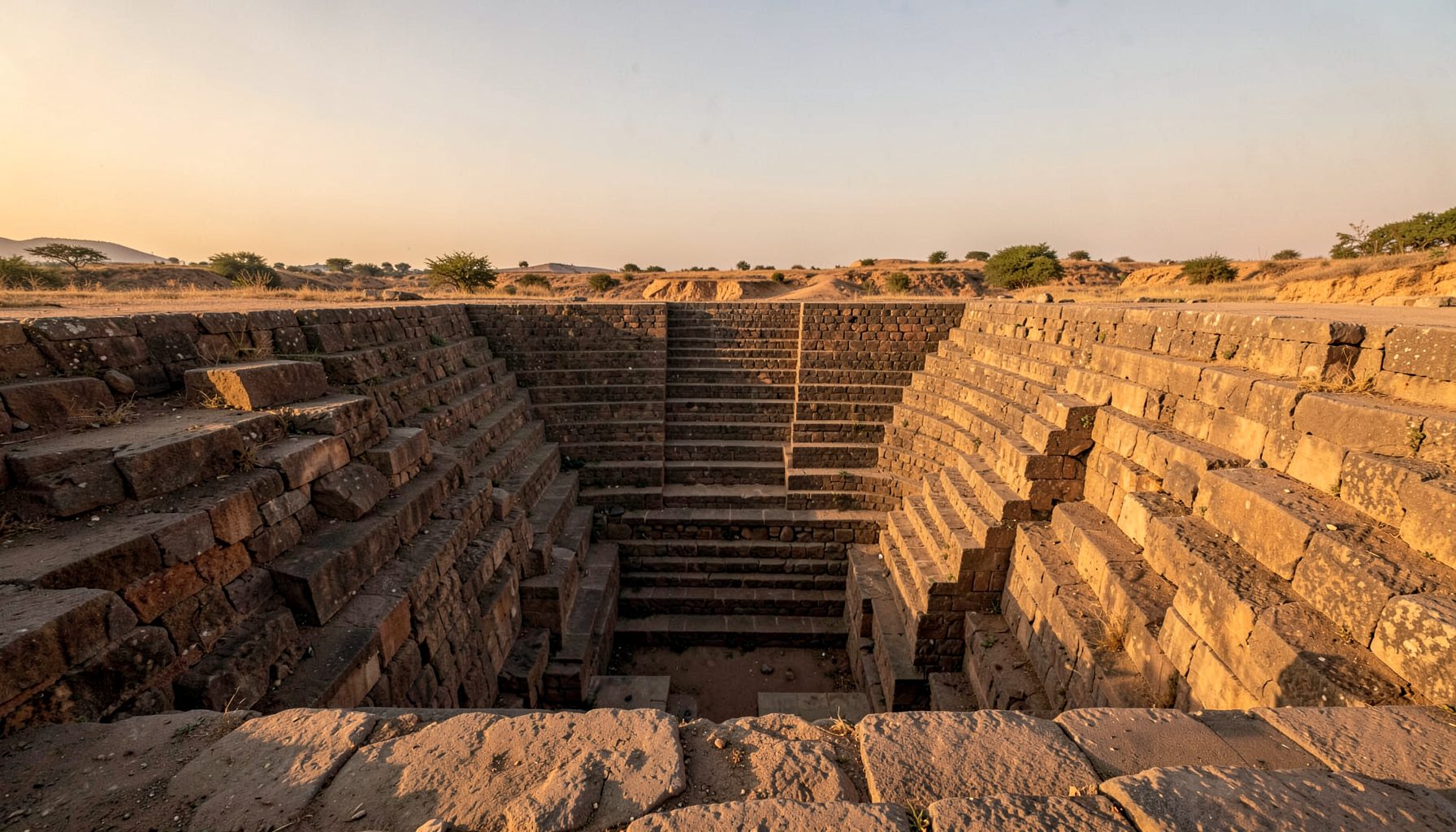
The most useful comparison looks beyond vocabulary. It considers how people entered the water, how deeply the structure was excavated, whether it had corridors or pavilions, and how its design responded to rainfall, geology, ritual practice, and settlement patterns. This approach helps viewers understand stepwells as working infrastructure rather than picturesque ruins.
For an Australian audience, the subject has immediate relevance. Adelaide’s dry climate, Perth’s groundwater concerns, Melbourne’s interest in adaptive heritage, and Sydney’s public conversations about water security all provide useful points of connection. The structures also offer compelling material for exhibitions, architectural study, travel photography, and the local market for carefully researched heritage prints and books.
Baoli: A stepped well shaped by access
The word baoli, also written bawdi or baori, is strongly associated with northern and central India. It usually refers to a well reached by a straight or descending flight of steps. Some baolis are relatively plain, with masonry walls and a narrow shaft, while others include covered galleries, resting chambers, carved columns, and pavilions. Their scale ranges from village wells to monumental urban structures.
A baoli’s principal experience is longitudinal. Visitors move down through changing bands of shade and light until the water appears at the lowest level. This gradual descent made the structure practical during fluctuating seasons: when the water table fell, people could continue walking deeper into the well. The architecture therefore recorded changing hydrological conditions in its very layout.
In field photographs, useful baoli features include:
- A dominant straight staircase leading towards a well shaft
- Landing platforms where people could pause or collect water
- Arcades or chambers designed for shade
- Masonry repairs showing different periods of use
Baolis often stood near roads, settlements, forts, or caravan routes. Their shaded interiors could serve as social spaces, especially during hot months. In a contemporary Australian comparison, the cooling effect resembles the value placed on shaded civic spaces during Adelaide summers, although the Indian structures achieved it through depth, stone mass, and evaporative conditions rather than mechanical systems.
Vav: Monumental architecture beneath the ground
Vav is the Gujarati term most closely associated with the grand, multi-storeyed stepwells of Gujarat. The best-known examples are carefully planned architectural compositions, with long flights of steps connected by landings, pillared halls, sculptural panels, and subterranean galleries. Rather than appearing as a simple well with stairs, a vav can feel like a palace turned vertically into the earth.
The Rani ki Vav at Patan demonstrates this monumental approach, but the tradition includes many smaller and less elaborate examples. Vavs were commissioned by rulers, merchants, and wealthy patrons, and their decoration could express religious devotion, social prestige, and technical accomplishment. The descent was structured as a sequence of architectural thresholds, with each level offering shade and a different view of the carved stonework.
The difference between a baoli and a vav is therefore partly regional and partly descriptive. A Gujarati vav is generally more architecturally elaborate, while baoli is a broader term used across several northern regions. The distinction should not be treated as an absolute rule: local usage, restoration history, and popular tourism descriptions can blur the categories.
The underground climate of a vav is also important. Thick masonry moderated heat, making the lower levels several degrees cooler than the surface in some conditions. This quality offers a productive comparison with passive-cooling research in Australian architecture, particularly in Melbourne universities and design practices exploring thermal mass, courtyards, and low-energy buildings.
Kund: A ritual basin with stepped edges
A kund is usually a stepped tank or basin rather than a deep, narrow well. Its steps often descend symmetrically on several or all sides, creating a geometric frame around a broad body of water. Some kunds are attached to temples and intended for ritual bathing, while others supported everyday water collection and local ceremonies.
The geometry of a kund can be strikingly different from the linear movement of a baoli. Instead of following one extended stairway, users approach the water from multiple directions. Repeated flights, platforms, and retaining walls produce strong patterns when viewed from above, which explains the appeal of drone imagery and architectural sketches in documenting these sites.
A kund may also be built as part of a temple complex, where its water has ceremonial significance. Steps provide access at changing water levels, while surrounding shrines, pavilions, and sculpted edges connect the basin to religious activity. In some places, the distinction between water tank and stepwell becomes fluid because both structures are designed around seasonal fluctuation.
Visitors from Australia should remember that a sacred water structure is not simply a photographic setting. Shoes may need to be removed near shrines, modest clothing is appropriate, and bathing or touching water may be governed by local customs. These practical details matter when heritage photography is undertaken during a trip from Sydney, Brisbane, or another Australian city.
Barav: Maharashtra’s regional water vocabulary
Barav is a widely used Marathi term for a stepwell, particularly in Maharashtra. The word can refer to structures with stairs descending to a well, but local examples vary considerably in plan, scale, material, and ornament. Some are associated with temples or forts, while others sit quietly beside villages, agricultural land, old routes, or now-modernised town edges.
Maharashtra’s geology and monsoon patterns produce a distinctive context. A barav may be cut into or built from basalt, laterite, or locally available masonry, and its condition can reflect intense seasonal rain followed by long dry periods. On the Konkan coast, dense vegetation can conceal old water structures, making field walking, oral history, and careful location records essential; the Konkan stepwells study shows why these sites need more than a quick roadside visit.
Compared with a highly ornamented vav, a barav may appear restrained, but simplicity does not indicate lesser importance. Its design may be precisely suited to local rock, catchment, village use, and maintenance practices. A well-preserved but undecorated barav can reveal more about everyday water management than a famous monument whose original community relationships have been lost.
For researchers, the term is valuable because it helps locate Maharashtra’s less documented heritage. Local Marathi names, memories of former water routes, and knowledge held by residents can identify structures absent from tourist maps. Independent documentation projects such as Indian Stepwells bring together photography, sketches, field notes, and community information to extend that record.
Comparing form, function, and setting
The four terms become clearer when compared through practical questions. Is the water reached by one principal staircase or by steps around a basin? Are there multiple storeys and pillared halls? Is the site primarily linked to ritual, travel, farming, domestic use, or several purposes at once? What materials and construction methods respond to local rainfall and geology?
A useful comparison should also allow hybrid forms. A structure may be called a baoli in one source and a barav in another, while a temple tank may be described as a kund even when it includes a deep well chamber. Colonial records, modern signage, regional languages, and tourism writing each shape the vocabulary. Classification is most reliable when the name is recorded alongside a measured description and local usage.
When examining photographs or visiting a site, consider:
- The direction and length of the main descent
- The number of landings, galleries, and underground levels
- Whether water occupies a shaft, basin, channel, or reservoir
- The relationship to a temple, fort, road, settlement, or farm
- Evidence of current use, restoration, neglect, or altered drainage
This method is particularly helpful for Australian students and heritage groups. A school in Melbourne might compare a stepwell’s water logic with local reservoirs and stormwater systems, while a photography group in Perth could study how framing changes between a dry upper courtyard and a shaded lower chamber. The comparison remains respectful when it recognises each structure’s cultural setting rather than reducing it to a design solution.
Why these water structures still matter
Stepwells demonstrate that water infrastructure can be civic, ecological, architectural, and cultural at the same time. Their stairs accommodated falling water levels, their stone walls created cooler environments, and their gathering spaces supported social life. Their survival also depended on maintenance, changing water use, and continued community recognition.
The environmental lesson is relevant in Australia, where drought restrictions, groundwater management, and heat resilience are familiar public concerns. A stepwell cannot simply be copied into a Sydney suburb or inserted into an Adelaide development, yet its principles invite useful questions about shade, gravity-fed access, thermal mass, rain capture, and shared responsibility for water.
Heritage documentation can take many forms: measured drawings, oral histories, drone surveys, archival research, conservation reports, and high-quality photography. Exhibitions in Melbourne or Canberra can place Indian stepwells alongside Australian histories of tanks, wells, dams, and water harvesting without pretending that the traditions are interchangeable. Local weekend design markets and independent bookshops can also help make carefully sourced heritage publications accessible beyond academic audiences.
Long-term preservation begins with attention to ordinary examples as well as celebrated monuments. A small barav hidden by vegetation, a damaged kund near a temple, or an unrecorded baoli on the edge of a growing town may contain valuable evidence about regional water knowledge. Recording its name, location, materials, condition, community associations, and seasonal behaviour creates a foundation for future conservation.
Get in Touch
Have information about a stepwell that is not yet on our map? We would be glad to document it and give you full credit. Whether it is a Barav, Kund, Vihir, or any other form of stepwell, every contribution helps preserve India's water heritage.
Call or message us with details about the location, and we will follow up.
#9372496819
Send a Message
What People Say
"The Maharashtra Stepwells campaign has brought attention to structures that were nearly forgotten. The architectural documentation and drone photography are invaluable resources for researchers and students alike."
"Collaborating with the Indian Stepwells team gave our architecture students hands-on exposure to traditional water-harvesting structures. The presentations were insightful and inspiring."
"I shared details of a stepwell near my village that was not on any map. The team visited, documented it beautifully, and credited me. It felt wonderful to contribute."