 Explore Maharashtra
Water Conservation Lessons from Ancient Stepwell Technology
Across India, stepwells were built as practical water infrastructure, public gathering places and carefully engineered responses to seasonal rain. Known as bawdis, baolis, vavs, kunds and baravs, these structures stored water below ground, reduced evaporation and allowed communities to reach a shrinking water supply through changing seasons.
For Australians facing longer dry periods, urban growth and pressure on rivers and groundwater, their design offers useful principles rather than a blueprint to copy. The most valuable lessons concern passive cooling, local materials, shared responsibility and the patient management of rainfall before it runs away.
How stepwells turned rainfall into a reserve
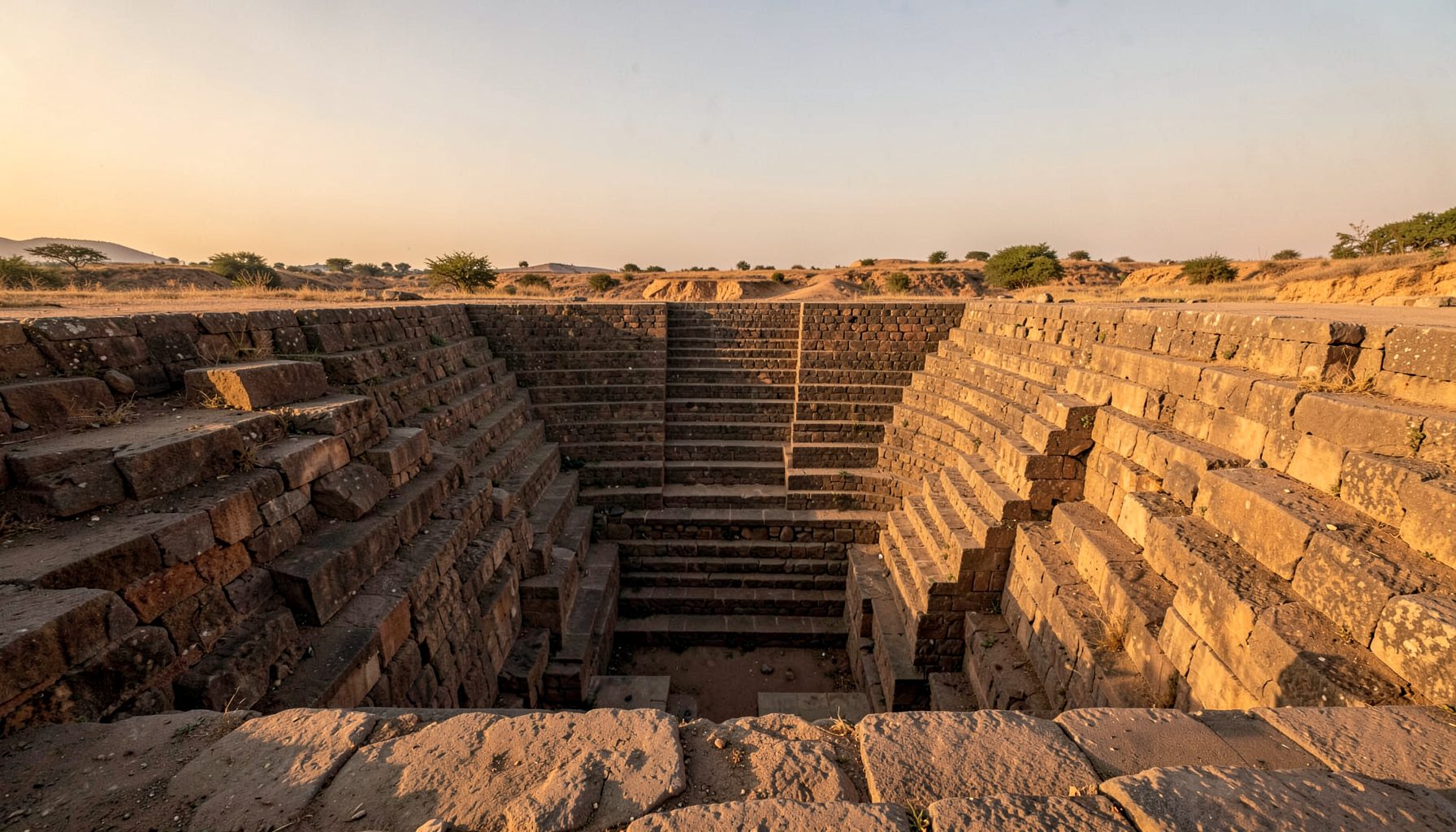
A stepwell began with an understanding of the local water cycle. Builders studied the slope of the land, the behaviour of seasonal streams and the depth of the water table before deciding where to excavate. Rainfall could then be guided into a stepped shaft, where it remained accessible after surface pools and shallow wells had dried.
The descent was central to the system. As water levels fell, steps allowed people to continue collecting water without pumps or complex machinery. The surrounding masonry stabilised the sides of the excavation, while shaded depths helped keep stored water cooler and slowed evaporation during hot months.
This approach is especially relevant in parts of Australia where intense rainfall may arrive in short bursts, followed by long dry spells. Capturing stormwater close to where it falls can reduce pressure on mains supplies and make better use of irregular precipitation.
Passive cooling and efficient underground storage
The geometry of a stepwell did more than provide access. Deep corridors, recessed platforms and thick stone walls created cooler conditions than the exposed ground above. These shaded spaces became places for rest, conversation and ritual, demonstrating how water infrastructure could support everyday public life without consuming energy.
Underground storage also limits the surface area exposed to wind and sun. Modern tanks already use some of this logic, but the stepwell shows how storage, shade and human access can be designed as one connected system. A shaded community reservoir or partially buried tank may lose less water than an uncovered pond in a hot climate.
The lesson is not that every Australian suburb needs a monumental stone shaft. It is that climate-responsive design can perform several jobs at once: storing water, moderating heat, creating habitat and offering a civic space. This is the kind of practical thinking documented through photography and field research on Indian Stepwells.
Reading the landscape before building
Many historic stepwells were positioned in relation to temples, roads, settlements and natural drainage lines. Their location reflected both hydrology and human movement. A well that was difficult to reach would serve fewer people, while one placed beside a busy route could become a dependable stop for residents, travellers and animals.
Modern water projects can learn from this attention to place. Before installing tanks, wetlands or infiltration gardens, planners need to understand how water moves across a block, where soil drains slowly and which public spaces already attract people. Local knowledge often reveals flooding patterns that do not appear in a short engineering survey.
In Australia, this might mean treating a suburban reserve, school ground or roadside swale as part of a wider catchment system. In Werribee, western Melbourne or Adelaide’s dry outer suburbs, small interventions linked across a neighbourhood may provide greater resilience than one oversized facility located far from daily life.
Materials, maintenance and community use
Stepwells were usually built with materials available in their region, including sandstone, basalt, granite, brick and lime-based mortar. Their construction responded to local geology and craft traditions. Durable materials mattered, but so did the ability of local workers to repair damaged steps, clear silt and maintain drainage channels.
That maintenance culture is a significant water-conservation lesson. Infrastructure fails when it is treated as invisible after installation. A rain garden blocked by sediment, a tank with a broken inlet or a wetland choked with weeds cannot perform its intended role. Historic water systems depended on recurring attention from the communities that used them.
The social dimension also matters. Stepwells could be places for gathering, shade and exchange, which made their care a shared concern. Australian councils and water authorities may achieve better results when stormwater projects are integrated into parks, walking routes and community facilities rather than presented as fenced-off technical assets.
Practical lessons for Australian catchments
The most useful ideas can be adapted at several scales, from a household courtyard to a regional water-sensitive urban design project. They work best when storage, access and maintenance are considered together.
- Capture roof runoff before it reaches the street or storm drain.
- Place tanks, ponds or infiltration beds according to natural site contours.
- Use shade and partial burial to reduce evaporation during hot weather.
- Connect water features with parks, paths and other community destinations.
- Select durable local materials that can be repaired by nearby trades.
- Plan regular inspections for silt, cracks, weeds and blocked inlets.
Australian conditions vary sharply. Perth’s sandy soils, Brisbane’s intense summer storms and Canberra’s frost-prone winters require different details, even when the broader principle remains the same. Water conservation is most effective when design responds to a specific climate and catchment rather than applying one universal model.
A second set of principles concerns governance and public behaviour. Historic examples show that technology works within a social system, not separately from it.
- Make water levels and maintenance responsibilities visible to the community.
- Protect recharge areas from contamination and excessive construction.
- Record local histories alongside measurements and engineering drawings.
- Teach children how rainfall becomes stored water and groundwater.
- Include Traditional Owner knowledge through respectful, properly recognised partnerships.
What Maharashtra reveals about adaptation
Maharashtra contains a varied collection of baravs, kunds and other stepped water structures shaped by basalt landscapes, monsoon rainfall and changing settlement patterns. Some are modest local wells, while others have elaborate stairs, platforms and shrines. Their differences show that stepwell technology was never a single fixed design.
In the Deccan, the timing of rain was as important as its total volume. Water had to be captured during the monsoon and protected through the dry season. Stone construction, deep excavation and carefully managed access helped communities bridge that seasonal gap. Current fieldwork through the Maharashtra campaign helps bring these regional variations into public view.
For researchers and designers, documentation is part of conservation. A measured drawing, aerial image or oral history can reveal how a structure relates to its catchment and settlement. It can also prevent a damaged or neglected site from disappearing from official records before restoration is considered.
From heritage evidence to modern policy
Ancient structures should not be romanticised as perfect systems. Some became polluted, silted or redundant when pipelines and bore infrastructure changed settlement patterns. Their value lies in the principles they make visible: storing water locally, reducing exposure to heat, respecting gravity and linking infrastructure with public life.
Those principles can inform Australian policy around water-sensitive cities, household rainwater harvesting and drought planning. Councils might use heritage case studies in design guidelines, while schools and community groups could map historic and contemporary water assets in the same catchment. Such work turns conservation from an abstract target into something people can see.
Public attention is now shaped by competing online interests. A heritage project may sit beside football coverage, including Premier League standings, in the same browsing session. Clear photography, accurate captions and accessible research help water history reach audiences who may not initially search for architecture or environmental education.
Making water knowledge visible
Good documentation gives forgotten infrastructure a second life. Detailed images show worn steps, repaired masonry, algae lines and changing water levels; sketches explain structure, while drone views reveal how a site fits into its wider landscape. Together, these records can support researchers, teachers, conservation groups and local decision-makers.
For an Australian audience, the communication style should be practical and grounded. People often talk about saving water through the familiar language of tank levels, water restrictions, garden use and the next dry season. Heritage stories become more relevant when they connect directly with household bills, overheated streets and the reliability of local creeks.
Digital publishing also reaches readers through varied interests and search habits. An article about Australian multihand blackjack may attract a different audience from a field report on a centuries-old baoli, yet both demonstrate the value of clear, well-structured online information. The central task is to make evidence easy to discover without reducing complex heritage to decoration.
Stepwells offer a durable way to think about water: catch it where it falls, store it with care, cool it naturally, maintain it collectively and understand its relationship with the wider landscape. Those lessons can guide modest household projects and ambitious urban planning alike, especially as Australian communities prepare for a less predictable water future.
Get in Touch
Have information about a stepwell that is not yet on our map? We would be glad to document it and give you full credit. Whether it is a Barav, Kund, Vihir, or any other form of stepwell, every contribution helps preserve India's water heritage.
Call or message us with details about the location, and we will follow up.
#9372496819
Send a Message
What People Say
"The Maharashtra Stepwells campaign has brought attention to structures that were nearly forgotten. The architectural documentation and drone photography are invaluable resources for researchers and students alike."
"Collaborating with the Indian Stepwells team gave our architecture students hands-on exposure to traditional water-harvesting structures. The presentations were insightful and inspiring."
"I shared details of a stepwell near my village that was not on any map. The team visited, documented it beautifully, and credited me. It felt wonderful to contribute."