 Explore Maharashtra
The Symbolism of Naga Figures in Stepwell Carvings
Across India, serpents appear in temple sculpture, village shrines, household rituals and stories about rivers, rain and the underworld. In a stepwell, however, a naga figure acquires a particularly direct relationship with water. It may guard a landing, coil around a pillar, emerge from foliage or occupy a small shrine beside the descending stairs. Its meaning is layered rather than fixed.
The Sanskrit word naga can refer to a serpent deity, a supernatural being associated with subterranean waters, or a powerful ancestral presence. Local traditions add their own names and stories, so an image in a baoli, bawdi, vav, kund or barav should be read with attention to its region. A carved cobra in Maharashtra may share broad symbolism with a serpent at Patan in Gujarat, while its ritual context remains distinctly local.
For visitors from Australia, the visual language can be approached through familiar concerns about water security and landscape. Rainwater tanks, drought-conscious gardens and restrictions in cities such as Melbourne and Sydney make the practical intelligence of historic water structures easier to appreciate. Yet a stepwell was never simply a tank. It was infrastructure, shrine, meeting place, shaded route and a carefully designed threshold between the human and sacred worlds.
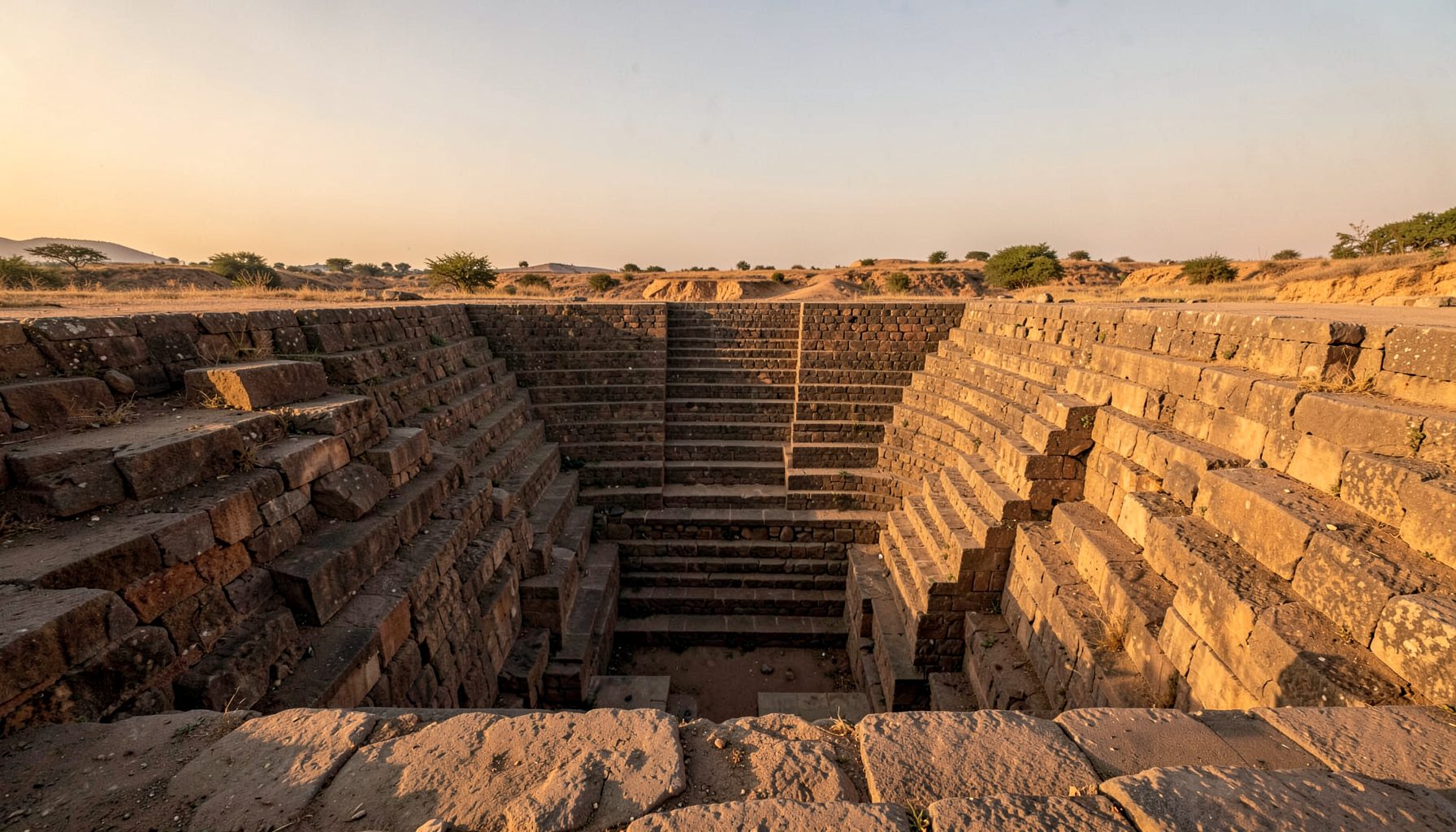
Indian Stepwells documents these structures through photography, sketches, aerial views and field research, with special attention to Maharashtra. The carvings are considered alongside masonry, geology, oral history and present-day use. This approach matters because a naga is not an isolated decorative motif: its position, scale, companions and relationship to the water basin all help reveal what a community may have believed about protection, fertility and the unseen life of water.
Serpents Between Water And The Underworld
In Hindu, Buddhist and Jain traditions, serpent beings are frequently linked with springs, rivers, rainfall and hidden treasures. Their imagined realm may lie below the earth or beneath a body of water, making them natural guardians for a structure that descends underground. The vertical movement of a stepwell reinforces this association: each stair takes the visitor farther from the sunlit surface and closer to a cool, enclosed domain.
This symbolism does not mean that every serpent carving represents the same deity. It may portray a naga king, a female serpent figure, a protective cobra or a more general emblem of renewal. Multiple-headed forms can express supernatural power, while a hood spread above another figure may indicate shelter or authority. Careful documentation should therefore record the carving’s details rather than applying a single universal label.
The connection with fertility is equally significant. Water makes crops grow, supports animals and sustains settlement, while the snake’s ability to shed its skin gives it an association with renewal. In a stepwell, these meanings gather around the most valuable resource in the landscape. The image can be understood as a warning against disrespect, a prayer for abundance, or a sign that the water belongs to a living moral order.
A Guardian At The Threshold
Stepwells are composed of transitions: from street to stairway, light to shade, noise to quiet and surface level to water. Naga figures often appear at these points because guardians belong at thresholds. Their presence can mark the entrance to a sacred precinct, a landing where ritual activity took place, or a vulnerable architectural junction requiring symbolic protection.
Architectural context is essential. A serpent beside a shrine should be examined differently from one carved into a bracket or parapet. Look for associated lotus flowers, makaras, human worshippers, musicians, elephants or celestial beings. A naga intertwined with vegetal patterns may emphasise fertility and abundance; a solitary hooded serpent may carry a more concentrated protective role.
This threshold quality also explains why naga imagery can feel both welcoming and unsettling. The figure invites respect but resists casual possession. Such ambiguity is useful when presenting heritage to a contemporary audience. A photograph should preserve the atmosphere of the place without turning a sacred symbol into an exotic prop, particularly when the site remains connected to local ritual practice.
Regional Stories And Changing Meanings
The broad mythology of nagas travels across the subcontinent, but local communities give it specific histories. In Maharashtra, serpent worship may be connected with Nag Panchami, village guardian traditions, agricultural cycles or family shrines. Some stepwells have lost their original carvings through weathering, repairs or stone reuse, while others retain fragments whose meaning survives through oral accounts.
Field research can bring together several kinds of evidence: inscriptions, archival maps, temple records, conversations with residents and close photographs of sculptural details. A local name for a well may reveal more than an architectural classification. It can identify a serpent shrine, a former water source or a remembered ritual that is absent from official records.
Documentation also involves acknowledging uncertainty. A damaged figure may be mistaken for a naga when it is a makara, a dragon-like aquatic creature, or part of a larger mythological scene. Dating should not be inferred from style alone, since repairs and reused blocks complicate the visible fabric. Comparisons with memory-work documentation can be valuable here: difficult heritage requires precise observation, clear provenance and respect for the people connected to a place.
The same principle applies to digital publishing. A drone image may show the geometry of a well, but it cannot explain why residents avoid, visit or protect a particular corner. Combining aerial views with ground-level images and community testimony produces a more honest record of living heritage.
Reading The Carving In Its Landscape
A naga’s meaning is strengthened by the environment around it. If the stepwell sits near farmland, a temple, a seasonal stream or an old settlement route, the serpent may reflect practical dependence on water as much as religious imagination. The landscape also shows whether the structure still functions: are there damp stones after rain, plants growing in the shaft, traces of recent cleaning or offerings placed near the carving?
Australia offers a useful point of comparison without suggesting that the traditions are identical. People accustomed to checking dam levels, conserving shower water or maintaining a rainwater tank understand that water systems carry social responsibilities. Heritage interpretation in Adelaide, Brisbane or Perth can use this everyday connection to make Indian hydraulic architecture accessible, while still explaining the specific religious meanings of naga worship.
Public presentation should also account for different forms of protection. In Australia, heritage management is shaped by state legislation, such as the Heritage Act 2017 in Victoria or the Heritage Act 1977 in New South Wales. Indian sites are governed through a different legal and administrative landscape, and many local stepwells may lack strong protection or regular maintenance. Photography, publication and restoration should therefore be carried out with permissions, local consultation and attention to vulnerable stonework.
A useful parallel can be found in community-led landscape recording, including projects such as Irish place archives, where local memory helps connect physical remains with stories, names and loss. For a stepwell, this kind of record can preserve information about seasonal water use and ritual practice even when the carving itself becomes difficult to read.
Recording Naga Imagery Responsibly
The strongest documentation combines visual description with cultural humility. Instead of captioning an image simply as “snake decoration,” describe the hood, posture, number of heads, material, location and condition. Note whether the figure is accompanied by an inscription or offering, and distinguish direct evidence from interpretation. This method helps researchers compare sites without flattening their differences.
Photographers should avoid climbing on sculptures, moving offerings or entering restricted areas for a better angle. A scale reference can be included without placing objects against the carving. In busy urban settings, a quiet early-morning visit may produce clearer images, while in rural areas a local guide can explain access customs and seasonal conditions.
The following practices support accurate and respectful fieldwork:
Field Practices For Heritage Documentation
- Record the site name, village, district, coordinates and date of observation.
- Photograph the naga from several distances, including its relationship to stairs, water and nearby shrines.
- Ask permission before photographing active worship, offerings or identifiable community members.
- Compare oral accounts with inscriptions, maps, conservation records and architectural evidence.
- Note damage, plant growth, water levels and repairs without disturbing the structure.
- Share corrections and undocumented site information through the Maharashtra campaign.
A public archive should make room for uncertainty and change. The aim is not to freeze a naga figure inside an imagined ancient past, but to show how its significance has travelled through construction, worship, neglect, repair and renewed interest. Exhibitions in Australia can place detailed photographs beside architectural drawings and water-management comparisons, allowing audiences to see both the artistry and the continuing cultural responsibility.
Researchers who know of an undocumented stepwell can share local information with the documentation project. A brief report, a village name, a sketch or a few carefully taken photographs may become the first record of a site that has never appeared in a heritage survey. In that way, the serpent’s role as guardian extends into the present: it reminds us that water, memory and architecture require active care.
Get in Touch
Have information about a stepwell that is not yet on our map? We would be glad to document it and give you full credit. Whether it is a Barav, Kund, Vihir, or any other form of stepwell, every contribution helps preserve India's water heritage.
Call or message us with details about the location, and we will follow up.
#9372496819
Send a Message
What People Say
"The Maharashtra Stepwells campaign has brought attention to structures that were nearly forgotten. The architectural documentation and drone photography are invaluable resources for researchers and students alike."
"Collaborating with the Indian Stepwells team gave our architecture students hands-on exposure to traditional water-harvesting structures. The presentations were insightful and inspiring."
"I shared details of a stepwell near my village that was not on any map. The team visited, documented it beautifully, and credited me. It felt wonderful to contribute."