 Explore Maharashtra
The Stepwells of the Betwa River Valley
The Stepwells of the Betwa River Valley form part of a landscape in which water shaped settlement, defence and ritual. The Betwa crosses Bundelkhand before joining the Yamuna in Uttar Pradesh, while the Ken, Bina and Paisuni connect the region’s drier uplands with cultivated valleys. Bundelkhand’s water heritage is practical as well as monumental: it records how communities stored monsoon surplus and reached groundwater between rains.
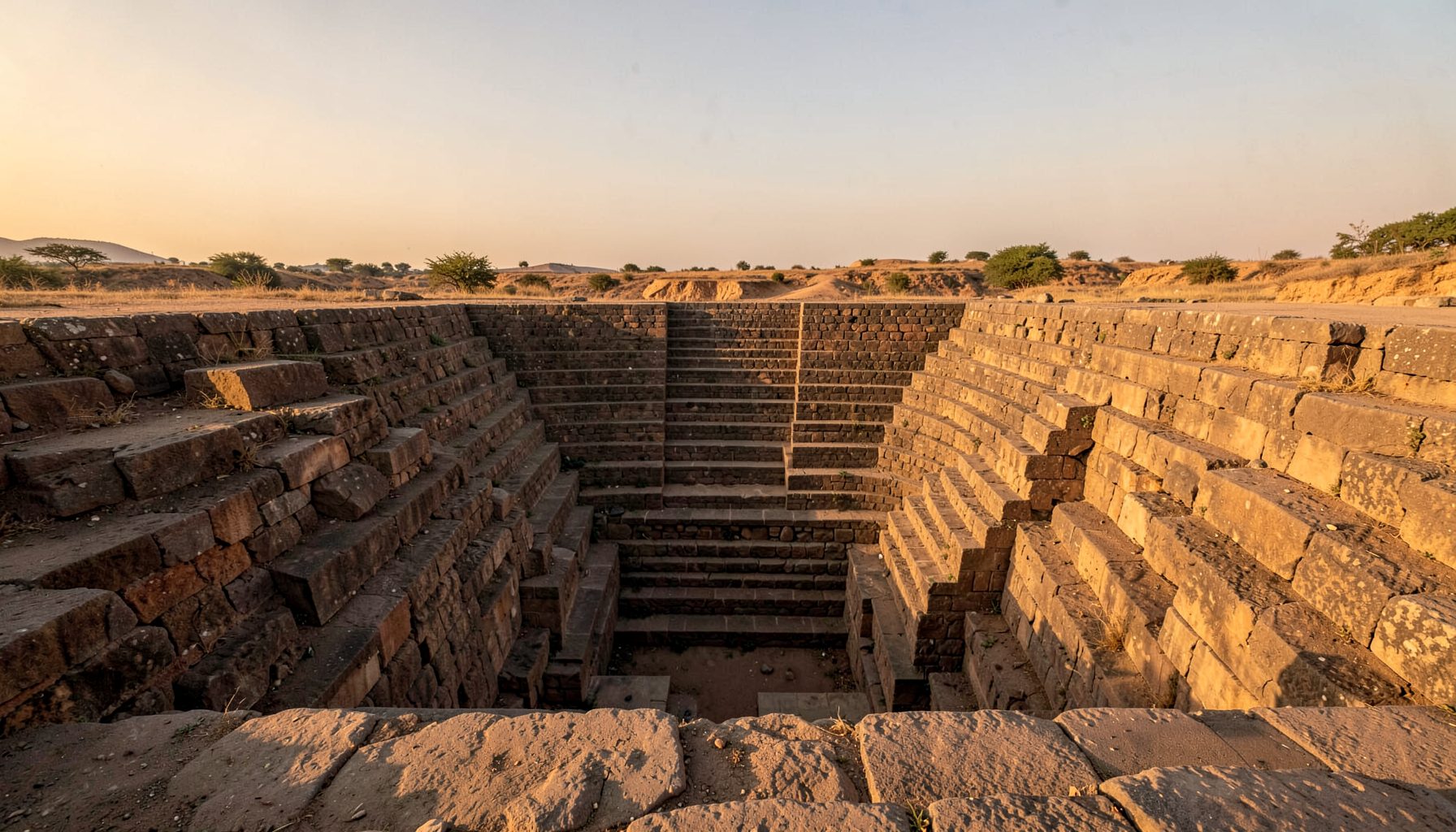
Across Madhya Pradesh and Uttar Pradesh, these structures appear under names such as bawdi, baoli, vav, kund and barav. Their plans range from open stepped tanks to narrow, shaft-like wells, and their sandstone courses were often finished with carved brackets, niches and figurative panels. They were not ornamental ponds: many served villages, temples and travellers while also supporting bathing, ritual and, in some periods, commercial activity.
Water engineering in a seasonal landscape
A typical stepwell combines an open access tank with a descending stair or series of landings leading to a deeper shaft. The upper level caught rain and runoff, while the descending levels offered shade and a place to draw water. A well cut into the water table could remain useful after a shallow tank dried. The architecture converted a seasonal resource into a dependable shared amenity.
Design followed local conditions rather than a single blueprint. Broad flights suited open tanks and collective gathering; narrow shafts suited settlements built on rockier ground. Masonry steps, retaining walls and arched openings resisted the pressure of saturated soil. Lime plaster and dressed sandstone helped protect surfaces, while niches created cool places for vessels and resting bodies.
Water management also depended on what happened above ground. Catchments, embankments, channels and settlements directed runoff towards useful storage, sometimes at the cost of downstream flows. Archaeology can reveal those relationships through wall alignments and changing floor levels, but historical water rights were rarely written down in the same way. Present groundwater conditions cannot be read directly from an old stepwell’s appearance.
Stonework, memory and everyday use
The descent changes the meaning of the monument. Bright upper terraces narrow into cooler, darker passages, making the movement towards water part of the experience. Carvings of warriors, musicians, courtly figures and ascetics placed social and sacred roles around a practical structure. Much of this visual programme survives unevenly, making close photography and measured sketches valuable evidence alongside descriptive histories.
Material objects can also carry history into family life. The connection between keepsakes and bereavement explored through Victorian mourning jewellery offers a useful reminder that architecture, ornament and remembrance overlap. A stepwell is not a memorial object, but its worn steps and inhabited surfaces likewise held ordinary acts of care. That shared use complicates any simple division between utility, art and heritage.
- Stepped access links the water table to public space rather than concealing it behind a pump or tower.
- Niches and brackets reveal the skills of masons who worked with local sandstone and lime.
- Sculpture records clothing, instruments, devotional figures and ideas of rank.
- Erosion, silt and altered drainage reveal how a historic structure meets present-day water management.
Field researchers therefore record more than the famous baoli at the centre of a settlement. A blocked stair, spring outlet or domestic tank can be evidence of a different relationship with water. Audio, oral testimony and seasonal observation can preserve knowledge that a single visit in the dry season misses. Such evidence also helps visitors distinguish an active community water source from an archaeological monument.
Places that reveal the valley’s story
Bori, Khajuraho and Chanderi provide especially useful points of entry to the regional story. At Bori, long flights of steps descend towards a deep shaft in the Raisen landscape. Khajuraho’s freestanding baoli, close to the celebrated temple complex, carries a dense sculptural vocabulary associated with the Chandela period. Around Chanderi, open tanks and deep wells show how water structures served a historic trading town as well as its surrounding countryside.
These sites should not be treated as isolated masterpieces. Their significance lies in a network linking courtly patronage, craft traditions, agricultural demand and religious practice. Bori’s scale suggests the capacity and ambition of its builders; Khajuraho shows how imagery could turn infrastructure into a statement of authority; Chanderi’s waterworks sit within a wider townscape shaped by trade routes and changing rulers.
Names and family memory matter here as much as the visible fabric. A Czech reflection on heroes’ descendants touches on a related cultural concern: inherited reputation gains meaning through repeated public storytelling. In the Betwa valley, oral accounts of a particular well, its benefactor or a vanished neighbourhood can identify features absent from official records. Such accounts deserve careful checking, yet they often reveal where further survey work should begin.
Australian connections to living water heritage
For Australian readers, the strongest comparison is not architectural identity but the social life of shared water. Australian museums and galleries already collect objects that explain settlement, climate and engineering, and exhibitions can place Indian stepwell photography within that wider context. Alongside its current emphasis on Maharashtra, Indian Stepwells presents its fieldwork and preservation approach through original photographs, architectural sketches, drone imagery and field research, offering a model for combining visual documentation with practical conservation.
Several Australian realities make that comparison especially immediate. Sydney’s large Indian diaspora maintains family histories, restaurant networks and festival customs that carry memories of village water sources. Melbourne’s BYO coffee tradition and reusable-container culture at places such as Queen Victoria Market have created a familiar public conversation about waste. Adelaide’s hot, dry summers and garden watering restrictions make every stored litre more visible, even though its rainfall history is very different from Bundelkhand’s.
- Sydney: Indian community events and family food traditions can open discussions about water, migration and shared public space.
- Melbourne: BYO cups, container-refill stalls and market traders show how environmental customs become part of city life.
- Adelaide: Rain tanks, garden-water rules and dry-summer planning provide a practical point of comparison.
- Canberra and regional museums: Displays that combine objects, maps and community voices offer a model for presenting a water system without stripping away its human context.
These parallels are useful when they sharpen questions, not when they flatten very different environments into a single story. A photograph of a baoli can encourage an Australian viewer to ask who maintained it, who controlled access and whose work made it possible. Exhibitions can answer by pairing the image with oral histories, conservation records and details of the surrounding watershed.
Documenting what may still be hidden
Preservation in the Betwa River Valley depends on both precise records and community memory. An apparently minor structure may still hold information about an older settlement route, a spring, a craft tradition or a former distribution of water. Documentation shared through the contact page can help build a fuller picture, particularly where local residents know of a baoli or bawdi missing from published surveys.
This approach also changes how photographs and drone images are made. A striking aerial view can reveal the relationship between a stepwell and nearby streets, fields or defensive walls, yet it should support field inspection rather than replace it. Permissions, local customs and the condition of fragile masonry need attention before equipment enters a site. Conservation priorities may differ between a working well, a protected monument and a structure embedded in a living settlement.
The most enduring descriptions connect water to both necessity and memory. They record a shaded place to wait, a household route to the tank, a carved figure and a seasonal change in groundwater. When those details are preserved together, the stepwells of the Betwa River Valley remain more than isolated traces of past engineering. They remain a living record of how Bundelkhand adapted its settlements to water, and how communities sustain that inheritance.
Get in Touch
Have information about a stepwell that is not yet on our map? We would be glad to document it and give you full credit. Whether it is a Barav, Kund, Vihir, or any other form of stepwell, every contribution helps preserve India's water heritage.
Call or message us with details about the location, and we will follow up.
#9372496819
Send a Message
What People Say
"The Maharashtra Stepwells campaign has brought attention to structures that were nearly forgotten. The architectural documentation and drone photography are invaluable resources for researchers and students alike."
"Collaborating with the Indian Stepwells team gave our architecture students hands-on exposure to traditional water-harvesting structures. The presentations were insightful and inspiring."
"I shared details of a stepwell near my village that was not on any map. The team visited, documented it beautifully, and credited me. It felt wonderful to contribute."