 Explore Maharashtra
Tamil Nadu's water heritage: kunds and temple tanks compared
The southern Indian state of Tamil Nadu holds one of the densest networks of historic water-harvesting structures anywhere in the world, built across dynasties from the Pallavas to the Nayaks. Two of the most visible forms are kunds and temple tanks, both stepped reservoirs hewn from stone or finished in dressed masonry. While they share a hot, semi-arid climate with regions like the Murray-Darling basin in New South Wales, where community awareness of water conservation runs deep, the Tamil traditions developed in response to monsoon rhythms and temple-centred village life.
For an Australian reader considering heritage travel across the subcontinent, the distinction between these two forms matters more than most guidebooks acknowledge. Travellers arriving in Chennai after a long flight from Sydney or Melbourne are often puzzled by the overlapping terminology used in tour literature. Field researchers moving between Kanchipuram, Thanjavur, and Madurai frequently note that local guides may call the same structure by either name depending on its ritual role rather than its engineering form.
The differences become clearer when architecture, hydrology, and ritual functions are examined together. Both traditions served thirsty populations for over a millennium, yet their design logic, religious symbolism, and community ownership diverged in ways that still shape South Indian villages today. Heritage photographers documenting the subcontinent, often working from bases in Adelaide or Brisbane, increasingly publish side-by-side comparisons online.
Defining the two traditions
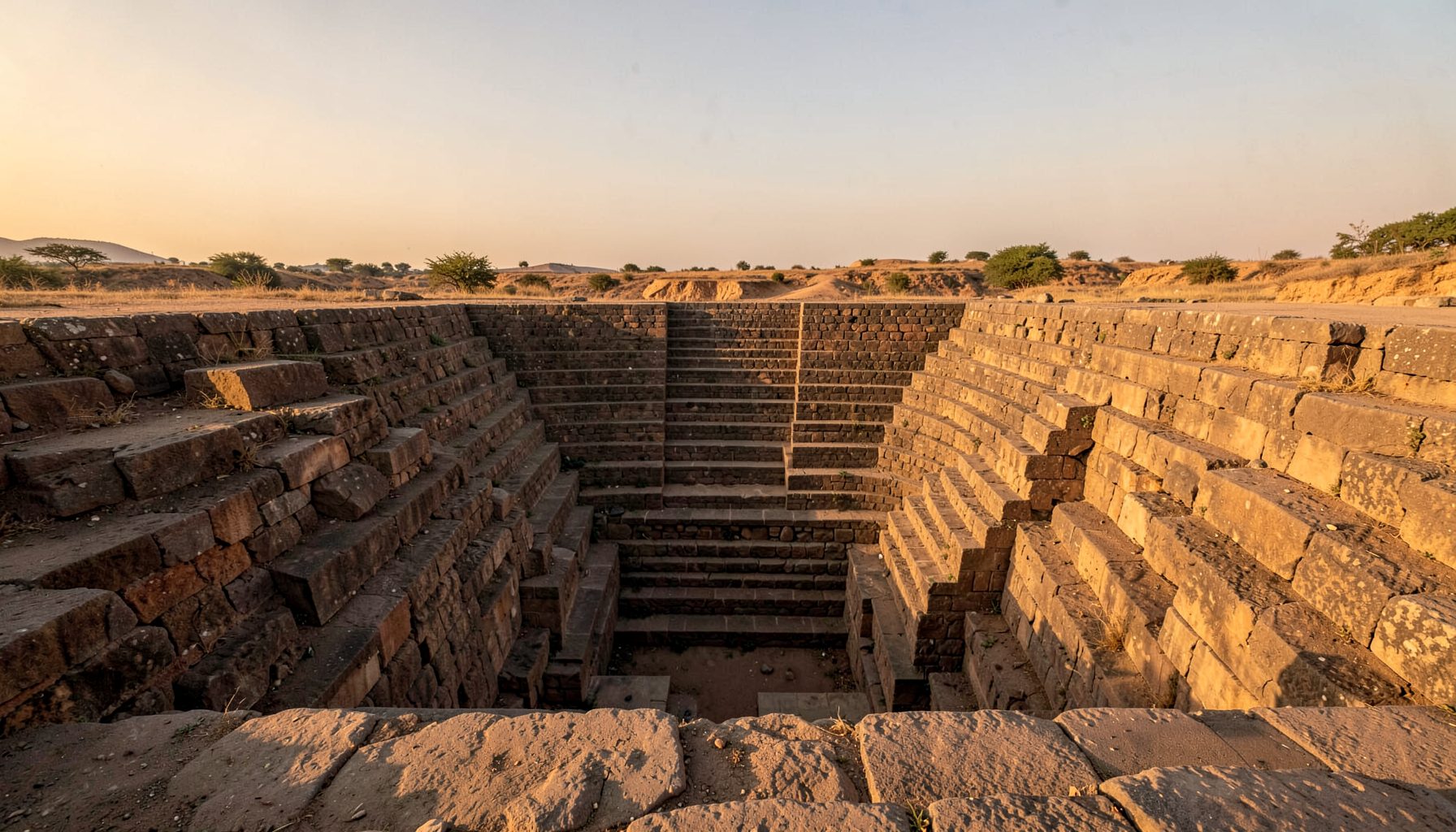
A kund is essentially a stepped bathing tank, usually attached to a temple complex but engineered primarily for ritual ablution and water storage. The word derives from the Sanskrit kunda, meaning a pit or basin, and the form appears across the subcontinent from Gujarat to Karnataka. In Tamil Nadu the kund is typically square or rectangular, lined with carved granite steps descending in two or three tiers to a central pool. Most surviving examples date to the Chola period, though earlier Pallava prototypes exist at sites such as Mahabalipuram.
A temple tank, called a kalyani or pushkarini in Tamil, performs a similar ablution role but is conceptually tied to the temple as a sacred body of water. These tanks are often larger, more ornately carved, and positioned within the outer prakaram enclosure of the temple. Unlike a kund, a temple tank is consecrated through specific rituals and is considered a locus of the deity's presence. Famous examples at Meenakshi Temple in Madurai and Brihadeeswarar Temple in Thanjavur illustrate the scale and ornament these structures could reach under royal patronage.
Researchers working with archives at the University of Melbourne have noted that the academic literature in English sometimes blurs these distinctions, treating kunds as a subset of temple tanks. In the field, however, Tamil-speaking communities maintain clear categories. A kund may serve a village without being formally consecrated, whereas a temple tank carries ritual restrictions on who may draw water and when.
Architecture and construction methods
Construction techniques behind kunds and temple tanks share the same broad toolkit: dressed granite, hydraulic lime mortar, and a sloping bed designed for self-cleaning during monsoon flow. The detailing differs markedly, however. Kunds tend toward minimal ornamentation, with plain pilasters, simple cornices, and steps wide enough for communal bathing. Temple tanks feature sculpted mandapas over the steps, lotus motifs carved into the basins, and sometimes miniature shrines at the cardinal points.
Engineering wise, both rely on inlet channels from nearby catchments and outlet sluices that release excess water downstream. The temple tanks of Thanjavur were integrated into the broader Grand Anicut canal network built by Raja Raja Chola I in the eleventh century, a parallel that historians at the Australian National University in Canberra have drawn with colonial-era irrigation works in inland New South Wales. Kunds were generally smaller, locally funded projects maintained by temple committees or village panchayats.
One striking architectural variant appears at the Kailasanathar Temple in Kanchipuram, where the sandstone kund displays early Dravidian stylistic motifs. The granite temple tanks further south tend to be larger and later, reflecting the wealth of the Chola and Vijayanagara periods. Visitors accustomed to the reading rooms of institutions like the State Library of Victoria will recognise the dense, ledger-like quality of the carved inscriptions on these tanks, which record donations, repairs, and water-rights agreements.
Ritual use and community life
The ritual calendar shaped how these structures functioned. Temple tanks were drawn upon during major festivals, particularly the float festival in January or February, when illuminated deities are taken onto the water on decorated barges. Kunds saw less ceremonial traffic but served daily ablutions for devotees and resident priests. Both hosted rites of passage, including the first tonsure ceremony for children, a custom tied to agrarian fertility beliefs.
Community ownership diverged just as clearly. Temple tanks sat under temple trusts with formal endowments, while kunds were often maintained through collective labour organised at the village level. In modern Tamil Nadu, that distinction persists in land records and water-rights documentation. Tamil diaspora communities in Sydney's western suburbs, particularly around Harris Park and Parramatta, often keep informal records of family connections to specific village tanks, and these records can aid heritage researchers tracing patterns of rural life.
Australian readers familiar with the funding models behind historic swimming baths, whether the Clovelly Baths in Sydney or the Sea Baths in Wollongong, will recognise a parallel logic: publicly accessible civic water features sustained by a mix of public funding and community subscription. The comparison is imperfect but useful for grasping the financial underpinnings of Tamil water architecture.
Hydrology and water management
From a hydrological standpoint, both structures function as storage reservoirs fed by seasonal monsoon runoff and sometimes by diverted streamflow. Their stepped geometry allows sediment to settle in the upper tiers while cleaner water collects below, a passive filtration principle that modern engineers have revisited for sustainable urban design. Australian landscape architects working on stormwater capture projects in Melbourne have, in some cases, adopted the visual language of stepped tanks without fully acknowledging the lineage.
The volume of water held varied enormously. Small village kunds might store a few thousand litres, sufficient for a hamlet's dry-season needs. Major temple tanks such as the Potramarai Kulam at Madurai extended over several acres and could hold millions of litres. Chola engineers connected these larger tanks to canal networks, distributing stored water across thousands of hectares of paddy land. The ecological benefits extended well beyond ritual use, supporting groundwater recharge and soil moisture in adjacent fields.
Climate change is now testing both traditions. Tamil Nadu has experienced erratic monsoons and extended droughts in recent decades, leaving many tanks and kunds dry for longer periods. Sediment accumulation, algal blooms, and encroachment have compounded the problem. Scholars have suggested that comparative studies between Tamil Nadu and arid-zone communities in western New South Wales could yield shared strategies for tank rehabilitation, a possibility worth exploring through future fieldwork collaborations.
Recommendations for readers
Documentation of Tamil Nadu's lesser-known water heritage has lagged behind the more photographed monuments of North India. Photographers visiting from Melbourne or Brisbane sometimes find that village kunds are unnamed on official maps, with access routes shifting between visits. The wider Indian Stepwells project, which maintains a growing archive of water-structure photography and architectural sketches, has begun outreach to Tamil-speaking communities to identify undocumented sites, and readers who know of a kund or temple tank not yet in the record can pass on details through the Indian Stepwells contact page where photographs, sketches, and oral histories all help shape future research.
Field surveys benefit from drone imagery, which reveals the full footprint of temple tanks hidden behind temple walls, an approach now common in Australian archaeological surveys of nineteenth-century water races in the Victorian goldfields. Locals with knowledge of seasonal access tracks and recent restoration work remain the most valuable source of accurate data. A useful parallel for Australian heritage volunteers is the long-running survey of ecclesiastical sites across the British Isles, including documentation of medieval round towers and their associated enclosures, and readers interested in how community-led surveys unfold elsewhere may find the St Kevin's round tower study a useful reference point.
The Indian Stepwells archive itself remains the central hub for ongoing research, exhibition planning, and collaboration requests. For those interested in the broader economics of cultural preservation, it is worth noting the parallel role played by small heritage grants, similar in scale to those distributed through Australian bodies such as Market Up, which support small creative enterprises and could, in theory, sponsor local research assistants in Tamil Nadu.
- Travel between December and March, when Tamil Nadu is at its driest and tank beds are exposed, revealing architectural detail usually hidden underwater.
- Engage a local guide familiar with temple etiquette, since many temple tanks remain consecrated sites with rules about photography and access.
- Carry a notebook as well as a phone camera, because heat and humidity can fog lenses by late morning.
- Send high-resolution images with GPS data to the project team if you photograph a kund not already in the archive; contributors are credited.
- Pair the trip with a stop at the Government Museum in Chennai, where inscribed tank donations are catalogued in the epigraphy wing.
- Read recent Australian scholarship on monsoon variability to contextualise the climatic pressures currently affecting these structures.
Get in Touch
Have information about a stepwell that is not yet on our map? We would be glad to document it and give you full credit. Whether it is a Barav, Kund, Vihir, or any other form of stepwell, every contribution helps preserve India's water heritage.
Call or message us with details about the location, and we will follow up.
#9372496819
Send a Message
What People Say
"The Maharashtra Stepwells campaign has brought attention to structures that were nearly forgotten. The architectural documentation and drone photography are invaluable resources for researchers and students alike."
"Collaborating with the Indian Stepwells team gave our architecture students hands-on exposure to traditional water-harvesting structures. The presentations were insightful and inspiring."
"I shared details of a stepwell near my village that was not on any map. The team visited, documented it beautifully, and credited me. It felt wonderful to contribute."