 Explore Maharashtra
Courtly Wells and the Music of Water
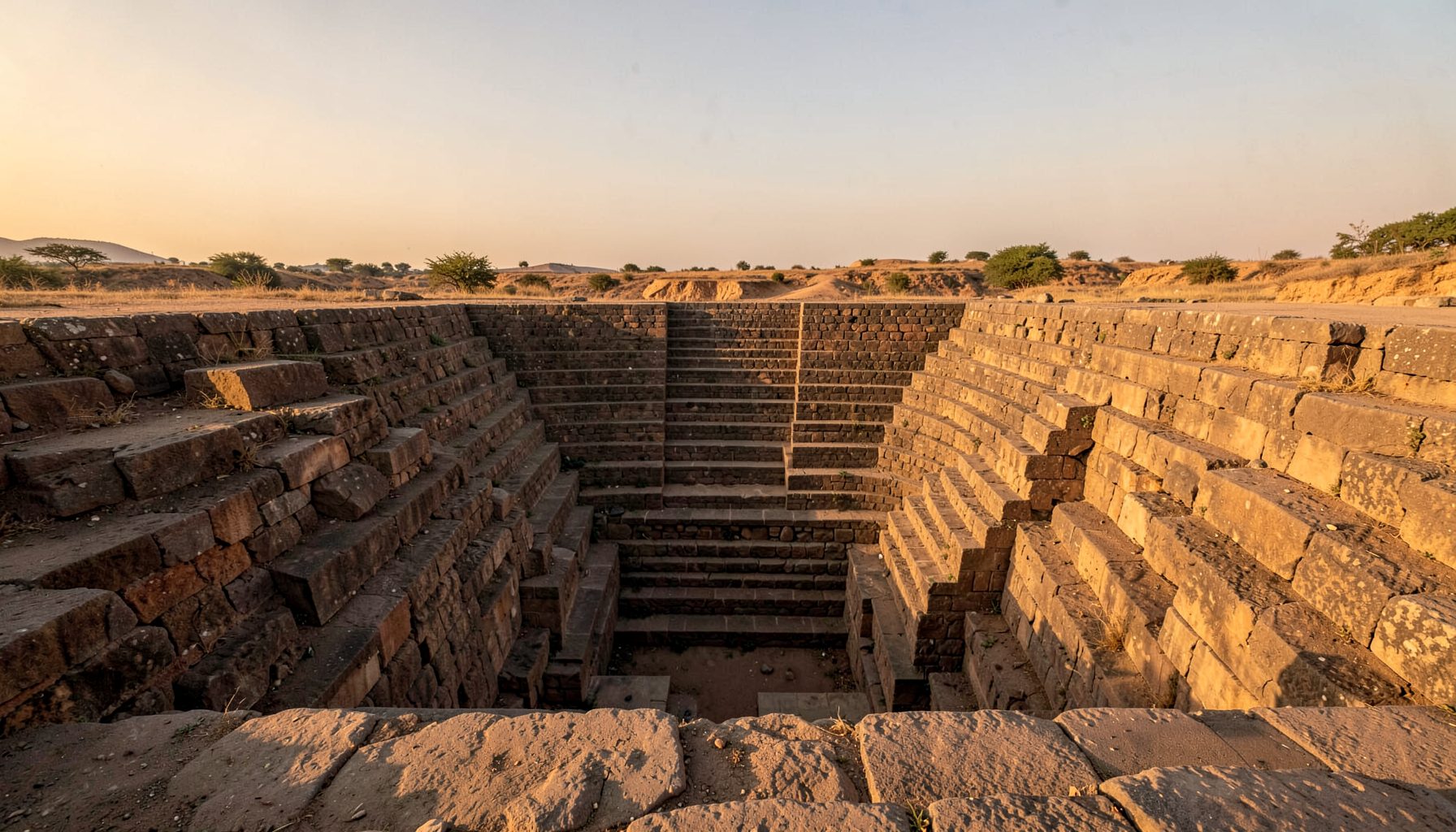
Stepwells in the poetry of medieval Indian courts sit at the meeting point of architecture, political ritual and literary invention. A verse about a shaded descent can carry more than ornament: it can suggest hospitality, justice, fertility, spiritual access or the reach of royal authority. Read beside surviving bawdis, baolis, vavs, kunds and baravs, such passages reveal how water shaped the emotional geography of courtly life.
The surviving record is fragmentary. Court poets favoured the memorable image over technical description, while labels such as baoli, bawdi, vav, kund and barav shift between languages and regions. A poem cannot safely be assigned to a particular monument without checking inscriptions, local histories, terrain and architecture. Even so, recurring images show what courtly audiences expected a stepped well to communicate.
The strongest passages turn architecture into rhythm. Steps, cool shafts, echoes, birds, lotuses and the meeting of sunlight and water become carriers of mood. A king bathing, a lover approaching a well or a traveller finding shade may carry ethical and political meanings. Verse compresses these sensory truths into a few lines, allowing a public waterwork to appear intimate and a royal project to appear accessible.
Poetry also preserves a social world that architecture alone can conceal. It hints at who was permitted to approach the water, whose labour maintained it and how rulers wished their generosity to be remembered. Its silences matter too. The perspective is usually that of court insiders, while water carriers, cleaners, gardeners and people displaced by urban change rarely speak. Historical interpretation must hold beauty and omission in the same view.
A Courtly Language of Water
Names offer the first literary clue. Bawdi and baoli belong to a family associated with a place where one descends; vav and wadi are common in Marathi-speaking regions, while kund and barav point toward tank-like forms. Across these labels lie different gradients of depth, ornament and access. Medieval poets rarely supplied a measured plan, but they could call attention to descent, enclosure and water reached by stages.
In courtly verse, a well could be compared with moonlit metal, a pearl or a dark mirror. Such comparisons were conventional, yet they shaped how a structure was experienced. The reflected sky gave the shaft visual depth; the stair organised movement between heat and shade; repeated voices or dripping water supplied sound. Architecture and image-making reinforced one another.
The court archive is plural: Sanskrit verse, Prakrit and later Braj lyric, Persian poetry and prose, inscriptions, genealogies and painted manuscripts all circulated in different combinations. Keshavdas at Orchha and Amir Khusrau at Delhi belong to a wider culture in which gardens, tanks and wells were familiar courtly signs, though neither should be made to match a specific structure without evidence. Their value lies in the shared vocabulary through which later and local accounts can be read.
Poetry and the Geography of Rule
Rulers knew that water belonged at the centre of political display. A dependable well or tank enlarged the royal city, supported gardens, enabled ritual bathing and made hospitality tangible. Inscriptions often praise a ruler through works that remain useful after the donor’s name has been shortened. Verse does the same in more concentrated form, turning provision into a moral quality and a monument into a ruler’s continuing presence.
Gardens and wells also mapped degrees of access. A private palace tank, a neighbourhood stepwell and a public tank could all carry royal prestige, but they gathered different people and permitted different uses. Court poetry tends to move smoothly from royal presence to communal benefit. A sharper reading notices the threshold, queue, fee or prohibition that the verse leaves outside frame.
At Sultanate and Rajput courts, Persianate descriptions and miniature painting made water architecture part of an ideal landscape of ordered trees, terraces, channels and reflected light. In Deccan traditions, panegyric and devotional praise likewise joined royal stability to the fertility of the land. These pairings were more than decorative. They proposed that a just ruler shaped climate, space and abundance, making poetry a medium through which environmental command became visible.
Voices Beyond the Palace
Not every poem about water belonged to an elite religious or royal hall. Vaishnava and Shaiva poets, Sufis, Jain writers, bards and women associated with courts carried well imagery into vernacular speech. Kabir could make inward truth spring like water; Mirabai made the well a figure for love that cannot be contained; Amir Khusrau joined courtly beauty to devotional longing. Such usages widened the stepwell’s cultural life beyond official commemoration.
Claims that a named stepwell belonged to women require care, even when its architecture or local tradition suggests that women gathered there. Courtly texts can make access seem universal while recording only elite experience. They may also preserve the names of queens, courtesans or devotional women near particular wells. The strongest interpretation combines such literary traces with physical evidence rather than treating a romantic image as a complete social history.
Local knowledge adds dimensions no court archive holds: a vanished pond beneath a road, a village word for a stair, the day a well ceased to fill, or stories about household water before piped supplies. Such memories can be tested against surveys and oral histories without becoming folklore untouched by evidence. Researchers with observations, old photographs or family records can contribute them through the share local knowledge page, extending the record beyond what elites wrote.
Reading Verse Beside Architecture
A responsible reading moves between text and structure. A poet’s image of enclosure can prompt questions about plan; a stepped profile may sharpen the meaning of descent in a line of verse. Original photographs and measured sketches can reveal thresholds, seasonal water levels and sightlines that a verbal image compresses. Drone imagery may document relationships among a well, settlement and waterways, although it cannot replace ground-level observation.
In Maharashtra, the vavs and baolis of the Deccan and Khandesh provide a particularly valuable field for this approach. Sites such as the Mandwa baoli in Nandurbar, with its inscribed and layered structure, invite comparison with regional court memory and later devotional narratives. The point is not to label every nearby poem as an account of the monument. It is to ask whether recurring terms, rituals and spatial metaphors illuminate the local setting in which both poetry and building took shape.
Comparative archives matter because water structures often outlive the purposes for which they were built. A place-based project such as the Dead Ireland project reinforces the value of recording landscapes before altered drainage, abandonment or development erases their legibility. The same principle applies to a Deccan stepwell: a field note, measured section or remembered place name may preserve a relationship that stone alone cannot explain.
Conservation for the Present
Preservation now confronts pressures different from those imagined by medieval poets: rising groundwater in some districts, falling water tables elsewhere, silted channels, cracked steps, concrete infill and encroachment around old urban wells. Tourism can support attention while adding wear to fragile surfaces. The poetic afterlife of a stepwell may deepen public interest, yet conservation must be based on sound drainage, structural knowledge and respect for continuing religious or domestic use.
The Maharashtra campaign links original photography, architectural sketches, drone surveys and field research to the practical work of documenting threatened and lesser-known sites. Its value lies in building a connected public record, not simply celebrating spectacular monuments. Verified entries can alert municipalities and owners to physical problems, while community observations can reveal uses and names missing from official inventories.
Many Australian cities recognise water as a finite public inheritance, giving the stepwell question immediate resonance. In Melbourne, where summer gardens can dry quickly, permanent water-saving rules and the Victorian Water Act 1912 have made drip irrigation, mulch and attention to household leaks familiar habits. Adelaide’s hot, dry summers and dual-supply networks encourage rainwater tanks; the South Australian Water Management Act 2000 regulates entitlements and restrictions. Brisbane families have likewise adapted to SEQ Water restrictions through shorter showers, garden changes and drought-tolerant planting under Queensland’s Water Act 2000.
Sydney adds another local reality through drought cycles and bushfire recovery, with water use managed under the New South Wales Water Management Act 2000. At Adelaide Central Market, shoppers carrying refillable bottles among spice stalls and South Asian groceries encounter water in daily habits rather than royal ceremony. Heritage law offers a parallel lesson: Victoria’s Heritage Act 1958, the New South Wales Heritage Act 1977 and South Australia’s Environment and Heritage Act 2015 all attach legal significance to places valued by communities. Stepwells, courts and poems survive together when documentation, conservation and public use are treated as connected cultural work.
Get in Touch
Have information about a stepwell that is not yet on our map? We would be glad to document it and give you full credit. Whether it is a Barav, Kund, Vihir, or any other form of stepwell, every contribution helps preserve India's water heritage.
Call or message us with details about the location, and we will follow up.
#9372496819
Send a Message
What People Say
"The Maharashtra Stepwells campaign has brought attention to structures that were nearly forgotten. The architectural documentation and drone photography are invaluable resources for researchers and students alike."
"Collaborating with the Indian Stepwells team gave our architecture students hands-on exposure to traditional water-harvesting structures. The presentations were insightful and inspiring."
"I shared details of a stepwell near my village that was not on any map. The team visited, documented it beautifully, and credited me. It felt wonderful to contribute."