 Explore Maharashtra
Stepwells in the age of plumbing: why they still matter
Australian households rarely question the tap. Rainfall is captured by roofs, stormwater drains and pipes, while drinking water arrives after complex treatment. Yet the history of water access in cities such as Delhi, Ahmedabad, Jaipur and Pune reveals another reality: water was once stored, lifted and shared in the open air. Stepwells in the age of plumbing remain relevant because they show that climate-responsive design can also be social infrastructure.
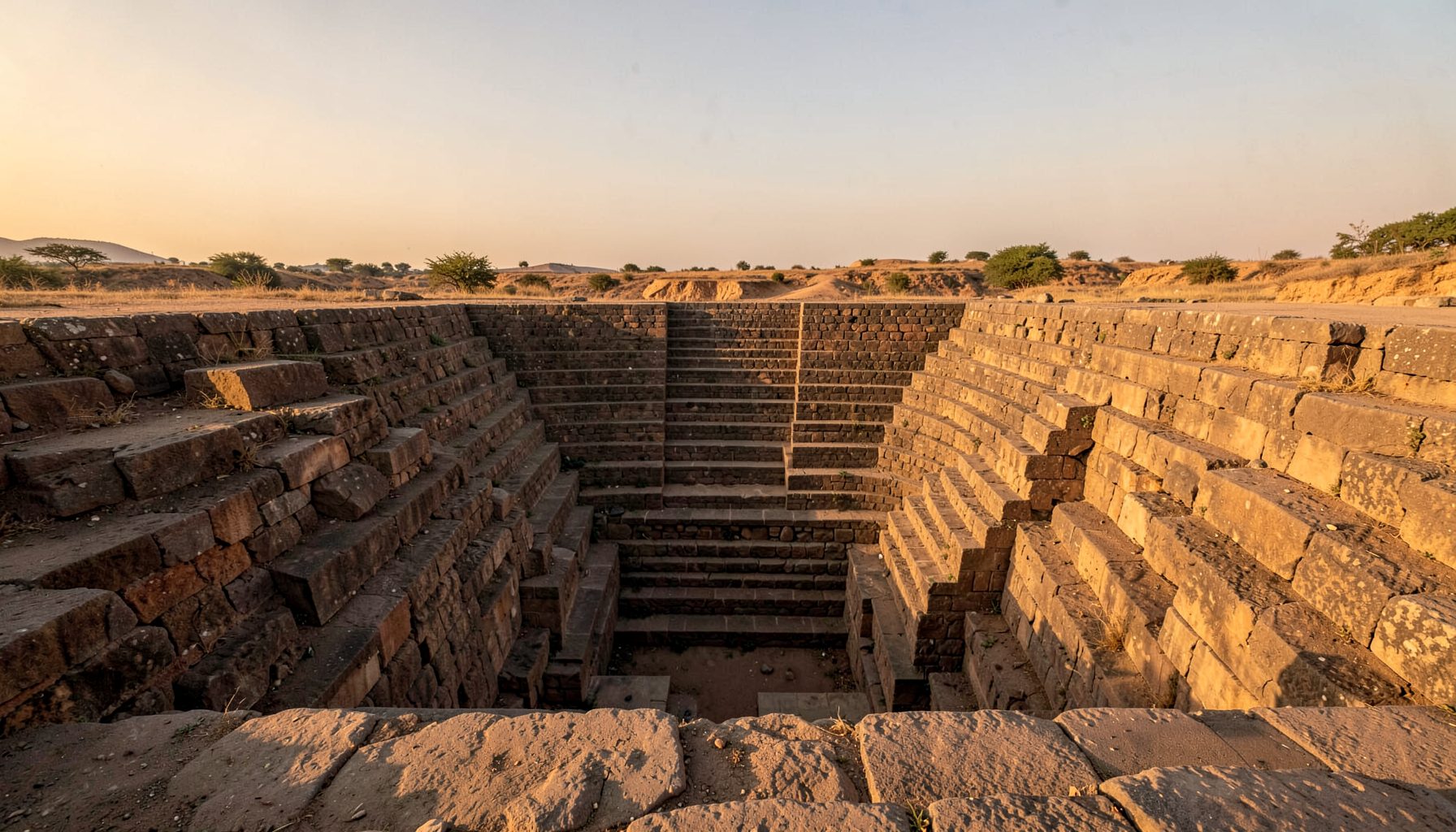
These structures are known by different names across India: bawdis in Maharashtra, baolis in Rajasthan, vavs in Gujarat, kunds in the north and baravs in parts of western India. They vary greatly in form, from pillared halls and descending flights to compact circular tanks. Shared features include catchment channels, storage shafts, stone steps and carefully positioned inlets that slow or filter incoming water. Their architecture records local materials, labour, rainfall patterns and the priorities of the communities that built them.
Piped networks made these systems less visible, but they did not make seasonal scarcity disappear. Monsoon variability, dry spells and urban growth continue to test assumptions about secure water supply. Australian readers may first associate resilience with rainwater tanks, recycled water and drought restrictions; stepwells broaden that understanding to include passive cooling, groundwater recharge and civic gathering places. Their value now lies across heritage conservation, climate adaptation and public education.
Water before the mains
India's historic stepwells developed around a central tension: monsoon rain arrives in concentrated bursts, while settlements need water across the dry season. Catchment areas directed runoff into reservoirs, where gravity, porosity and seasonal lift systems moved it between storage levels. In regions with suitable geology, slow percolation could also replenish groundwater. A shared well could serve hundreds or thousands of people, making its capacity and maintenance a community responsibility.
Their thermal performance was equally significant. Deep shafts and shaded stone corridors create cool, humid microclimates as heat transfers from the surface and evaporation cools moving air. Panna Meena ka Kund in Jodhpur and monumental baolis such as Chand Baori at Abhaneri demonstrate that hydraulic engineering could become monumental architecture. Modern interpretations should avoid romanticising them, since some structures silted up, failed or became unsafe, yet their integrated approach to water, shade and public life remains instructive.
Stepwells as civic architecture
Stepwells were more than water containers. Their steps, corridors and platforms accommodated waiting, conversation, ritual, commerce and informal gathering. Women often carried pots down to the lower levels, while upper terraces provided places for rest and observation. The descending route also created a distinctive public landscape, bringing different users into contact around a shared resource. In this sense, the engineering supported both physical survival and social continuity.
Heritage gains value when communities retain stories alongside masonry. A comparable focus on memory and belonging appears in the County Mayo memorial, where architecture becomes a vessel for public history. Stepwells can serve a similar role in India, recording relationships between water, caste, gender, religion and neighbourhood. Preserving only their visual form would miss the communities whose practices gave these places meaning.
Documenting Maharashtra's hidden water heritage
Maharashtra's bawdis occupy a landscape of strong seasonal contrast, where settlements depend on monsoon rainfall and careful groundwater management. Many have been absorbed into villages or altered by roads, houses, temples and agricultural expansion. Others survive as inaccessible ruins, which makes systematic field research essential. Archaeological recording can establish construction phases, repair histories and relationships with nearby tanks, wells and settlement sites.
The Maharashtra documentation campaign combines original photography, architectural sketches, drone imagery and close observation of local construction. This evidence helps researchers distinguish original features from later interventions and identify structures omitted from formal inventories. It also supports exhibitions and educational programmes that explain stepwells as water systems rather than picturesque ruins. Good documentation can turn an overlooked monument into a locally understood piece of environmental heritage.
Australian parallels in water governance
Australian cities offer several useful comparisons. Sydney experiences intense rain as well as dry periods, making stormwater capture and permeable surfaces increasingly important. Melbourne residents are familiar with staged restrictions and prescribed garden-watering days. Brisbane's humid summers produce heavy downpours that can overwhelm conventional drainage, while Adelaide's dry climate has encouraged water-efficient landscaping and sharper scrutiny of household consumption and pricing. Across these cities, residents increasingly encounter notices about watering, roof tanks and restrictions during hot weather.
The local market now sells rainwater tanks, greywater systems, water-efficient fixtures and smart irrigation controllers. Legislation similarly combines national and state frameworks: the Plumbing Code Australia provides a national model, implemented through state and territory codes, while water-management laws govern aspects of harvesting, allocation and drainage. The Water Management Act 1997 in New South Wales, South Australia's Water Act 2007 and Queensland's Water Management Act 1997 illustrate this layered system. Stepwells offer a reminder that heritage structures with hydraulic functions may require similarly coordinated attention.
Community knowledge and living preservation
Local knowledge can reveal details that formal records miss. Residents may know the original source of a well, the season when its tank held water, the location of blocked inlets or stories associated with particular steps. Such knowledge can guide safer restoration and prevent inappropriate reconstruction. People aware of an undocumented stepwell can share local knowledge, helping researchers build a more complete picture of regional water heritage.
Preservation should also account for present-day climate and public access. Repairing masonry without addressing runoff, contamination or structural instability can leave a site looking complete while remaining unsafe. Interpretation must respect sacred or restricted areas and avoid turning vulnerable structures into tourism spectacles. The strongest programmes combine conservation training, local guardianship and careful visitor management, allowing a stepwell to remain both a historic place and a functioning part of its community.
A framework for lasting stewardship
The most useful approach treats each stepwell as infrastructure, architecture and a record of collective memory. Priorities should cover research, conservation, climate management and public participation rather than focusing only on visual restoration.
- Commission condition surveys that map masonry damage, water quality, drainage paths, structural movement and previous repairs.
- Record seasonal water levels, rainfall and groundwater conditions to understand each structure's continuing hydraulic behaviour.
- Partner with municipal authorities and local water agencies where restoration affects drainage, public safety or groundwater management.
- Publish geotagged photographs, measured drawings and field notes so that researchers can verify findings and identify further sites.
- Train local guides and craftspeople in conservation methods that respect traditional materials and construction techniques.
- Design exhibitions and school programmes around water management, climate adaptation and the social histories embodied by stepwells.
This approach recognises that preservation extends beyond retaining old stonework. It keeps environmental knowledge visible, connects archival research with community memory, and invites cities facing hotter, less predictable seasons to consider water management as part of public space.
Get in Touch
Have information about a stepwell that is not yet on our map? We would be glad to document it and give you full credit. Whether it is a Barav, Kund, Vihir, or any other form of stepwell, every contribution helps preserve India's water heritage.
Call or message us with details about the location, and we will follow up.
#9372496819
Send a Message
What People Say
"The Maharashtra Stepwells campaign has brought attention to structures that were nearly forgotten. The architectural documentation and drone photography are invaluable resources for researchers and students alike."
"Collaborating with the Indian Stepwells team gave our architecture students hands-on exposure to traditional water-harvesting structures. The presentations were insightful and inspiring."
"I shared details of a stepwell near my village that was not on any map. The team visited, documented it beautifully, and credited me. It felt wonderful to contribute."