 Explore Maharashtra
Photographing Stepwells with Depth, Light and Purpose
Stepwells are among South Asia's most photographed yet least understood architectural forms. Carved deep into the earth across the Indian subcontinent for over a thousand years, these subterranean reservoirs combine engineering, sculpture, and hydraulics in a single vertical composition. Photographers flying in from Sydney or Melbourne often arrive expecting symmetrical tourist postcards, only to discover that real impact comes from reading the structure first, anticipating the light, and accepting that the best frame may be the one nobody else takes.
This guide draws on fieldwork across Maharashtra and the wider Deccan, with advice tailored for visitors who usually travel once, shoot briefly, and need every exposure to count. Whether you are an enthusiast mapping your first vav or a working professional preparing for a heritage commission, the principles below will help you return with imagery that earns its place on the wall.
Reading the Stepwell Before You Raise the Camera
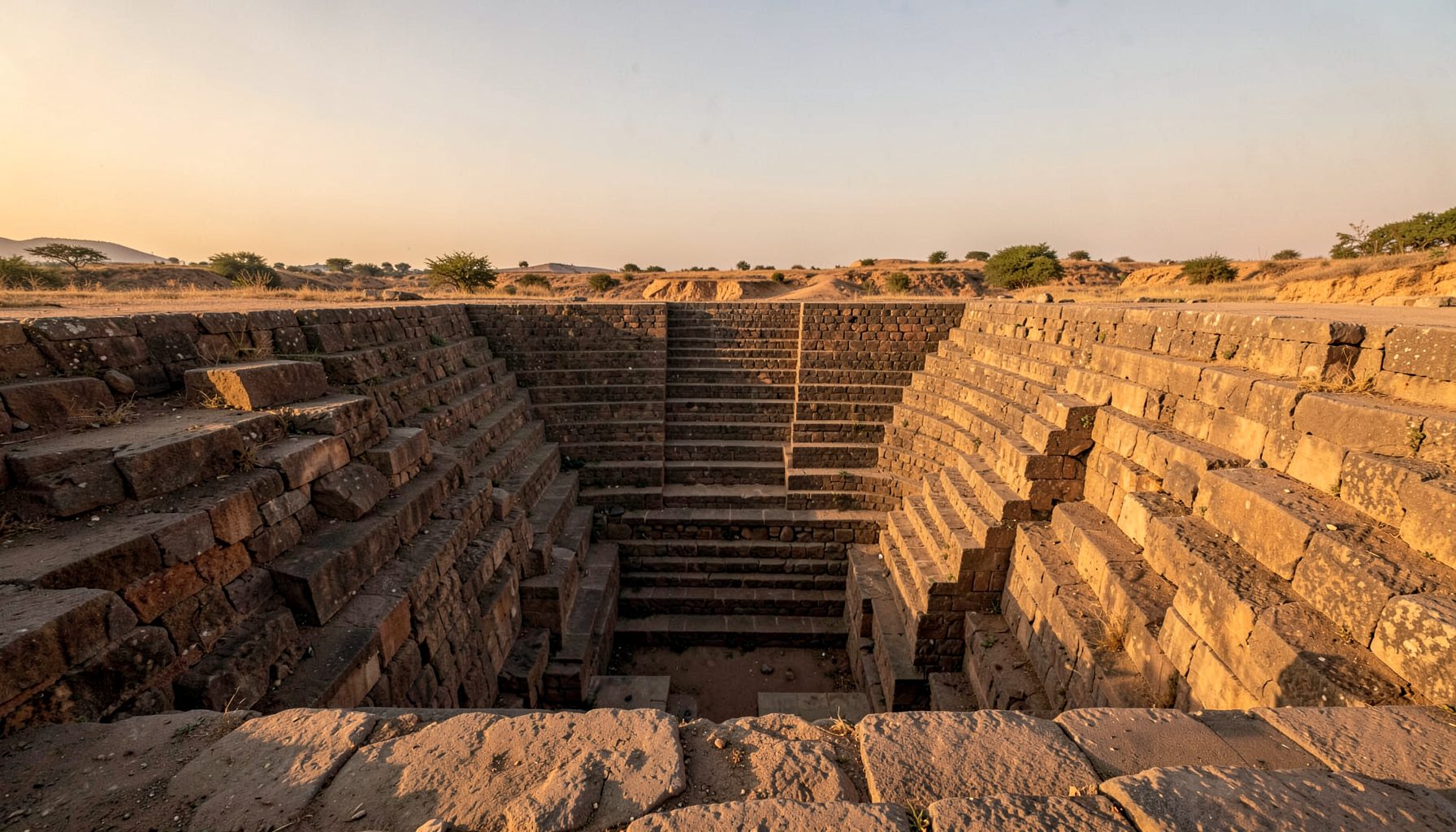
A stepwell is not a single subject. It is a sequence of descending platforms, pillared corridors, octagonal wells, and water-stained shafts that change appearance from every level. Spend your first hour on site without a lens cap on. Walk down each flight of stairs, count the storeys, and note where direct sun penetrates the floor at different times of day. At Adalaj in Gujarat or Raniji ki Baori in Rajasthan, the geometry shifts so dramatically between the top terrace and the water line that a single 24mm frame cannot contain the story.
Look for the dialogue between the built form and its ruin. Cracked beams, missing columns, and restored staircases each carry a different mood. Australian photographers accustomed to documenting convict-era ruins at Port Arthur or the woolstore conversions of Fremantle often find that decay here is expressed through water erosion and lichen rather than fire and weather. That difference shapes everything from your tonal palette to whether you expose for highlight or shadow.
Sketch a quick floor plan in a notebook before the serious shooting begins. Mark the orientation of the entrances, the location of any garland niches, and the position of overhead openings that create shafts of light. This rough diagram will save you from wandering during the best ten minutes of the day and will let you pre-visualise shots you can return to if weather or crowds disrupt the first attempt. Resources such as the field archive at Indian Stepwells offer a useful primer on regional typologies before you commit to an itinerary.
Gear Choices and Camera Settings for Subterranean Conditions
The single biggest technical challenge inside a stepwell is the contrast between bright sky and deep shadow. A full-frame body with strong dynamic range, such as recent Sony, Nikon, or Canon models stocked at Camera House stores across Australia, gives you the latitude to recover detail without resorting to HDR mush. Carry a wide-angle zoom covering 14-24mm and a short telephoto in the 35-85mm range for tighter architectural studies. A tripod is often restricted or impractical on wet, uneven steps, so a high-quality in-body stabilised body or a fast wide prime becomes your best friend.
Set your base exposure around the mid-tones of the carved stone, then meter carefully for the sky openings. Spot metering on the brightest stonework near a light shaft prevents the shadow galleries from crushing into pure black. Many heritage photographers shooting in Rajasthan swear by a polariser to cut glare on damp surfaces, but inside the narrowest vavs a circular polariser can cost you two stops, so use it only when shafts of light are hitting polished stone directly.
For interior panoramas, level your head, use nodal point rotation, and keep the camera at chest height to minimise distortion on the descending lines. Shoot verticals as well as horizontals; many magazine and book commissions, including those handled by Sydney-based photo editors, prefer vertical frames for portrait layouts. Pack microfibre cloths in sealed bags because alkaline dust in dry regions and humidity near the water line will coat front elements within minutes.
Timing the Light: Seasonal Windows and Daily Rhythms
Light inside a stepwell behaves almost like a cathedral. The window in the ceiling or the absence of upper storeys determines where photons fall, and the sun's altitude changes that pattern minute by minute. The best time is usually the hour after sunrise or the hour before sunset, when the sun is low enough to throw long shafts across the lower galleries but bright enough to illuminate the carved columns from the side.
Seasonality matters as much as time of day. Post-monsoon, between late September and November, the air carries a clarity that Australian landscape photographers will recognise from the red dust settling across Uluru after rain. The catch is that water levels are highest then, and many steps near the well mouth may be submerged, restricting your angle of approach. Pre-monsoon shoots in March and April offer bone-dry floors and the dramatic possibility of photographing worshippers descending for rituals, but dust haze reduces contrast and requires more aggressive post-processing.
Plan at least two sessions at the same stepwell if your schedule allows. A dawn shoot captures the eastern galleries in raking light, and a late-afternoon return captures the western faces. Use the midday lull to scout adjacent sites, drink chai with the caretaker, and review files on a tablet. Travellers flying from Adelaide or Brisbane on heritage-focused itineraries sometimes lose patience with this rhythm; resist the urge to tick off six sites in a day.
Compositional Techniques for Storytelling Imagery
Strong stepwell imagery relies on three recurring devices: the leading stair, the human figure, and the framed aperture. The leading stair draws the eye from the foreground platform down to the water, creating depth that no lens alone can manufacture. Position yourself at the top landing with the bottom of the well framed by two pillars, and let the diagonal of the steps do the storytelling.
The human figure, whether a local resident descending for water, a pilgrim pausing at a shrine, or even your own shadow, supplies scale and emotional anchor. Always ask permission, ideally through the site manager or a community elder, and be prepared to share your images afterwards. Photographers exhibiting at the Art Gallery of New South Wales or ACMI in Melbourne frequently include human elements because curators respond to the cultural weight a single figure adds to an architectural study.
Framed apertures are the stepwell equivalent of the European cloister view. Shoot through a darkened arch toward a brightly lit courtyard or water tank. The contrast compresses perspective and draws attention to the carved details of the foreground frame. From the bottom of a multi-storey vav, look upward through the opening and expose for the sky, accepting that the surrounding galleries will become a textured silhouette rather than a fully resolved image.
Post-Processing Workflows for Heritage Photography
Treat the raw file as the document of record and the final image as the interpretation. Begin with lens corrections and a flat profile, then rebuild contrast locally rather than globally. Mask the sky openings, the lit columns, and the shadow galleries separately so that each zone receives its own exposure, white balance, and clarity adjustment. This approach mirrors the field technique of metering for each region and produces a more honest result than a single contrast slider.
Colour management deserves particular care. The sandstone and basalt of Maharashtra carry warm ochre tones, while the marble and limestone of Rajasthan shift cooler. Use a grey card or a ColorChecker at the start of each session to anchor white balance; the cost in luggage weight is small, and the savings in editing time are substantial. Australian retouchers working on commercial assignments in Asia often deliver in ProPhoto RGB, then convert to sRGB for web and Adobe RGB for print, depending on whether the destination is a Melbourne gallery show or an online archive.
If you are unsure how to present a controversial restoration or a heavily damaged gallery, look to the documentation standards used by organisations such as the Archaeological Survey of India. Honest before-and-after pairings, clear captions, and metadata that records GPS, date, and lens all strengthen the archival value of your work and help the wider community of researchers.
Working Respectfully with Communities and Heritage Custodians
A stepwell is rarely an empty monument. Many continue to serve surrounding villages as water sources, washing places, and active temples. Approach the site through the village when possible, greet the caretakers, and ask whether any ceremonies are scheduled before you set up a tripod. Offer to send printed images to the community, an exchange that costs little in dollars and builds goodwill that pays back across years of return visits.
Local guides, particularly in less-documented stepwells of the Deccan, hold oral histories that never appear in guidebooks. Pay fairly, credit their knowledge in any published caption, and resist the temptation to gatekeep access. If you uncover an undocumented kund or barav, consider sharing the coordinates and your images through the contact page so that future researchers can build on your work rather than repeating it.
Australian photographers interested in deeper engagement might also consider donating prints to a community school or partnering with a heritage trust back home, such as those linked to the National Trust of Australia, to run a small travelling exhibition. Visibility abroad helps the case for conservation funding in India, and the resulting body of work is far stronger than a portfolio of empty tourist frames.
A field checklist worth printing:
- Wide zoom covering at least 14-35mm, with a fast prime as backup
- Sturdy tripod or monopod, plus reliable hand-held technique for restricted sites
- Polariser and graduated ND filter, used selectively inside narrow vavs
- Microfibre cloths in sealed pouches and a small blower for dusty wells
- Notebook for floor plans, light notes, and contact information for local caretakers
- Spare batteries, since alkaline dust and humidity shorten their life quickly
Pitfalls worth avoiding on your first trip:
- Shooting only from the top terrace and ignoring the lower galleries entirely
- Relying on midday sun, which flattens texture and washes out carved detail
- Forgetting to ask permission before photographing people, rituals, or shrines
- Over-processing files until the natural patina of stone is lost in clarity
- Failing to back up cards before continuing to the next site
Get in Touch
Have information about a stepwell that is not yet on our map? We would be glad to document it and give you full credit. Whether it is a Barav, Kund, Vihir, or any other form of stepwell, every contribution helps preserve India's water heritage.
Call or message us with details about the location, and we will follow up.
#9372496819
Send a Message
What People Say
"The Maharashtra Stepwells campaign has brought attention to structures that were nearly forgotten. The architectural documentation and drone photography are invaluable resources for researchers and students alike."
"Collaborating with the Indian Stepwells team gave our architecture students hands-on exposure to traditional water-harvesting structures. The presentations were insightful and inspiring."
"I shared details of a stepwell near my village that was not on any map. The team visited, documented it beautifully, and credited me. It felt wonderful to contribute."