 Explore Maharashtra
How India's stepwells shape modern rainwater harvesting designs
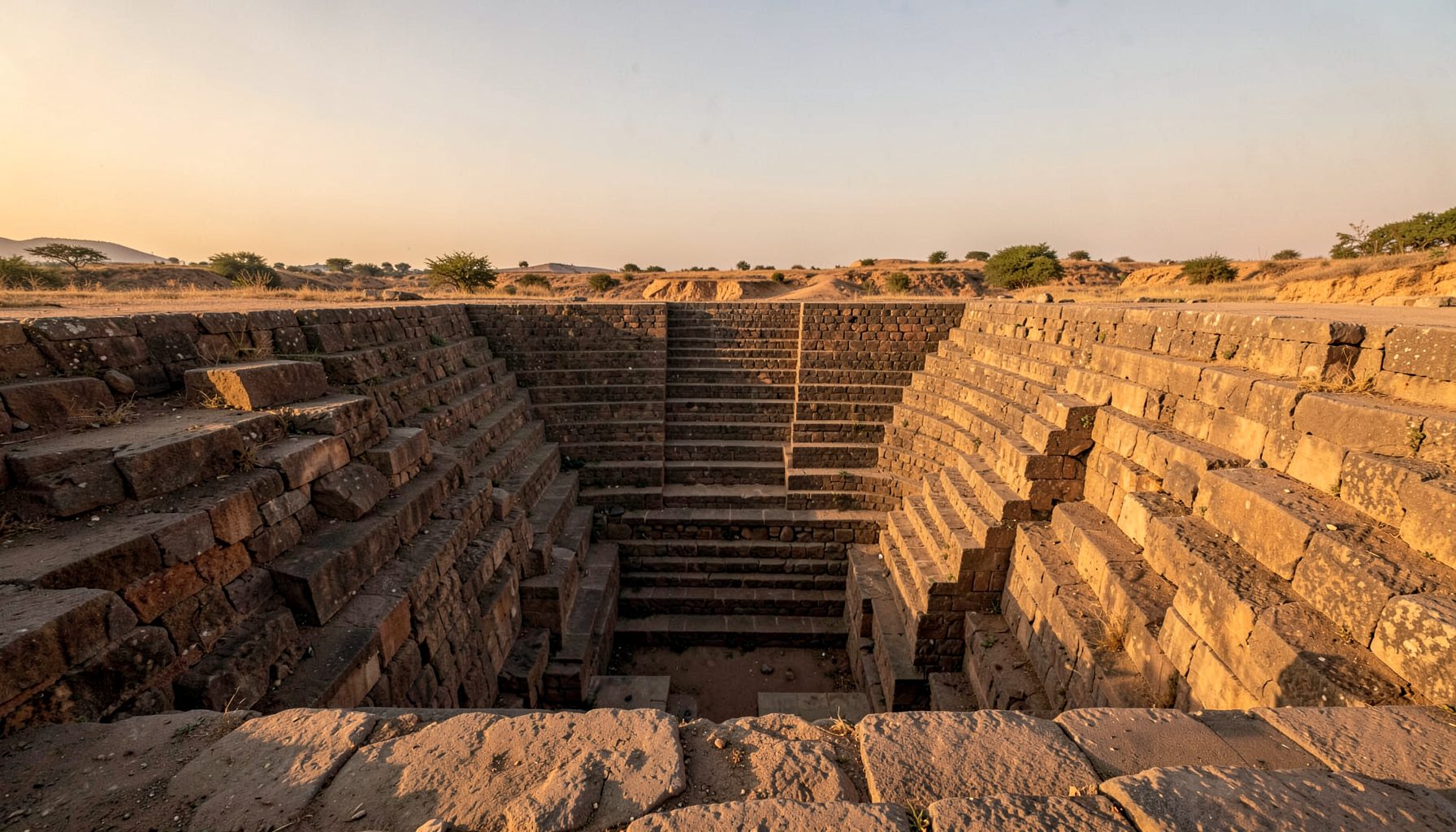
Across the dry plains and arid belts of western India, generations of masons carved descending staircases into the earth to reach the water table. These stepwells — known locally as vavs, baolis, kunds, and baravs — were far more than utilitarian water sources. They functioned as social centres, pilgrimage waystations, and microclimates that cooled the air around them by several degrees. Recent scholarship has begun to recognise that the hydraulic thinking embedded in their walls carries direct relevance to twenty-first-century water harvesting, especially in regions where rainfall is seasonal and unpredictable.
In Australian suburbs from Perth to Brisbane, rainwater tanks have become standard fittings on new homes, with Brisbane City Council continuing to subsidise household catchment installations as part of long-term drought planning. Yet the engineering ancestors of those slimline cylinders were often built centuries earlier and on a far grander scale. The geometry of a traditional Gujarati vav, for instance, allowed monsoon runoff to be filtered through successive terraces before percolating into deeper aquifers. The same logic, applied through modern pumps and slimline tanks, lives on in contemporary catchment architecture.
The shift from monumental masonry to modular plastic represents a dramatic change in scale and material, but the underlying principles remain surprisingly constant. Capture, slow, sink, store, and share — these five verbs guided the designers of Rajasthani baoris in the eleventh century and continue to underpin Australian rainwater harvesting guidelines today. Recognising that lineage helps explain why vernacular water structures deserve serious study rather than mere romantic admiration.
The team behind indianstepwells.com has spent years documenting these subterranean monuments, producing original photography, drone surveys, and architectural sketches that bring the engineering back into focus. Their work demonstrates how heritage infrastructure can quietly inform climate-resilient design.
Hydraulic lineage from baoris to backyard tanks
The earliest stepwells emerged around the third century CE, with examples like the sandstone reservoir at Mohanpura in Rajasthan dating to the Mauryan era. Builders quickly refined their strategies when experience showed that simple scooped ponds would be insufficient. The cascading design, with broad flights of steps descending through multiple platforms, did more than provide a way down — it slowed incoming water and allowed suspended sediments to settle on wider ledges before the clarified liquid reached deeper storage levels.
Modern Australian rainwater tanks operate on a similar logic, albeit at a smaller scale. First-flush diverters mimic the sediment-settling terraces of ancient wells, while leaf-guard screens perform the filtering function once handled by gravel-packed infiltration basins. The permaculture movement, originated in Tasmania by Bill Mollison and David Holmgren in the 1970s, codified many of these principles into a globally shared design language that draws quietly on vernacular wisdom from many cultures, including South Asia.
Aquifer recharge and the sub-surface storage model
Stepwells were not simply cisterns that sat above ground; they were active participants in the local hydrological cycle. Rain that fell on surrounding courtyards, rooftops, and paved plazas was channelled through graded surfaces into the well shaft. Once there, the water continued its journey downward, gradually recharging depleted aquifers during the brief but intense monsoon season. This made the structures useful for far longer than the rainy months, sustaining agriculture and domestic supply through long dry stretches.
Contemporary Australian practice has rediscovered the value of sub-surface storage, particularly after the prolonged Millennium Drought of 1997 to 2009 emptied many of the country's surface reservoirs. Underground tanks, soakage trenches, and infiltration pits now form part of council planning requirements in many Sydney and Adelaide suburbs. Engineers working on these systems are effectively reapplying the catchment logic that stepwell builders perfected a millennium ago.
Cross-cultural documentation and heritage lessons
Documenting ancient water infrastructure presents a familiar set of challenges across continents. Researchers must balance architectural analysis with oral history, navigate contested land tenure, and find funding for projects whose value is cultural rather than commercial. The difficulties of cataloguing a remote Irish ecclesiastical site share much with the work of surveying a forgotten baoli in a Madhya Pradesh village. Heritage practitioners working on projects as varied as the Kilmacduagh Abbey survey and mapping the vavs of North Gujarat rely on patient fieldwork, careful photography, and meaningful engagement with local communities.
This parallel work reminds us that water heritage is global heritage. The drip-irrigation channels of the Andes, the qanats of Persia, and the fog-catching nets of Morocco each carry their own lessons, but the underlying human imperative — capturing scarce rainfall and stretching it through lean seasons — remains universal. Australia's own Indigenous water knowledge, including the careful management of soaks and rock holes across the arid interior, forms another strand of this rich global tapestry.
Permaculture, community systems, and shared knowledge
In the suburbs of Fremantle and the outer reaches of Brisbane, community rain gardens and shared rainwater systems are quietly reshaping neighbourhoods. These schemes often draw on permaculture principles developed locally, with practitioners frequently citing the slow-water, slow-flow philosophy as their inspiration. Indigenous knowledge holders, working alongside engineers and ecologists, are also contributing long-observed patterns of landscape hydrology that predate European settlement by tens of thousands of years.
This blending of formal and traditional knowledge mirrors what happened centuries ago in India, where stepwell patrons commissioned local artisans who understood the regional geology, local rainfall rhythms, and community water needs. The result was infrastructure that was both functional and culturally embedded. Modern schemes that respect that approach, combining technical expertise with on-ground understanding, tend to last longer and serve wider populations.
Designing for drought in the twenty-first century
The lessons carried in the stones of stepwells grow more relevant as climate change reshapes rainfall patterns across southern Australia. Cities such as Melbourne have invested heavily in desalination and water recycling to buffer against reduced inflows, yet distributed rainwater harvesting still offers a powerful decentralised complement. Storage cisterns connected to roof catchments, integrated with subsurface infiltration, can reduce pressure on centralised supplies while easing stormwater flooding in heavy downpours.
For designers, planners, and curious residents, the path forward involves looking back as much as it does forward. Study a vav in Gujarat, a temple tank in Tamil Nadu, or a soak site in the Western Desert, and the same quiet logic appears: slow the water, sink it deep, store it patiently, share it generously. That wisdom, refined over centuries, still has much to teach a nation adapting to a warmer, drier future.
Practical guidance for adopting stepwell principles
- Install a first-flush device on every rainwater downpipe to mimic the sediment-settling function of stepwell terraces.
- Pair above-ground tanks with subsurface soakage pits to encourage aquifer recharge rather than relying solely on surface storage.
- Choose dark, shaded, or buried tank locations to keep stored water cool and reduce evaporation losses through summer.
- Connect multiple roof catchments to a single manifold so larger storm events can be captured efficiently across the household.
- Incorporate swales and contoured garden paths that direct runoff sideways and slowly, replicating the catchment flow around traditional vavs.
- Check local council rebate schemes, particularly in Brisbane and parts of regional Victoria, where subsidies can offset installation costs.
- Reach out through the contact page of Indian Stepwells to contribute field observations or request collaboration on documentation projects.
Get in Touch
Have information about a stepwell that is not yet on our map? We would be glad to document it and give you full credit. Whether it is a Barav, Kund, Vihir, or any other form of stepwell, every contribution helps preserve India's water heritage.
Call or message us with details about the location, and we will follow up.
#9372496819
Send a Message
What People Say
"The Maharashtra Stepwells campaign has brought attention to structures that were nearly forgotten. The architectural documentation and drone photography are invaluable resources for researchers and students alike."
"Collaborating with the Indian Stepwells team gave our architecture students hands-on exposure to traditional water-harvesting structures. The presentations were insightful and inspiring."
"I shared details of a stepwell near my village that was not on any map. The team visited, documented it beautifully, and credited me. It felt wonderful to contribute."