 Explore Maharashtra
How Stepwells Shaped Modern Rainwater Harvesting
For most households in Adelaide or Melbourne, catching rain in a steel tank beside the garage feels like ordinary twentieth-century plumbing. Few would connect it to the stepped stone structures descending into the earth at Jaisalmer, Abhaneri or Patan, where communities in Rajasthan and Gujarat built their own water architecture centuries ago. Those sites — called bawdis, baolis, vavs, kunds and baravs depending on region and form — gathered monsoon downpours, filtered them through perforated stone, cooled them underground and returned them to the water table. Modern rainwater harvesting in Australia is not an invention so much as a rediscovery of engineering logic that India perfected long before galvanised steel reached the outback.
That logic matters now. Australian cities live with a peculiar hydrology: long dry summers broken by sudden storms, rising water prices, and councils scrambling to capture runoff that once soaked away into pipes and creeks. Adelaide homeowners already treat rainwater tanks as normal, Perth requires them in many new developments, and Sydney still maintains nineteenth-century sandstone conduits that shaped the city's growth. Indian Stepwells documents the older tradition through original photography, architectural sketches, drone imagery and field research, and its current focus on Maharashtra offers a useful lens for anyone working on water-sensitive urban design.
The comparison is more than picturesque. A stepwell was not a tank in the modern sense; it was an entire cascade of decisions about catchment, filtration, storage depth, overflow and public access. Each decision has an echo in Australian practice, whether that is a first-flush diverter sold at Bunnings, a council stormwater pit under a car park, or a household pump-and-tank package quoted by a local plumber.
What a stepwell actually did
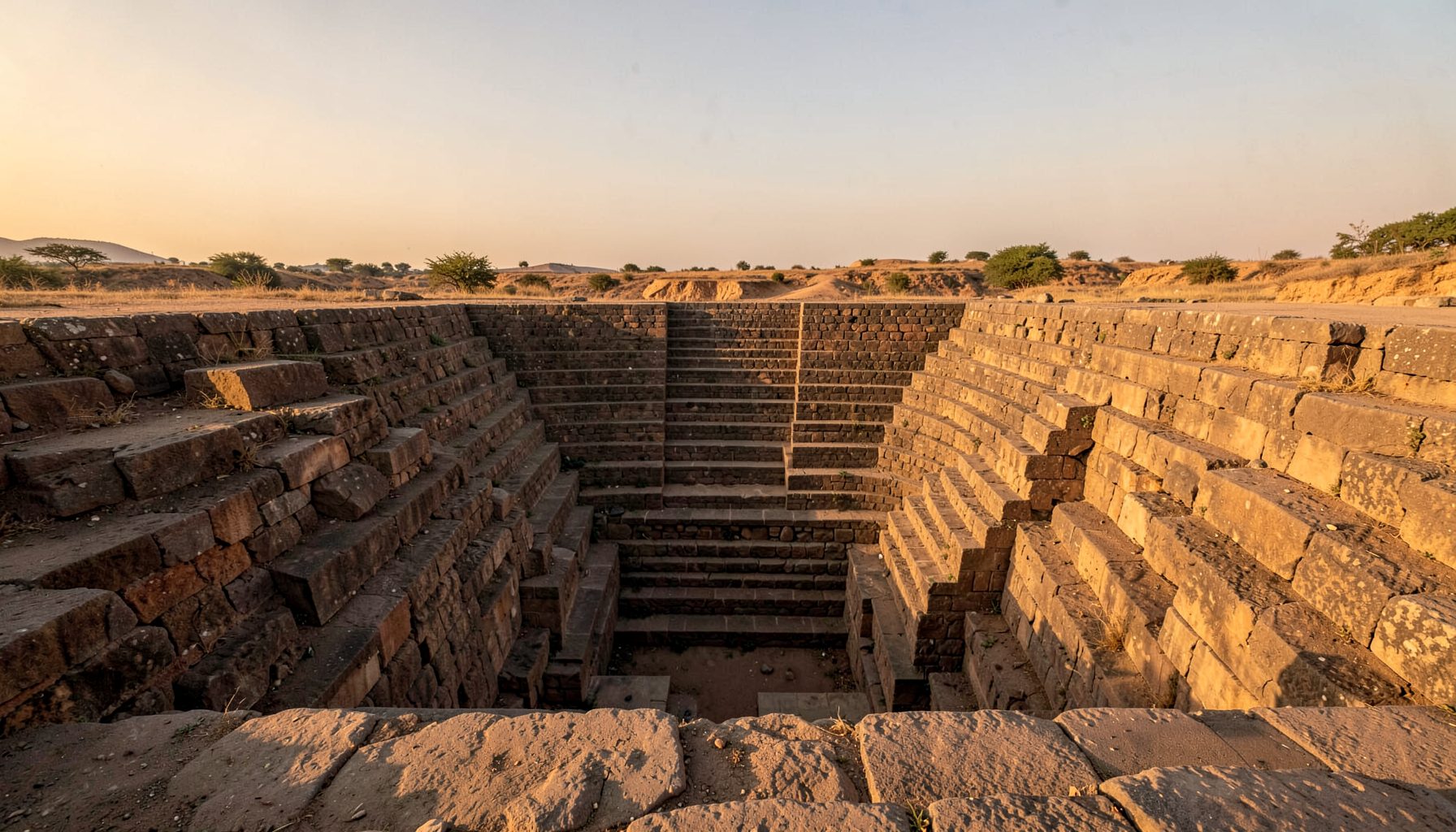
A stepwell is usually dug perpendicular to the slope, so that every roof, courtyard and street in the upper catchment drains toward it through channels and graded surfaces. The pit then descends through a series of platforms and corridors, each tier narrowing the water body. Perforated stone screens with geometric jali patterns slow the flow, trap sediment and admit air, so water enters the underground reservoir filtered rather than dumped. At the bottom, the water sits in contact with cool rock and saturated earth, which suppresses evaporation and holds temperatures steady through a desert summer.
The typologies reflect local needs. Deep square bawdis served towns, kunds and smaller vavs served villages and shrines, and stepwells with long stepped corridors served pilgrims and gathering places as much as they served taps. Patan's Adalaj baoli, with its converging octagonal geometry, shows how water was made the centre of social life; the deeper structures of Rajasthan show how far engineers pushed percolation into dry ground. The about the project pages at Indian Stepwells explain how the team records these structures, including ones that appear on no official list.
Read as infrastructure, a stepwell performs four jobs at once: it captures a flood, it treats water by gravity, it stores it below ground where heat cannot reach it, and it recharges the aquifer. Few modern domestic systems manage all four, which is exactly why the ancestor model keeps resurfacing in contemporary discussions of rainwater harvesting.
Where Australia already follows the same logic
South Australia offers the closest parallel. Adelaide sits in a Mediterranean climate, and residents have long installed rainwater tanks for garden irrigation and household use, with SA Water offering rebates and free water-saving consultations. The timing mirrors the Indian monsoon pattern in an unexpected way: a South Australian tank captures brief, intense summer thunderstorms that would otherwise run off hard surfaces, much as a bawdi intercepts a single heavy burst after months of dryness.
Melbourne's approach is more civic. Melbourne Water's stormwater strategy targets roof and street runoff, and the city's water-sensitive urban design work shifts water from pipes into rain gardens, street swales and lined channels that slow the flow and let it infiltrate. During recent water restrictions, households were asked to keep storages clear, which underlined how much of the city's water behaviour depends on captured runoff. Sydney points to a different heritage precedent entirely: the Tank Stream, built in the 1860s from sandstone, still carries stormwater beneath the city and is now interpreted as a piece of working heritage.
Perth has arguably the strongest commercial case. High water prices, Waterwise rebates and tank requirements for new developments have made underground and above-ground storage a standard feature of Australian homes. In the wider market, retailers stock diversion kits and leaf guards, while tradespeople quote pump-and-tank systems, so the hardware of rainwater harvesting has become as ordinary as a gutter. The custom of topping up bottles at communal refill stations, the Australian answer to the shared well, reflects a culture that treats water as a managed household resource rather than a free utility.
Design principles worth borrowing
The most transferable idea from stepwells is filtration by gravity and depth. A stepped corridor and a perforated screen do the work of a modern filter cartridge without power, because the descending path slows the water and lets silt settle before it reaches storage. Australian installers can reproduce this logic with a first-flush diverter at the gutter, a leaf screen and a sediment trap at the tank inlet — a cheap, low-maintenance sequence that matches the reliability of the stone versions.
Underground placement is the second lesson. A buried tank in an Australian summer keeps water cooler than an exposed one, reduces evaporation, protects from sunlight and leaves the yard usable. It also mirrors how a stepwell behaves: the deeper the storage, the more stable the temperature, and the slower the loss. Where space is tight, modular buried systems have become the standard answer, much as a deep vav concentrates supply into a narrow footprint.
The third lesson concerns overflow. A stepwell never simply filled and failed; surplus water moved onward, either into irrigation channels or back into the aquifer through designed outlets. Modern systems benefit from the same thinking. Overflow to a soakage pit, a swale or a garden bed turns a storage problem into a landscape feature, while staged use — potable supply and garden irrigation first, overflow last — stretches every litre. Even the physical form of the chabutra, with its shadow and seating, has been reinterpreted in contemporary landscape design as a place to sit beside water rather than merely a reservoir to hide.
Community value and the value of recording
Stepwells were social infrastructure. People bathed there, collected water, rested on the steps and met during festivals, so their survival depended as much on use as on engineering. That is the argument Indian Stepwells makes for documenting lesser-known structures in Maharashtra and inviting local communities to contribute what they know about undocumented sites. It is a reminder that rainwater harvesting is not only a technical problem; it is about who a water system serves and how a place treats its own resource.
Volunteer-run catalogues elsewhere illustrate how much expertise sits outside institutions. Projects such as the Dead Ireland archive or the Norwegian pinball archive show how enthusiasts documenting local heritage can preserve knowledge that official surveys miss — whether it is the history of a village street or the design of an obsolete machine. The same instinct applies to stepwells: photographs, measurements and local testimony from residents can protect a structure that would otherwise be demolished for a car park.
Practical steps for Australian homes and councils
For households, the gains come from sequencing decisions correctly: capture the roof runoff, divert the first flush, bury or shade the storage, plan the overflow and keep the system maintainable. For councils, the stepwell analogy suggests something larger — treating catchment areas as landscapes that move water slowly, and treating stored water as a shared asset rather than a private convenience.
Readings and field photographs of any stepwell, including village structures not yet documented, can be sent through the site's page where you share field information. Contributions like these build the record that makes future research and preservation possible.
- Size storage against roof catchment and household demand, using local storm patterns rather than a national average.
- Install a first-flush diverter and leaf screen at the gutter, the modern equivalent of the perforated stone screen at a stepwell.
- Choose buried or shaded tanks where possible, reducing evaporation losses through hot summers.
- Design overflow deliberately, directing surplus into swales, soakage pits or garden beds instead of relying on street drainage.
- Schedule annual gutter, screen and tank maintenance, since even a passive gravity system depends on unobstructed flow.
- Pair storage with water-efficient fixtures, so captured water meets actual demand instead of replacing mains supply that was never needed.
- Record and interpret community water infrastructure, whether an Indian stepwell or a local stormwater channel, so future upgrades respect what already works.
Get in Touch
Have information about a stepwell that is not yet on our map? We would be glad to document it and give you full credit. Whether it is a Barav, Kund, Vihir, or any other form of stepwell, every contribution helps preserve India's water heritage.
Call or message us with details about the location, and we will follow up.
#9372496819
Send a Message
What People Say
"The Maharashtra Stepwells campaign has brought attention to structures that were nearly forgotten. The architectural documentation and drone photography are invaluable resources for researchers and students alike."
"Collaborating with the Indian Stepwells team gave our architecture students hands-on exposure to traditional water-harvesting structures. The presentations were insightful and inspiring."
"I shared details of a stepwell near my village that was not on any map. The team visited, documented it beautifully, and credited me. It felt wonderful to contribute."