 Explore Maharashtra
A stepwell with a mosque inside: Junagadh's syncretic water architecture
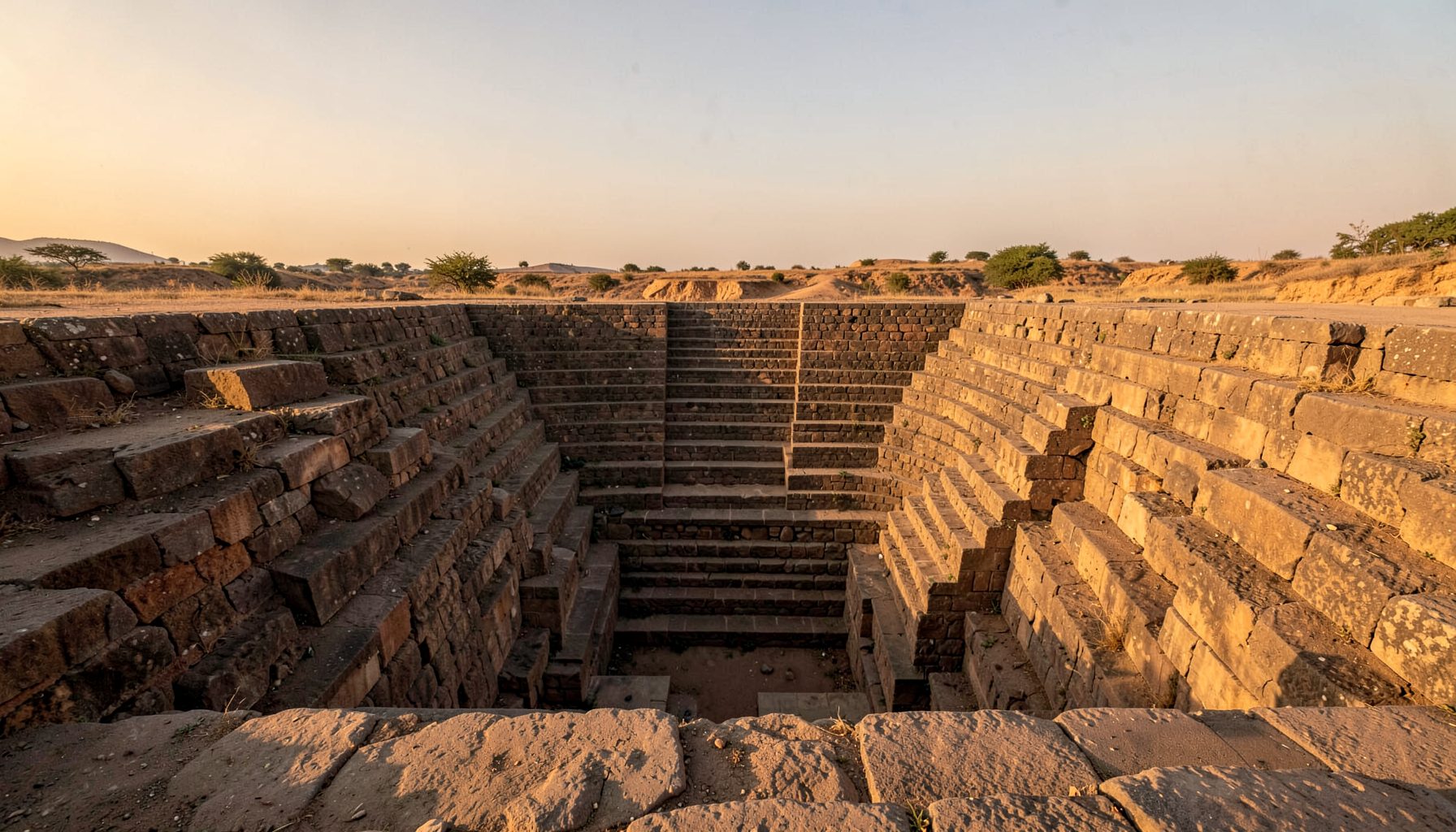
In Junagadh's old city, Gujarat, Navghan Kuvo descends through five sculpted levels into a deep monsoon-fed shaft. Its arcades and carved pillars frame a small upper mosque, placing worship within a monument built around collective water storage. The ensemble is neither a mosque beside an unrelated well nor a conventional temple complex. It is a layered civic structure whose rooms, stairs and water have acquired religious and civic meanings over time.
Navghan Kuvo belongs to the broad family of Indian stepwells, whose regional names include vavs, baolis, bawdis, kunds and baravs. Their stepped access allowed water to be reached as the groundwater table rose and fell. At Junagadh, this practical core is joined to a religious threshold: the mosque occupies the upper precinct while the architectural levels descend below it.
A stepwell was never simply an underground reservoir. It was infrastructure, architecture and social space, providing cool storage, gathering places and access to water before modern reticulation. The mosque at the summit gives the ensemble a different rhythm. Worship, neighbourhood movement and heritage visitation occupy the same precinct without making the original hydraulic design disappear.
For readers in Melbourne and Sydney, the comparison is practical rather than picturesque. Both cities are expanding, and both confront hotter summers, intense rain episodes and prolonged dry periods. Australian households already manage rain tanks, swimming pools, garden irrigation and car washing under changing water restrictions. Navghan Kuvo shows how a centuries-old response to monsoon uncertainty can inform present debates about climate-sensitive public space.
Water, shade and the life of a shared well
Stepwells turn difficult hydrology into a sequence of usable spaces. Descending flights follow the historic water level, while platforms, columns and chambers create shade and shelter. Their apparent solidity conceals a precise understanding of groundwater, seasonal recharge and overflow. Viewed in plan, the structure is both well and passage; viewed from within, it becomes a changing room of light, temperature and sound.
Surveying this relationship is central to Indian Stepwells' Maharashtra campaign, which records less familiar water structures through field research, photography and community knowledge. That work matters because conservation decisions depend on more than a picturesque façade. A blocked inlet, altered floor or changed groundwater path can erase the social life that made the structure coherent. Mapping the entire hydraulic system reveals relationships that a close view of carved steps can conceal.
The same attention applies to contemporary restoration. Cleaning is useful only when it does not remove historic deposits or evidence of repair, and new steps must not be made to look falsely old. Better conservation treats the well as a functioning cultural system: architecture, water, custodians and users belong in one account. The result can accommodate worship and visitation while preserving the clear differences between original, repaired and modern fabric.
Religious coexistence without one easy label
The monument's history is layered. Its lower fabric is generally associated with a medieval stepwell tradition, often dated to the eleventh century, while additions and restorations associated with nineteenth-century Nawab Mahabat Khan shaped much of the upper precinct, including the mosque. Islamic arches and the prayer room sit above older carving traditions without erasing them. Architecture therefore records successive decisions about access, patronage and religious use.
Calling this syncretic architecture is useful only if it avoids a polished story of timeless harmony. Syncretism here describes coexistence and adaptation: one building system acquired another layer of meaning, and different communities used water and space according to changing circumstances. It does not require everyone to have shared identical beliefs, nor does it erase conflicts over access. Interpretation should acknowledge both collaboration and ordinary institutional change.
The mosque's active role keeps that history alive. Daily prayers, Ramadan, festivals and tourism can place different demands on the same stairs and landings. This makes the site a practical lesson in visitor management. A respectful account recognises the mosque first as a place of worship, while photographs, sketches and drone views document the monument as architecture. Heritage documentation becomes strongest when those identities support rather than compete with one another.
Reading motifs without inventing meaning
Navghan Kuvo's ornament rewards slow looking. Figures, foliage, geometric bands and carved pillars occupy surfaces that also carry signs of age, repair and movement. Their presence can demonstrate technical skill and continuity, but an image alone does not explain who commissioned a motif or what it meant. A reliable reading combines the carved evidence with inscriptions, archaeological context and local testimony.
Context can change the meaning of a familiar sign, as skull and crossbones shows in the history of Irish gravestones. Symbols travel, acquire new associations and are often flattened into misleading shorthand. The same caution applies at stepwells. Calling every carved figure "Hindu", or every later opening "Muslim", can replace evidence with labels. The aim should be precise description before interpretation.
Photography and drone imagery can support that distinction. A measured elevation records geometry; a close image records tool marks and repair; an aerial survey can expose alterations to the surrounding settlement. None automatically explains chronology. Records should distinguish what is visible from what is inferred, and restoration drawings should show uncertainty rather than manufacture a seamless medieval appearance. Open image archives allow specialists and descendants to challenge interpretations later.
Preservation, public memory and contested histories
A stepwell with several identities also has several sets of stakeholders. In India, that can mean a mosque committee, residents, municipal authorities, archaeological specialists and conservation organisations. In Australia, comparable heritage work sits within overlapping Commonwealth, state and local frameworks. Depending on significance and location, protection may involve the National Heritage List under the Commonwealth EPBC Act 1999, state laws such as NSW's Heritage Act 1995 or Victoria's Heritage Victoria Act 2017, and council heritage overlays.
Layered places require layered records. The history of the 527th MP Company at the Battle of Xuan Loc demonstrates how military, colonial and memorial narratives can attach to the same landscape while later generations reorganise its meaning. Stepwells can similarly pass from water infrastructure to neighbourhood landmark, religious institution and tourism site. Public history should retain those transitions rather than select only the phase that best fits a present-day brand.
Australian public memory provides a close parallel. Sydney's and Melbourne's war memorials, migrant churches and neighbourhood mosques often carry several histories at once, while their communities negotiate access, commemoration and new arrivals. Heat adaptation adds another layer. Melbourne's rain tanks and Sydney's swimming pools show how precious water is managed in everyday life; drought stages imposed by Sydney Water and Melbourne Water show how those habits can change quickly. A heritage strategy that ignores water access and community routines is incomplete.
A practical framework for respectful stewardship
Digital publication needs the same editorial discipline as conservation. Search results can blur subject boundaries by placing an unrelated article about cashable bonus terms beside genuine research on Indian stepwells. Such a mismatch may confuse readers and weaken trust in an archive. Metadata, navigation and related-content tools should separate field documentation from commercial material, while every image should retain its photographer, date, location and permissions.
A workable preservation programme would include the following:
- Complete a measured condition survey before cleaning, excavation or structural repair, with particular attention to cracks, displaced stones and water pathways.
- Assess the site's hydrology and catchment so conservation does not sever the relationship between the monument, groundwater and surrounding settlement.
- Record oral histories with informed consent, compensate contributors where appropriate and deposit copies with local community archives.
- Co-design visitor arrangements with religious custodians, including worship schedules, festival access, seating, signage and appropriate dress guidance.
- Use drone imagery only with the required permissions and privacy controls, while publishing surveys alongside rather than instead of ground-level evidence.
- Separate archival documentation from advertising and commercial content in menus, tags, metadata and automatically generated related links.
An Australian pilot could bring together a mosque or migrant association, a council heritage team, residents and traders from Melbourne's Queen Victoria Market or Sydney's Harris Street precinct. Notices and small exhibitions could connect water-conservation lessons with household habits while directing visitors without interrupting worship. The finished record would function as evidence, a meeting place and a practical model for climate-sensitive heritage, rather than a picturesque curiosity.
Get in Touch
Have information about a stepwell that is not yet on our map? We would be glad to document it and give you full credit. Whether it is a Barav, Kund, Vihir, or any other form of stepwell, every contribution helps preserve India's water heritage.
Call or message us with details about the location, and we will follow up.
#9372496819
Send a Message
What People Say
"The Maharashtra Stepwells campaign has brought attention to structures that were nearly forgotten. The architectural documentation and drone photography are invaluable resources for researchers and students alike."
"Collaborating with the Indian Stepwells team gave our architecture students hands-on exposure to traditional water-harvesting structures. The presentations were insightful and inspiring."
"I shared details of a stepwell near my village that was not on any map. The team visited, documented it beautifully, and credited me. It felt wonderful to contribute."